

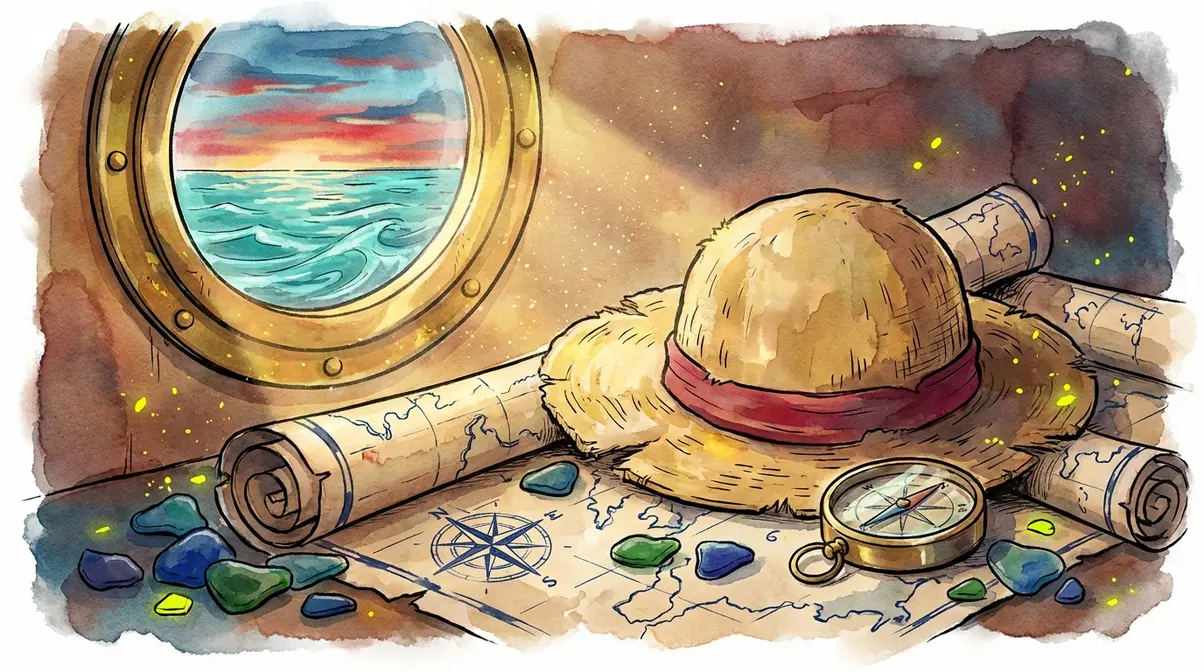


One Piece is a Japanese manga series written and illustrated by Eiichiro Oda, serialized in Shueisha’s Weekly Shōnen Jump magazine since July 22, 1997. It follows Monkey D. Luffy, a rubber-bodied teenager in a straw hat, and his ragtag pirate crew as they sail the Grand Line in search of the legendary treasure called the “One Piece.”
By March 2026, it had over 600 million copies in circulation worldwide, making it the best-selling comic series in volume format and the best-selling manga series ever.
One Piece and the Man Who Drew It All by Hand
Eiichiro Oda was born January 1, 1975, in Kumamoto, Japan. He decided at age four that he wanted to be a manga artist so he’d never have to get a “real job.” His biggest influence was Akira Toriyama’s Dragon Ball, and his fascination with pirates traces back to the TV cartoon Vicky the Viking. By 17, his short story Wanted! had placed second at the prestigious Tezuka Award.
He apprenticed under Nobuhiro Watsuki, creator of Rurouni Kenshin, and began sketching the prototypes for One Piece in 1996 under the working title Romance Dawn.
Oda originally planned a five-year run. Nearly three decades later, the story is still going.
The manga has been serialized in Shueisha’s shōnen manga magazine Weekly Shōnen Jump since July 1997, with its chapters compiled in 114 tankōbon volumes as of March 2026.
He earns an estimated ¥3.1 billion (roughly $23 million) per year, and his creative philosophy remains refreshingly humble. In a 2009 SWITCH magazine interview, he said: “I don’t put any messages in the manga I draw. If I draw a story, the themes emerge all on their own.”
One Piece by the Numbers: A Record Nobody Else Can Touch
The statistics are staggering and almost comical in their dominance.
- One Piece has officially surpassed 600 million copies in circulation worldwide with the release of Volume 114 on March 4, including more than 450 million in Japan and over 150 million overseas.
- The second best-selling manga series is Doraemon, with only about half the sales, at 350 million.
- In the past, One Piece already surpassed some American comic book series, such as Spider-Man and Batman. Superman is estimated to have around 600 million sales with around 18,000+ issues combined. Meanwhile, with just 114 volumes, One Piece has now dethroned it.
- In just under 4 years, One Piece sales went from 500 million to 600 million, which is a 20% increase in sales.
The One Piece manga is nowhere near its end, despite having entered its final saga. There are still at least 5–7 years of One Piece content, if not more.
That means the number is only climbing.
What Makes One Piece So Special?
The premise sounds like something you’d pitch a seven-year-old: a kid eats a magic fruit, turns into rubber, and goes looking for pirate treasure. But the execution has kept millions of adults reading for almost thirty years.
Here’s why.
Worldbuilding that rewards patience
Oda plants narrative seeds hundreds of chapters before they bloom. Fans debate endlessly whether this is meticulous planning or brilliant improvisation. One longtime reader put it well: “I don’t think Oda is like Tolkien who had everything mapped out right at the start. But he is very, very good at giving that impression of a fully developed world.”
The worldbuilding tackles slavery, racism, governmental tyranny, and revolutionary movements with surprising sophistication for a series published in a teen magazine.
Emotional gut-punches hidden inside a cartoon
One Piece is goofy. It is also devastating. The bonds between the Straw Hat crew form the emotional backbone of the entire series, with each member carrying backstories rooted in abandonment, loss, and the search for belonging. Fan-favorite moments include the Viking funeral for the crew’s ship, the Going Merry, where the vessel itself apologizes and thanks the crew for loving it.
Grown adults weep openly about a cartoon boat, and nobody considers it strange.
Arcs that function like self-contained novels
The series is divided into story arcs, each with its own setting, antagonist, and emotional payoff. This turns what could feel like an unimaginable slog into a series of satisfying climaxes.
The Enies Lobby arc is routinely cited as a turning point. The Sabaody Archipelago arc is praised for one of the most devastating endings in shōnen history.
Every arc feels like a different genre wearing the same straw hat.
Why Kids Love One Piece (and Why They’re Not the Only Ones)
One Piece is technically a shōnen series, a genre targeting young male readers around ages 13–19. But survey data tells a different story: the 19–29 age range accounts for roughly 43% of viewership, while ages 1–19 make up only about 12%.
Luffy’s simple dream of becoming King of the Pirates speaks directly to children, but the political intrigue, moral ambiguity, and decades of accumulated lore hold adults captive.
In a 2014 poll conducted by eBookJapan for Japan’s Ministry of Education “Children’s Reading Day,” One Piece ranked first for “manga that children want to read.” On Tencent’s anime and manga portal, it ranked first for “must-read manga for the younger generation in China.”
The series uses accessible, sometimes childlike surface elements to deliver an expansive, thematically rich narrative.
Racism is explored through the allegory of the Fish-men. Government corruption runs through the entire plot. Every Straw Hat crew member carries scars that resonate universally. Kids get the rubber punches and pirate ships. Adults get everything underneath.
One Piece in 2026: The Biggest It Has Ever Been
Right now, One Piece is everywhere, simultaneously, in more forms than at any point in its history.
FlixPatrol reports that One Piece has become the Number 1 show in the world on Netflix following the release of Season 2. According to data from March 11, 2026, the show is now Number 1 in 43 countries around the world.
On Rotten Tomatoes, the new run has pulled in a stunning 100% rating so far from 19 reviews, a decided improvement on the 86% of the first season.
On Metacritic, the title is at a strong 80/100, a major jump on the 67/100 of its first season.
The new episodes of One Piece anime’s Elbaph arc will be simulcast on Crunchyroll and Netflix from April 5, 2026.
As a seasonal anime, the Elbaph arc will feature 26 episodes in 2026 and air in two separate cours.
Meanwhile, WIT Studio’s full anime remake, The One Piece, remains in production for a future Netflix debut.
And then there’s the stunt.
A newly released project video on the franchise’s official YouTube channel shows Oda writing a secret on a single sheet of paper. The page is torn across the top and bottom, leaving visible only the phrases: “What is the One Piece?” and “Monkey D. Luffy is —”. According to an official announcement, the lower half of the page, containing the full “truth,” will be sealed inside a treasure chest and symbolically sunk to the bottom of the sea.
Its contents will only be revealed after the manga concludes.
Only Eiichiro Oda would celebrate 600 million copies sold by literally burying his biggest secret in the ocean.
Multiple fans have since started planning an attempt to retrieve the treasure box early.
Of course they have.
Frequently Asked Questions About One Piece
How many volumes of One Piece are there?
By March 4, 2026, a total of 114 volumes have been released.
The manga is currently in the Elbaph arc, part of the Final Saga.
Is One Piece finished?
No.
The series has entered its final saga, but that saga is made of several arcs rather than one short closing chapter.
After Egghead and Elbaph, further arcs are expected inside this final saga, including a large-scale final war and an epilogue sequence.
Most estimates place the ending at least five to seven years away.
Where can I start watching or reading One Piece?
The manga is available on Manga Plus and the Shonen Jump app, with the three most recent chapters free on both platforms.
The anime streams on Crunchyroll. Netflix’s live-action adaptation, starring Iñaki Godoy as Luffy, offers the fastest entry point for newcomers, with two seasons now available.
How many copies has One Piece sold?
Publisher Shueisha confirmed that the series has now passed 600 million copies in circulation worldwide, with sales data previously reported by Oricon backing up the milestone. The number makes it the best-selling manga in history.
Is One Piece appropriate for kids?
The Netflix live-action is rated TV-14. The anime and manga are classified as shōnen, targeting readers roughly 13 and older.
Younger children may enjoy the humor and action, but the series deals with themes including war, loss, slavery, and political corruption. Parental discretion is reasonable for viewers under 10.
What is the Netflix live-action One Piece Season 2 about?
The epic adventure covers major storylines, including the Loguetown, Reverse Mountain, Whisky Peak, Little Garden, and Drum Island arcs.
The series has already been renewed for a third season, which is currently in production.


'%3e%3cg id='Final-Copy-2_2_' transform='translate(1275.000000, 200.000000)'%3e%3cpath class='st0' d='M7.4,12.8h6.8l3.1-11.6H7.4C4.2,1.2,1.6,3.8,1.6,7S4.2,12.8,7.4,12.8z'/%3e%3c/g%3e%3c/g%3e%3c/g%3e%3cg id='final---dec.11-2020'%3e%3cg id='_x30_208-our-toggle' transform='translate(-1275.000000, -200.000000)'%3e%3cg id='Final-Copy-2' transform='translate(1275.000000, 200.000000)'%3e%3cpath class='st1' d='M22.6,0H7.4c-3.9,0-7,3.1-7,7s3.1,7,7,7h15.2c3.9,0,7-3.1,7-7S26.4,0,22.6,0z M1.6,7c0-3.2,2.6-5.8,5.8-5.8 h9.9l-3.1,11.6H7.4C4.2,12.8,1.6,10.2,1.6,7z'/%3e%3cpath id='x' class='st2' d='M24.6,4c0.2,0.2,0.2,0.6,0,0.8l0,0L22.5,7l2.2,2.2c0.2,0.2,0.2,0.6,0,0.8c-0.2,0.2-0.6,0.2-0.8,0 l0,0l-2.2-2.2L19.5,10c-0.2,0.2-0.6,0.2-0.8,0c-0.2-0.2-0.2-0.6,0-0.8l0,0L20.8,7l-2.2-2.2c-0.2-0.2-0.2-0.6,0-0.8 c0.2-0.2,0.6-0.2,0.8,0l0,0l2.2,2.2L23.8,4C24,3.8,24.4,3.8,24.6,4z'/%3e%3cpath id='y' class='st3' d='M12.7,4.1c0.2,0.2,0.3,0.6,0.1,0.8l0,0L8.6,9.8C8.5,9.9,8.4,10,8.3,10c-0.2,0.1-0.5,0.1-0.7-0.1l0,0 L5.4,7.7c-0.2-0.2-0.2-0.6,0-0.8c0.2-0.2,0.6-0.2,0.8,0l0,0L8,8.6l3.8-4.5C12,3.9,12.4,3.9,12.7,4.1z'/%3e%3c/g%3e%3c/g%3e%3c/g%3e%3c/g%3e%3c/svg%3e) Your Privacy Choices
Your Privacy Choices