


A Hundred-Year-Old Trick
Dazzle camouflage was a military paint scheme used on ships extensively during World War I, credited to British artist Norman Wilkinson, who came up with the idea in 1917 when German U-boat attacks seemed unstoppable. The design consisted of complex patterns of geometric shapes in contrasting colours, interrupting and intersecting each other, intended not to conceal but to make it difficult to estimate a target’s range, speed, and heading. Picasso himself reportedly took credit. Dazzle attracted the notice of artists such as Picasso, who claimed that Cubists like himself had invented it.
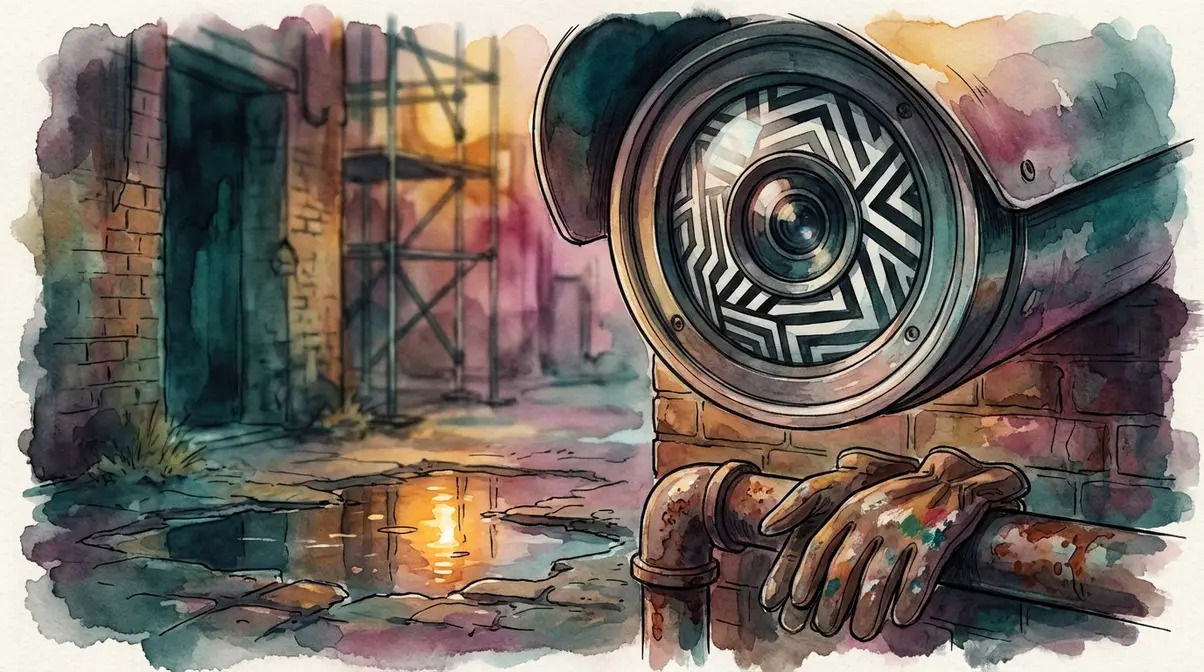
Over a century later, in a city threaded with an estimated 420,000 surveillance cameras, that same logic found new skin. Not on battleship hulls, but on human faces. The target wasn’t a torpedo operator squinting through a periscope. It was an algorithm.
The Dazzle Club
The collaboration began in August 2019 in response to the forced admission that facial recognition technology was being used by Argent on the King’s Cross Estate in London, a place in which the founders had all made art for many years. It was a collaboration between two different collectives, formed by four founding artists: Emily Roderick, Georgina Rowlands, Anna Hart, and Evie Price.
The provocation was specific and ugly. King’s Cross Central Limited Partnership, the private owner of the 67-acre site, had been running CCTV cameras equipped with facial recognition secretly within its premises for nearly two years, between May 2016 and March 2018, through a deal with the Metropolitan Police kept out of the public sphere. When the story broke, the backlash was swift. In September 2019, King’s Cross halted its use of the technology. But the genie was out. The cameras were everywhere else.
Once “Dazzled,” the group took to the streets for an hour-long walk starting at 6:30pm, led around an area of the capital in complete silence. These were no casual strolls. Since August 2019 the Dazzle Club had walked through some of the most heavily surveilled areas in Britain, each walk carefully choreographed and taking up to weeks of planning. They painted their faces in geometric blocks of blue, black, and orange, following a method called CV Dazzle. The group used the technique created by Brooklyn artist Adam Harvey, which dupes facial recognition cameras by blotting out the nose, deforming the eyebrows, and warping the eyeline.
I want to be clear about what this was. It was not a mural project. It was not a crew tagging walls with anti-surveillance patterns. It was performance art: bodies moving through surveilled space, painted to be seen by humans and invisible to machines. The distinction matters, because the debate around the Dazzle Club’s work hinges entirely on what you think art is supposed to do.
The Technical Case Against
Here’s where the romance runs into a wall. The answer to whether CV Dazzle actually works is: probably not. The original makeup designs were tested on facial recognition software that is now heavily dated and no longer in use. Modern-day surveillance technology is significantly more sophisticated. It can detect other identifying factors, such as a protester’s clothing, tattoos, and even their gait.
The founders themselves were candid about this. The Dazzle Club didn’t yet know if the camouflage makeup would truly fool police cameras. Co-founder Georgina Rowlands said they hadn’t been able to access the software the London police use: “So we haven’t been able to test it just yet. But we would love to see if it works.”
The Met maintained its system was 70 per cent effective at spotting suspects, but an independent review by Essex University surveillance expert Pete Fussey found it was accurate in just 19 per cent of cases. An analysis of three commercial facial recognition tools by MIT’s Media Lab in 2018 found the software 99 per cent accurate at identifying light-skinned men, but making mistakes in 21, 35, and 35 per cent of cases for dark-skinned women. The technology was already biased and broken. The question was whether painting your face made things better, or just made for better photographs.
The Symbolic Case For
In online privacy communities, this tension plays out with predictable heat. The pragmatists dismiss the whole enterprise. Makeup against modern computer vision? Bringing a paintbrush to a data fight. But the Dazzle Club’s supporters have a sharper counterargument than most critics give them credit for.
Dazzling isn’t foolproof, but the Dazzle Club’s main purpose isn’t to cheat surveillance tech. Their project is about using art to question the normalisation of surveillance, and our changing understanding of what it means to exist and move in public spaces in the 21st century. Co-founder Emily Roderick put it plainly in a CBC Radio interview: “Primarily, the Dazzle Club is there to talk about and discuss the use of facial recognition. But I think also we’re there to talk about the use of surveillance within the city more widely.”
Silkie Carlo, director of Big Brother Watch, framed the stakes in starker terms: “It actually starts to reverse the presumption of innocence. It means that members of the public in our everyday lives are effectively being subjected to a constant police lineup, constantly having our identities checked to make sure that we’re not criminals.” Carlo also noted that “no other European country has a face surveillance epidemic like the UK, aligning us with the likes of China rather than our democratic counterparts.”
The walks made that invisible architecture visible. They laid bare the increasingly few true public spaces in London, passing through many pseudo-public spaces that appear to be public land but actually belong to private landowners, commonly nicknamed “POPS.” You can read about it in the original i-D feature from January 2020, which remains one of the best accounts of what it felt like to walk dazzled through Greenwich on a rain-slicked night.
So Who Wins?
My honest opinion: both sides are right, and neither side is complete.
The skeptics are correct that CV Dazzle makeup, as a technical countermeasure, is functionally obsolete against current systems. Even though Harvey updated some of his designs in 2020, it would be difficult for the average protester to continually update and test the efficacy of their makeup as facial recognition continues to improve. The arms race is asymmetric. The algorithms have budgets. The artists have face paint.
But the artists are correct that the point was never really the paint. Once you step out into the street, Dazzle on, it is impossible not to notice the cameras, to wonder who is sitting in a poky room somewhere watching you make your way across the city. That perceptual shift is the actual product. Not the makeup. The awareness.
The Dazzle Club ran from 2019 to 2021, a collaboration by four London-based artists making embodied research into public space surveillance, drawing awareness of technologies and building new expressions of community and trust. It ended. The founders continue to write and speak about The Dazzle Club as part of their ongoing art practices. Meanwhile, work from Adam Harvey’s CV Dazzle was included in “Camouflage: Designed to Deceive,” an exhibition at the International Spy Museum in DC opening March 1, 2026.
There is something poetic in the lineage. Harvey himself once observed: “Camouflage was also once too exotic. Prior to WWI camouflage was used negatively as a term for hiding from the police, perhaps similar to how privacy is often discussed this century.” Norman Wilkinson painted warships to confuse periscopes. A hundred years later, four women in London painted faces to confuse cameras. The geometry migrated from steel hulls to cheekbones. The enemy went from submarines to servers. The question stayed the same: can you survive by refusing to be read correctly?
The Dazzle Club’s answer was less about fooling the machine and more about reminding the rest of us that the machine was there. That might not be enough. But in a city with an average Londoner caught on camera more than 300 times a day , it’s a start that matters.

'%3e%3cg id='Final-Copy-2_2_' transform='translate(1275.000000, 200.000000)'%3e%3cpath class='st0' d='M7.4,12.8h6.8l3.1-11.6H7.4C4.2,1.2,1.6,3.8,1.6,7S4.2,12.8,7.4,12.8z'/%3e%3c/g%3e%3c/g%3e%3c/g%3e%3cg id='final---dec.11-2020'%3e%3cg id='_x30_208-our-toggle' transform='translate(-1275.000000, -200.000000)'%3e%3cg id='Final-Copy-2' transform='translate(1275.000000, 200.000000)'%3e%3cpath class='st1' d='M22.6,0H7.4c-3.9,0-7,3.1-7,7s3.1,7,7,7h15.2c3.9,0,7-3.1,7-7S26.4,0,22.6,0z M1.6,7c0-3.2,2.6-5.8,5.8-5.8 h9.9l-3.1,11.6H7.4C4.2,12.8,1.6,10.2,1.6,7z'/%3e%3cpath id='x' class='st2' d='M24.6,4c0.2,0.2,0.2,0.6,0,0.8l0,0L22.5,7l2.2,2.2c0.2,0.2,0.2,0.6,0,0.8c-0.2,0.2-0.6,0.2-0.8,0 l0,0l-2.2-2.2L19.5,10c-0.2,0.2-0.6,0.2-0.8,0c-0.2-0.2-0.2-0.6,0-0.8l0,0L20.8,7l-2.2-2.2c-0.2-0.2-0.2-0.6,0-0.8 c0.2-0.2,0.6-0.2,0.8,0l0,0l2.2,2.2L23.8,4C24,3.8,24.4,3.8,24.6,4z'/%3e%3cpath id='y' class='st3' d='M12.7,4.1c0.2,0.2,0.3,0.6,0.1,0.8l0,0L8.6,9.8C8.5,9.9,8.4,10,8.3,10c-0.2,0.1-0.5,0.1-0.7-0.1l0,0 L5.4,7.7c-0.2-0.2-0.2-0.6,0-0.8c0.2-0.2,0.6-0.2,0.8,0l0,0L8,8.6l3.8-4.5C12,3.9,12.4,3.9,12.7,4.1z'/%3e%3c/g%3e%3c/g%3e%3c/g%3e%3c/g%3e%3c/svg%3e) Your Privacy Choices
Your Privacy Choices