

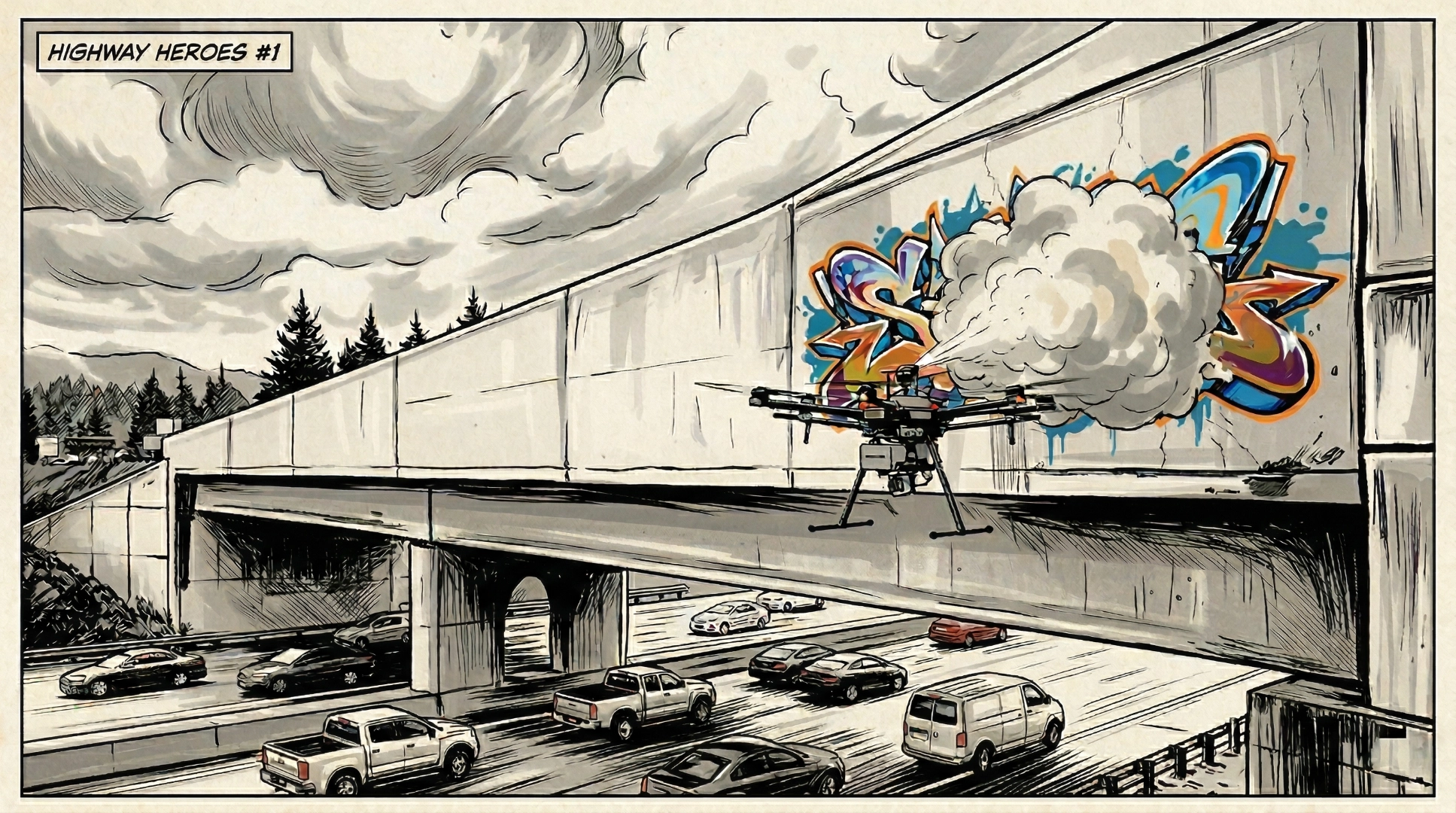

Imagine a bridge abutment forty feet above I-5, rain-dark concrete streaked with exhaust. In a wash of blue and orange, someone has left their name. The placement is the point: not beauty, exactly, but exposure, risk, and the promise of being seen from everywhere except up close.
“Heaven spot,” or “heaven” for short, is graffiti slang for daredevil pieces painted in places that are hard to reach: rooftops, overpasses, freeway signs. They confer status precisely because they are dangerous. The term carries a double meaning, since writing in such locations may lead to death, thus “going to heaven.” For decades, the heaven spot has been graffiti’s most notorious expression, a status symbol built on risk.
The Lightbulb Moment on the Capital Boulevard Bridge
Mike Gauger, a maintenance superintendent at the Washington State Department of Transportation, got the idea for a graffiti-fighting drone after sending a crew to paint over graffiti on the Capital Boulevard Bridge in Olympia for the second time in one week. It was frustrating: the job required pulling a bridge maintenance crew from other tasks and dispatching a specialized Under Bridge Inspection Truck. WSDOT has only six of these trucks to cover the entire state, and they’re usually reserved for higher-priority bridge work.
Gauger happened to be working with the Tacoma Narrows Bridge team, which was already using drones for bridge inspections. Those drones, equipped with high-resolution cameras, were reducing the number of times crews had to physically inspect underneath the girders, improving safety and saving money. His thought was simple: if drones could inspect, why couldn’t they spray paint?
He found one drone company, Aquiline Drones, willing to experiment with the idea. The first try failed. The second attempt appears to be working.
The Machine
The AD Endure is not a toy quadcopter. The Spartacus Endure is a $30,000 drone designed in-house for multiple missions like crop spraying, delivery, and roof or window washing, but it can now be equipped with a paint air sprayer to cover graffiti tags in hard-to-reach spots. Its architecture is coaxial octocopter, meaning eight rotors in stacked pairs, which gives it flight stability regardless of payload weight. The frame is carbon fiber with anodized aluminum fasteners. It can lift up to 33 pounds.
It features a modular payload system, allowing operators to swap out the undercarriage for different functions, all with a single drone platform. Customers can choose from an assortment of payloads: spray bars, straight lances, carrying baskets, winches, cameras, seed spreaders, ag spraying tanks, even lifeguard pontoon droppers. Barry Alexander, Aquiline’s founder and CEO, has compared it to a John Deere tractor: “Think of the Endure as your trusted John Deere tractor. Change out the bucket and off you go.”
Payloads swap in three minutes or less. That versatility is the whole pitch.
How It Works in the Field
The drone uses a spray nozzle linked to a paint supply on the ground. An operator positions it via remote control anywhere the tethered hose can reach, making quick work of painting over graffiti on tall retaining walls, bridges, and overpasses. A person on the ground operates the drone, which feeds gray paint through a hose. It is illegal to fly drones over active lanes of traffic, so areas where the drone operates are closed or slowed during use.
Two workers. One flies. One manages the paint supply. No crane truck. No harness. No one dangling forty feet above a highway.
The pilot program determined that drones are preferable in areas that pose a safety risk, such as tall heights and steep slopes, and in areas where specialized equipment like under-bridge bucket trucks would normally be required. However, the tethered drone was found to not be successful in locations where the tether could get caught, such as above a billboard. WSDOT and Aquiline are now developing a self-contained unit that holds one to two gallons of paint and doesn’t require a tether at all.
Twenty-One Missions and a $12 Billion Problem
According to WSDOT’s December 2024 report, the drone was used on 21 missions in 2024 alone, helping to cover up $22,000 worth of graffiti. The report found that using drones is safer and more efficient than traditional anti-graffiti methods, especially in hard-to-reach areas or places that could put workers in danger.
The numbers that surround this machine are staggering. WSDOT estimates it spent over $815,000 on graffiti removal in 2023, after taking staff time and equipment costs into consideration. “That’s nearly 10,300 hours of labor spent covering 700,000 square feet of graffiti along our highways.” Gauger estimates that removing tags in hard-to-reach locations can cost the state up to $25,000. Meanwhile, a can of spray paint costs just a few bucks. Nationally, graffiti-based vandalism costs an estimated $12 billion in annual cleanup expenses in the U.S. alone.
Having successfully incubated this solution with WSDOT, Aquiline Drones has now embarked on a nationwide campaign targeting states, municipalities, and regions. Oregon’s Department of Transportation has already connected with Washington officials about the program.
The Surveillance Layer
The paint-spraying drone is only half the system. Aquiline’s graffiti abatement solution operates in two phases: first, surveillance and monitoring using AI-enabled smart cameras that provide real-time detection of graffiti and vandalism; then abatement using the Endure drones. Suspected incidents are analyzed using computer vision and machine learning on the AD Cloud to eliminate false positives, and the process is described as strongly protective of personally identifiable information.
That sounds clean on paper. But the system uses AI detection to identify specific acts such as graffiti painting, other illegal acts, and loitering, with camera data triggering email notifications to traffic management centers and law enforcement. The word “loitering” is doing a lot of work in that sentence. For critics, this is where a graffiti-removal tool starts to look like persistent infrastructure surveillance, and where a conversation about paint becomes a conversation about civil liberties.
Painting Over a Larger Problem?
Cascade PBS framed the tension well: WSDOT’s new drone pilot program aims to cover up hard-to-reach areas known as “heaven spots,” but is it just painting over a larger problem?
B. Gnarley, a graffiti hunter who photographs graffiti around Washington state for his magazine of the same name, has used drones himself to shoot graffiti in heaven spots since he started publishing. He says people put graffiti in these places precisely because they’re harder to reach, and therefore harder to remove. Gnarley feels politicians go after graffiti for instant gratification. “It’s the same in every city. They’re always going to go after the low-hanging fruit. It’s easy to do,” he said.
In Seattle, the city has taken a different tack. Rather than deploy drones, its Many Hands Art Initiative commissions artists to create public murals, channeling creative energy into sanctioned work. Khazm Kogita, executive director of the hip-hop and arts organization 206 Zulu, has championed “free walls” and alternatives to vandalism. He told Cascade PBS that some in the graffiti community felt there were larger problems for the state to tackle, like homelessness, mental health, and addiction.
WSDOT’s own report acknowledged the limits: “While drones are a cost-effective additional tool, graffiti removal is and will remain a challenge for the agency based on available funding, staffing and resources.” Allocating resources to remove graffiti is challenging, even with the added benefits drones provide.
A Machine Between Two Worlds
The AD Endure sits at a peculiar intersection. It is, by any honest measure, a well-engineered piece of hardware. WSDOT is the first transportation agency to use drones to combat graffiti. The safety argument is real. The cost argument is persuasive. The modular design is genuinely clever. The AD Endure is a versatile, made-in-USA drone with a proven track record.
But the heaven spot was never just about paint on concrete. These are difficult, highly visible placements where danger has historically been folded into the subculture’s idea of legitimacy. The object itself doesn’t determine whether a location qualifies; civilian and law-enforcement traffic within view, along with the physical hazards of reaching it, are part of what gives the spot its meaning. Writers pursue these placements for the exposure and notoriety they provide. The danger is part of the mythology, and that mythology is expensive, public, and sometimes fatal.
A $30,000 drone that can reach those spots in minutes, operated by two people in a pickup truck, doesn’t just remove paint. It collapses a mythology. Whether that counts as progress or erasure depends entirely on where you’re standing, and how much risk a culture is willing to reward.
Further reading: WSDOT’s 2024 Graffiti Proviso Report (PDF)
'%3e%3cg id='Final-Copy-2_2_' transform='translate(1275.000000, 200.000000)'%3e%3cpath class='st0' d='M7.4,12.8h6.8l3.1-11.6H7.4C4.2,1.2,1.6,3.8,1.6,7S4.2,12.8,7.4,12.8z'/%3e%3c/g%3e%3c/g%3e%3c/g%3e%3cg id='final---dec.11-2020'%3e%3cg id='_x30_208-our-toggle' transform='translate(-1275.000000, -200.000000)'%3e%3cg id='Final-Copy-2' transform='translate(1275.000000, 200.000000)'%3e%3cpath class='st1' d='M22.6,0H7.4c-3.9,0-7,3.1-7,7s3.1,7,7,7h15.2c3.9,0,7-3.1,7-7S26.4,0,22.6,0z M1.6,7c0-3.2,2.6-5.8,5.8-5.8 h9.9l-3.1,11.6H7.4C4.2,12.8,1.6,10.2,1.6,7z'/%3e%3cpath id='x' class='st2' d='M24.6,4c0.2,0.2,0.2,0.6,0,0.8l0,0L22.5,7l2.2,2.2c0.2,0.2,0.2,0.6,0,0.8c-0.2,0.2-0.6,0.2-0.8,0 l0,0l-2.2-2.2L19.5,10c-0.2,0.2-0.6,0.2-0.8,0c-0.2-0.2-0.2-0.6,0-0.8l0,0L20.8,7l-2.2-2.2c-0.2-0.2-0.2-0.6,0-0.8 c0.2-0.2,0.6-0.2,0.8,0l0,0l2.2,2.2L23.8,4C24,3.8,24.4,3.8,24.6,4z'/%3e%3cpath id='y' class='st3' d='M12.7,4.1c0.2,0.2,0.3,0.6,0.1,0.8l0,0L8.6,9.8C8.5,9.9,8.4,10,8.3,10c-0.2,0.1-0.5,0.1-0.7-0.1l0,0 L5.4,7.7c-0.2-0.2-0.2-0.6,0-0.8c0.2-0.2,0.6-0.2,0.8,0l0,0L8,8.6l3.8-4.5C12,3.9,12.4,3.9,12.7,4.1z'/%3e%3c/g%3e%3c/g%3e%3c/g%3e%3c/g%3e%3c/svg%3e) Your Privacy Choices
Your Privacy Choices