



The Wedge is a surf break at the southeastern tip of the Balboa Peninsula in Newport Beach, California, where reflected wave energy off a 2,000-foot Army Corps jetty produces unpredictable peaks up to 30 feet tall. On March 17, 2026, Jamie O’Brien showed up for The Wedge’s opening day with soft-top boards and a YouTube crew, surfing outside any competitive structure while the professional surfing world tears itself apart over Olympic qualification and institutional control.
Opening Day at The Wedge, March 2026
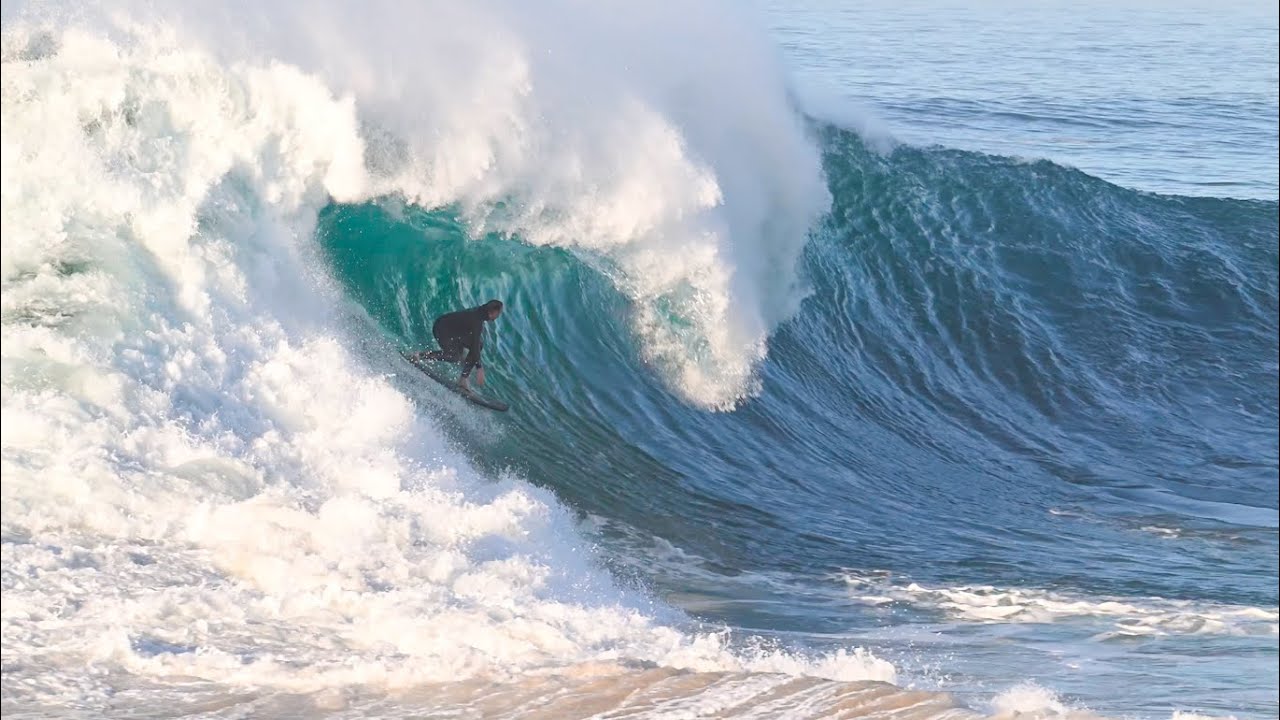
On Tuesday, March 17, 2026, Jamie O’Brien was in Newport Beach to herald opening day for The Wedge. A rare south swell in March had triggered the spot days earlier, sending 20-foot waves detonating across the break. O’Brien didn’t arrive with judges, jerseys, or a broadcast contract. He arrived with his crew and a quiver of boards from Fun Day, his soft-top company.
Maddox Alotis, appearing in O’Brien’s YouTube video, explained: “First time at The Wedge. [We] came straight from the snow, got a last minute call from Mr. Jamie O’Brien, who was like ‘Get down here, the Wedge is firing.’” The boards came from O’Brien’s newly minted soft-top company Fun Day, previously tested at the punishingly heavy Keiki shorebreak, and the Wedge session further proved they could handle heavy water.
This is the kind of thing that doesn’t show up on a Championship Tour schedule. The Wedge’s mechanics create steep shore-breaking waves capable of launching riders into the air or slamming them into shallow sand. As of 2013, the Encyclopedia of Surfing estimated that The Wedge had caused eight deaths, paralyzed 35 people, and hospitalized thousands more. Nobody qualifies for anything here. You just paddle out.
The Wedge Was Born from Tragedy and Concrete
The Wedge owes its creation to a series of harbor modifications driven by tragedy. In 1926, George Rogers Jr., a 15-year-old boy with polio, drowned in Newport Harbor after his boat capsized. His iron leg braces caused him to sink. His father then devoted a decade to lobbying for federal funding to improve the harbor’s safety, eventually helping secure around $2 million in public funding to extend the West Jetty. By 1936, the jetty was finally expanded. And by accident, the signature refraction waves were born.
Among teenagers in the 1950s, the spot was known as “102 Beach,” named after the cheap beer brand Brew 102. In the 1960s, bodysurfers changed the name from “the Hook” to “the Wedge.” Hollywood actor John Wayne sustained an injury bodysurfing the heavy break during his time as a USC football player, costing him his athletic scholarship. The wave has always existed outside any institution’s ability to control it.
The ISA-WSL War and the Olympic Qualification Meltdown
While O’Brien was getting shacked on a foam board, the professional surfing establishment was in open conflict. The International Surfing Association announced sweeping changes to the Olympic qualification system for LA 2028, backloading qualification to the 2028 calendar year and increasing the importance of the World Surfing Games relative to the WSL Championship Tour. A notable change reduces the number of surfers who will qualify via the WSL CT. For LA 2028, that will be reduced to five surfers of each gender with a cap of one surfer per country.
2025 world champion Yago Dora wrote: “Complete disrespect on the way you guys conducted this. Absolutely sad for our sport and future generations of surfers.” Leo Fioravanti called the previous system perfect, noting that “the 2027 WSL world champion isn’t even guaranteed to compete in the Olympics.” Erin Brooks added: “Consistency at the highest level is what defines competitive surfing. The WSL Championship Tour is where that happens.”
The WSL itself stated it believes “surfing’s success on the Olympic stage relies on the participation of the world’s elite surfers,” and expressed deep disappointment in the ISA’s “complete lack of consultation,” accusing the body of “canceling meetings and failing to respond to emails.” Meanwhile, Justine Dupont, chair of the ISA’s athletes’ commission, defended the new system, saying, “It’s difficult to satisfy everyone, but I find the new system more appropriate.”
A Reformatted Tour Meets a Fractured Sport
Marking the 50th year of professional surfing, the 2026 CT will feature 12 events across a combined men’s and women’s calendar. Non-elimination rounds have been removed, meaning every heat will carry direct consequences for rankings. The Pipe Masters will carry increased relevance, with 15,000 points on offer, 1.5 times the amount of a standard CT event.
WSL wildcards Carissa Moore and Stephanie Gilmore, whose combined 13 World Titles will carry serious reputation weight in the first round. John John Florence, however, announced in January 2026 that he had decided to defer his CT return until 2027, with his wildcard spot subsequently awarded to Ramzi Boukhiam. Florence chose family over the tour. O’Brien chose soft-tops at The Wedge. Neither decision registers in the Olympic qualification spreadsheet.
The Anti-Institutional Undercurrent
There is something clarifying about watching O’Brien drop into a 15-foot closeout on a foam board while the ISA and WSL trade accusations about canceled meetings and back-channel negotiations. Professional surfers including O’Brien, Blair Conklin, Brad Kuhn, and Brandon Clarke have all challenged The Wedge outside any institutional framework. The Wedge Preservation Society’s 1993 Blackball Flag legislation banned board riding from 10 am to 5 pm between May and October , and even that modest regulation came from bodysurfers protecting their own turf, not from a governing body in a boardroom.
The anti-WSL narrative isn’t really anti-WSL. It’s older than the WSL. It’s the permanent tension between surfing as a lived, physical act and surfing as a product managed by competing organizations. With LA 2028 still two years away, the debate highlights a growing tension between professional tour prestige and the Olympic movement’s emphasis on worldwide inclusion. Meanwhile, The Wedge doesn’t care about any of it. It just keeps breaking.
Frequently Asked Questions
What happened at The Wedge on opening day 2026?
On March 17, 2026, Jamie O’Brien surfed The Wedge’s opening day in Newport Beach , riding boards from his soft-top company Fun Day. A rare early-season south swell had sent 20-foot waves detonating at the break.
Why are pro surfers angry about the 2028 Olympic qualification system?
The ISA reduced CT qualification spots from 10 men and 8 women to just five per gender, with a cap of one surfer per country. Because CT qualification will be based on rankings as of mid-June 2028, a slow start could potentially leave a reigning world champion outside the top five.
What changed in the 2026 WSL Championship Tour format?
After five seasons, the WSL Finals format has been scrapped. The competition format returns to a points system, with the last event of the season returning to Pipeline. Non-elimination rounds have been removed, meaning every heat carries direct consequences.
How dangerous is The Wedge?
The Wedge is famous for massive and unpredictable waves that can reach up to 30 feet, generated by the interaction between incoming swell and the rock jetty. As of 2013, the Encyclopedia of Surfing estimated eight deaths, 35 paralyzed, and thousands hospitalized.
Where will surfing take place at the 2028 Olympics?
The 2028 Olympic surfing competition will take place at Lower Trestles , on the border of San Diego and Orange counties. By the time the first Olympic heat runs at Lower Trestles in July 2028, most of the field will have earned their places that same year.
Is John John Florence competing in 2026?
In January 2026, John John Florence announced that he had decided to defer his CT return until 2027. His wildcard spot was subsequently awarded to Ramzi Boukhiam.


'%3e%3cg id='Final-Copy-2_2_' transform='translate(1275.000000, 200.000000)'%3e%3cpath class='st0' d='M7.4,12.8h6.8l3.1-11.6H7.4C4.2,1.2,1.6,3.8,1.6,7S4.2,12.8,7.4,12.8z'/%3e%3c/g%3e%3c/g%3e%3c/g%3e%3cg id='final---dec.11-2020'%3e%3cg id='_x30_208-our-toggle' transform='translate(-1275.000000, -200.000000)'%3e%3cg id='Final-Copy-2' transform='translate(1275.000000, 200.000000)'%3e%3cpath class='st1' d='M22.6,0H7.4c-3.9,0-7,3.1-7,7s3.1,7,7,7h15.2c3.9,0,7-3.1,7-7S26.4,0,22.6,0z M1.6,7c0-3.2,2.6-5.8,5.8-5.8 h9.9l-3.1,11.6H7.4C4.2,12.8,1.6,10.2,1.6,7z'/%3e%3cpath id='x' class='st2' d='M24.6,4c0.2,0.2,0.2,0.6,0,0.8l0,0L22.5,7l2.2,2.2c0.2,0.2,0.2,0.6,0,0.8c-0.2,0.2-0.6,0.2-0.8,0 l0,0l-2.2-2.2L19.5,10c-0.2,0.2-0.6,0.2-0.8,0c-0.2-0.2-0.2-0.6,0-0.8l0,0L20.8,7l-2.2-2.2c-0.2-0.2-0.2-0.6,0-0.8 c0.2-0.2,0.6-0.2,0.8,0l0,0l2.2,2.2L23.8,4C24,3.8,24.4,3.8,24.6,4z'/%3e%3cpath id='y' class='st3' d='M12.7,4.1c0.2,0.2,0.3,0.6,0.1,0.8l0,0L8.6,9.8C8.5,9.9,8.4,10,8.3,10c-0.2,0.1-0.5,0.1-0.7-0.1l0,0 L5.4,7.7c-0.2-0.2-0.2-0.6,0-0.8c0.2-0.2,0.6-0.2,0.8,0l0,0L8,8.6l3.8-4.5C12,3.9,12.4,3.9,12.7,4.1z'/%3e%3c/g%3e%3c/g%3e%3c/g%3e%3c/g%3e%3c/svg%3e) Your Privacy Choices
Your Privacy Choices