

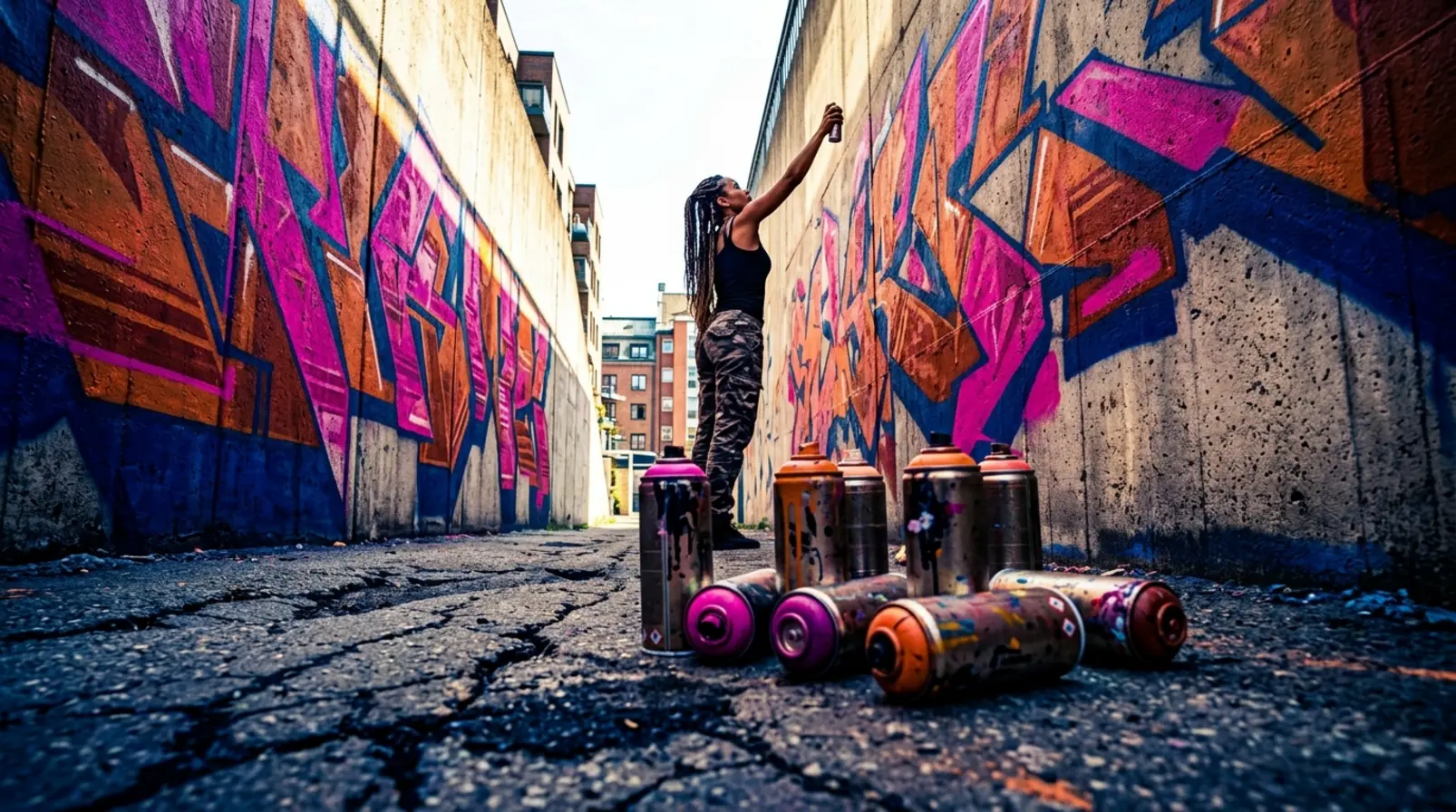

On many summer weekends, a stretch of concrete somewhere in the world gets handed over to spray cans. From July 10 to 12, 2026, it was Norway’s turn. The country’s first Meeting of Styles took place at Økern Senter in Oslo, where the official lineup listed more than forty international and Norwegian artists. The outdoor event was free, open to all ages, and built around three days of live painting. The organizers listed Økernveien 145 as the location and confirmed the dates, free admission and all-ages access, while Oslo Street Art Festival described it as Norway’s first Meeting of Styles.
At a glance, it looked like a festival. It is better understood as a ritual that has been repeating itself, city after city, for nearly three decades.
The spectacle is paint. The infrastructure is permission.
What a “meeting” actually is
Graffiti has never occupied a single setting. It moves between illicit writing, legal walls, commissioned murals, studios, trains, sketchbooks and sanctioned jams. Meeting of Styles belongs to the jam: the surface is secured in advance, the artists are invited rather than trespassing, spectators are welcome and the work can unfold without the immediate pressure of discovery.
That distinction is the point. Meeting of Styles describes itself as a nonprofit initiative intended to bring artists together, create spaces for expression and encourage exchange, cooperation and mutual respect. Its official history presents the network as a collaborative, cross-border project rather than a conventional competition. The format makes an argument that graffiti can function as a public and cooperative act without denying that much of the culture was formed under very different conditions.
Permission changes the workflow. An illicit piece is often made against the clock. A sanctioned jam gives artists time, scale and the ability to work beside people they might otherwise know only through photographs or social media. But permission does not make the wall neutral. Someone still owns the surface. Someone decides who can paint it, what rules apply and how long the finished work remains.
A graffiti “Hall of Fame,” like the one that helped produce Meeting of Styles in Wiesbaden, is valuable for precisely that reason. It is a recognized painting ground where writers can work openly and develop pieces at scale. It is not necessarily a museum. The walls may be repainted, and one artist’s work may eventually give way to another’s. What such a space preserves is not permanent paint. It is a continuing workflow.
Permission is not protection
The difference became painfully clear in Los Angeles in 2007. Meeting of Styles worked with Friends of the Los Angeles River and Crewest to secure a section of the channel where the Arroyo Seco meets the Los Angeles River. According to PBS SoCal’s account, permits were obtained and as many as one hundred artists participated, only for county crews to paint over the murals after officials objected to the project. The county later attempted to recover the cost of removing the work.
The episode matters because it exposes the limit of the word sanctioned. The artists had permission, until another authority effectively decided that the permission did not count. A legal wall does not escape power. It makes power visible. Someone grants access, someone controls the surface and someone may still revoke the arrangement after the paint has dried.
The stronger story of Meeting of Styles is therefore not that it transforms graffiti into a perfectly accepted public art form. It is that the event repeatedly constructs a temporary zone in which graffiti can operate differently. The wall is public for a weekend. The permission remains conditional.
Oslo built the temporary machine
The Oslo edition assembled the familiar parts of that machine. Its program scheduled live painting throughout the weekend, free graffiti workshops aimed especially at children and young people, and a related exhibition at Galleri Carl Berner T. The emphasis was not simply on displaying finished murals. Visitors could watch the surfaces develop, while younger participants were given a controlled introduction to the tools and techniques behind them.
The event also made its support structure unusually visible. The partner list included Montana Cans, local businesses, transit and hotel partners, Oslo municipal funding for the free youth workshops, and support from Vedal for mural production and festival infrastructure. That combination does not automatically prove either cultural legitimacy or corporate capture. It shows what a legal graffiti event requires: paint, walls, transport, permits, accommodation, money and an institution willing to absorb some of the risk.
The issue is not whether institutional support makes graffiti authentic or inauthentic. It is whether the culture can use that support without pretending the contradiction has disappeared. Brands can supply the cans. Municipal money can fund workshops. Property interests can provide the surface. None of them can permanently settle what the wall means once artists begin working on it.
From demolition threat to global network
Meeting of Styles began with a wall that could not be saved. In the mid-1990s, the abandoned Schlachthof complex in Wiesbaden, Germany, had become a major graffiti Hall of Fame, offering thousands of square meters on which artists could paint and exchange ideas. When demolition plans threatened the site, organizers responded with the first International Wall Street Meeting in 1997. Meeting of Styles’ official history says the gatherings grew out of the effort to defend what the Schlachthof represented, although the original site ultimately could not be preserved.
The failure to save the location produced something stranger and more durable. In 2002, the project was reorganized as the International Meeting of Styles Network, allowing local organizers in other cities to reproduce the model. What began as one scene’s response to a demolition threat became a portable structure: find a wall, secure access, bring artists together and create enough time for different styles to collide.
By the organization’s own count, Meeting of Styles has helped produce around five hundred events involving approximately fifty thousand artists and hundreds of thousands of visitors. A 2026 release from the city of Wiesbaden said the network had expanded into more than forty countries.
The network’s real achievement is not ownership. It is replication. Meeting of Styles could not preserve one threatened complex forever, so it preserved the conditions that had made the complex matter. The wall became replaceable. The meeting became the monument.
The language that travels with it
The format also carries a working vocabulary across borders, although that vocabulary varies by city, generation and scene. Graffiti.org’s glossary, which identifies itself as dated and heavily centered on New York terminology, defines recurring terms including the tag, throw-up, piece and black book. A tag is a writer’s signature. A throw-up is built for speed. A piece is a larger and more developed painting. A black book is where letterforms and ideas are worked out before they reach the wall.
Meeting of Styles did not invent those terms, and it does not force every local scene into one language. What it provides is a surface on which those dialects can meet. A Brazilian writer and a Norwegian writer working beside each other are not merely placing two images on the same wall. They are comparing decisions: how letters bend, where outlines break, how color moves and how much of a piece depends on habits developed somewhere else.
That exchange is harder to reproduce through a gallery or a phone screen because the wall records process as well as result. Artists encounter each other at full scale, in real time, while the work is still uncertain. The final mural matters, but so does the temporary workshop that forms around it.
Oslo’s murals may weather, be repainted or remain visible longer than anyone expects. Their uncertain lifespan does not make the weekend a failure. The durable part of Meeting of Styles was never any single image. It is the repeatable agreement underneath the image: a surface, a period of access, a group of artists and an audience allowed to watch the wall change.
A legal wall does not abolish graffiti’s politics. It puts them in plain sight.
The paint is the spectacle. The permission is the infrastructure. For one weekend, borrowed concrete becomes common ground.
'%3e%3cg id='Final-Copy-2_2_' transform='translate(1275.000000, 200.000000)'%3e%3cpath class='st0' d='M7.4,12.8h6.8l3.1-11.6H7.4C4.2,1.2,1.6,3.8,1.6,7S4.2,12.8,7.4,12.8z'/%3e%3c/g%3e%3c/g%3e%3c/g%3e%3cg id='final---dec.11-2020'%3e%3cg id='_x30_208-our-toggle' transform='translate(-1275.000000, -200.000000)'%3e%3cg id='Final-Copy-2' transform='translate(1275.000000, 200.000000)'%3e%3cpath class='st1' d='M22.6,0H7.4c-3.9,0-7,3.1-7,7s3.1,7,7,7h15.2c3.9,0,7-3.1,7-7S26.4,0,22.6,0z M1.6,7c0-3.2,2.6-5.8,5.8-5.8 h9.9l-3.1,11.6H7.4C4.2,12.8,1.6,10.2,1.6,7z'/%3e%3cpath id='x' class='st2' d='M24.6,4c0.2,0.2,0.2,0.6,0,0.8l0,0L22.5,7l2.2,2.2c0.2,0.2,0.2,0.6,0,0.8c-0.2,0.2-0.6,0.2-0.8,0 l0,0l-2.2-2.2L19.5,10c-0.2,0.2-0.6,0.2-0.8,0c-0.2-0.2-0.2-0.6,0-0.8l0,0L20.8,7l-2.2-2.2c-0.2-0.2-0.2-0.6,0-0.8 c0.2-0.2,0.6-0.2,0.8,0l0,0l2.2,2.2L23.8,4C24,3.8,24.4,3.8,24.6,4z'/%3e%3cpath id='y' class='st3' d='M12.7,4.1c0.2,0.2,0.3,0.6,0.1,0.8l0,0L8.6,9.8C8.5,9.9,8.4,10,8.3,10c-0.2,0.1-0.5,0.1-0.7-0.1l0,0 L5.4,7.7c-0.2-0.2-0.2-0.6,0-0.8c0.2-0.2,0.6-0.2,0.8,0l0,0L8,8.6l3.8-4.5C12,3.9,12.4,3.9,12.7,4.1z'/%3e%3c/g%3e%3c/g%3e%3c/g%3e%3c/g%3e%3c/svg%3e) Your Privacy Choices
Your Privacy Choices