




Two seconds of Kraftwerk became a legal dispute lasting decades. On September 3, 2026, Germany’s Federal Court of Justice upheld the finding that the rhythm sequence sampled from the band’s 1977 recording “Metall auf Metall” and looped in Sabrina Setlur’s 1997 track “Nur mir” qualified as a permissible pastiche for uses from June 7, 2021.
The intriguing part is whose understanding counts. The producer need not prove an intention to make a pastiche. Someone familiar with the source must be able to recognize the artistic relationship between the recordings. That gives the knowing listener a consequential role in a dispute over what a producer did with a machine.
How Pastiche Entered the Case
Germany’s pastiche exception took effect on June 7, 2021. Its meaning became the subject of a referral to the Court of Justice of the European Union, which clarified the standard on April 14, 2026. A qualifying creation must evoke an existing work while differing perceptibly from it, using protected characteristic elements in an artistic or creative dialogue that can itself be recognized.
That dialogue can include stylistic imitation, homage, or humorous or critical engagement. Pastiche is not a general exemption for anything creative made from somebody else’s material. The German court still had to apply the standard to these recordings.
The Listener Has to Hear the Relationship
The distinction is easy to lose: recognizing a borrowed sound is not the whole test. The pastiche character must be recognizable to a person familiar with the source. The European court did not require every listener to catch the reference, or require proof that the producer intended a pastiche.

This makes familiarity relevant without making popularity a legal requirement. An obscure source is not excluded because few people know it. The question is what someone who does know it can hear in the later work.
What Happened Around the Loop
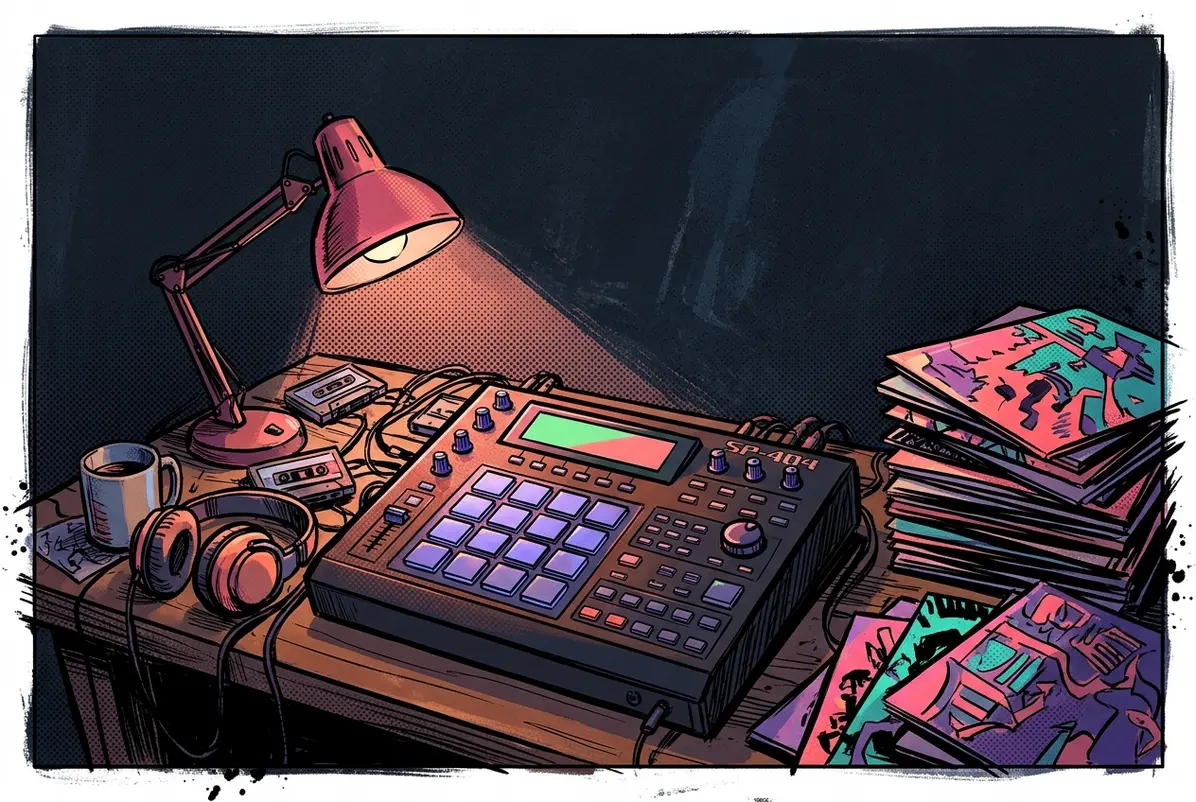
The judgment’s musical detail matters. It describes synthesizer sounds building around the opening loop, additional drum patterns, lead and background vocals, and later electric-guitar solos. The sampled sequence had been slowed by five percent and shifted metrically, changes the court described as barely perceptible even to an attentive, musically receptive listener.
The metallic rhythm remained audible, but the surrounding track acquired an independent character. The court also accepted that moving the electronic sequence into hip-hop created a recognizable artistic dialogue. Its assessment concerned what these recordings did together; changing genres alone was not announced as a universal permission slip.
A Dialogue Without Proven Intent
The defendants had initially denied taking the sequence. That did not prevent the court from finding an objectively recognizable creative dialogue between the works.
An IPKat analysis by Söğüt Atilla-Aydın welcomes the room this gives artists while questioning how persuasive “dialogue” is when an intention to engage need not be proved. The tension is useful: a recording can carry a relationship to another recording that its maker never has to explain convincingly in court.
The Date Still Matters
The result does not erase the earlier infringement finding covering the period from December 22, 2002 through June 6, 2021. As IPKat emphasizes, the pastiche exception protected the later period rather than clearing the entire history of the sample.
Nor does this German judgment settle sampling law everywhere. Lewis Silkin advises producers that clearance remains the lower-risk route: establishing a pastiche defense can still require an expensive, case-specific legal fight.
For sampling, though, the ruling leaves a substantial opening. A borrowed rhythm can remain audible while helping another recording become its own work. The familiar sound is part of how the listener hears the journey.
Frequently asked questions
What did the German court decide in the Kraftwerk sampling case?
On September 3, 2026, Germany's Federal Court of Justice upheld that the Metall auf Metall rhythm looped in Sabrina Setlur's Nur mir qualified as a permissible pastiche for uses from June 7, 2021, when Germany's pastiche exception took effect.
What counts as a pastiche under EU law?
According to the Court of Justice of the European Union's April 14, 2026 clarification, a pastiche must evoke an existing work while differing perceptibly from it, using its characteristic elements in a recognizable artistic or creative dialogue such as stylistic imitation, homage, or humorous or critical engagement.
Does a producer have to prove they intended a pastiche?
No. The producer need not prove an intention to make a pastiche. The relationship between the works must be objectively recognizable to a person familiar with the source recording.
Does every listener need to recognize the sample?
No. The European court did not require every listener to catch the reference. Popularity is not a legal requirement, so an obscure source is not excluded simply because few people know it.
Did the ruling clear the entire history of the Nur mir sample?
No. The earlier infringement finding covering December 22, 2002 through June 6, 2021 still stands. The pastiche exception only protects uses from June 7, 2021 onward.
Should producers still clear samples after this ruling?
Yes. Lewis Silkin advises that clearance remains the lower-risk route, because establishing a pastiche defense can still require an expensive, case-specific legal fight, and the German judgment does not settle sampling law everywhere.

'%3e%3cg id='Final-Copy-2_2_' transform='translate(1275.000000, 200.000000)'%3e%3cpath class='st0' d='M7.4,12.8h6.8l3.1-11.6H7.4C4.2,1.2,1.6,3.8,1.6,7S4.2,12.8,7.4,12.8z'/%3e%3c/g%3e%3c/g%3e%3c/g%3e%3cg id='final---dec.11-2020'%3e%3cg id='_x30_208-our-toggle' transform='translate(-1275.000000, -200.000000)'%3e%3cg id='Final-Copy-2' transform='translate(1275.000000, 200.000000)'%3e%3cpath class='st1' d='M22.6,0H7.4c-3.9,0-7,3.1-7,7s3.1,7,7,7h15.2c3.9,0,7-3.1,7-7S26.4,0,22.6,0z M1.6,7c0-3.2,2.6-5.8,5.8-5.8 h9.9l-3.1,11.6H7.4C4.2,12.8,1.6,10.2,1.6,7z'/%3e%3cpath id='x' class='st2' d='M24.6,4c0.2,0.2,0.2,0.6,0,0.8l0,0L22.5,7l2.2,2.2c0.2,0.2,0.2,0.6,0,0.8c-0.2,0.2-0.6,0.2-0.8,0 l0,0l-2.2-2.2L19.5,10c-0.2,0.2-0.6,0.2-0.8,0c-0.2-0.2-0.2-0.6,0-0.8l0,0L20.8,7l-2.2-2.2c-0.2-0.2-0.2-0.6,0-0.8 c0.2-0.2,0.6-0.2,0.8,0l0,0l2.2,2.2L23.8,4C24,3.8,24.4,3.8,24.6,4z'/%3e%3cpath id='y' class='st3' d='M12.7,4.1c0.2,0.2,0.3,0.6,0.1,0.8l0,0L8.6,9.8C8.5,9.9,8.4,10,8.3,10c-0.2,0.1-0.5,0.1-0.7-0.1l0,0 L5.4,7.7c-0.2-0.2-0.2-0.6,0-0.8c0.2-0.2,0.6-0.2,0.8,0l0,0L8,8.6l3.8-4.5C12,3.9,12.4,3.9,12.7,4.1z'/%3e%3c/g%3e%3c/g%3e%3c/g%3e%3c/g%3e%3c/svg%3e) Your Privacy Choices