

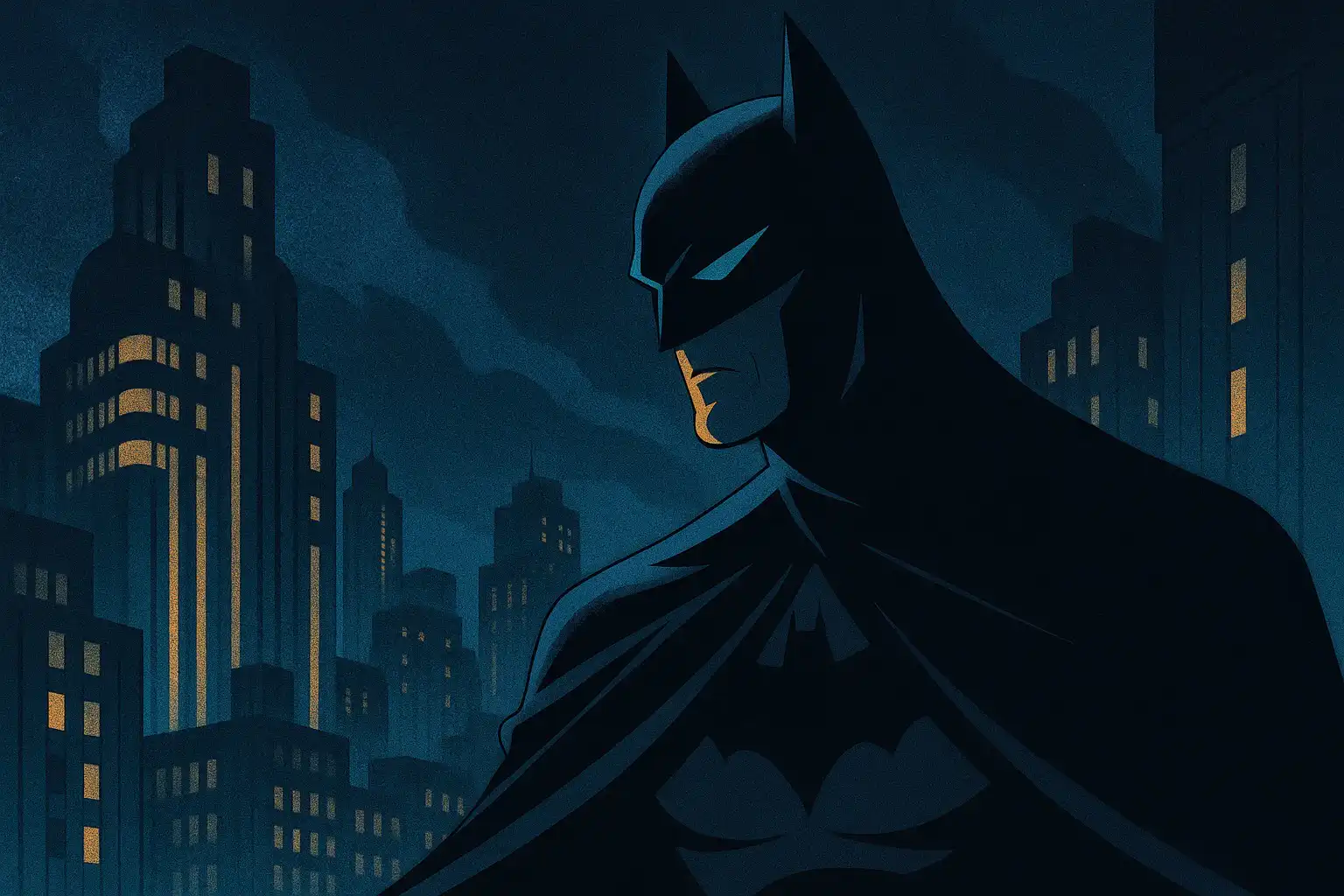


Some shows just hit different. You know the ones—still crackling with atmosphere 30 years later, still buried in your head like a cathedral organ, still making you wonder how they ever got away with something that moody, that sad, that elegant on a kids’ network.
Batman: The Animated Series wasn’t just a benchmark. It was a blueprint. A noir-soaked, Art Deco fever dream that somehow made children sit still for slow dissolves, Danny Elfman swells, and emotionally repressed men whispering in alleys about memory and justice. It had gravitas. It had muscle. It had Shirley Walker. It had Paul Dini. It had style. But above all, it had Kevin Conroy.
And for so many of us—especially those of us growing up queer, closeted, or just different—he had us.
You can read Conroy’s own story here, in his raw, arresting memoir Finding Batman, published in the DC PRIDE 2024 edition shortly before his death. It’s told in comic form, with panels that stretch from Catholic school to the AIDS crisis to the brutal machinery of Hollywood, and it feels more like a lost episode of the series than anything DC has made since. It’s not just a coming out—it’s a reckoning.
Because what Conroy did, quietly, was become Batman while carrying a private grief that mirrored Bruce Wayne’s own: a childhood torn apart, a brother ravaged by mental illness, a world that offered only masks, never mirrors. And he brought that to the mic. He let Batman be broken, but dignified. He played the hero like a man who needed to become someone else to survive.
And if you were a gay kid in the ‘90s—maybe getting bullied, maybe already building your own little double life—it mattered that the toughest guy in the room was voiced by someone who had walked through fire and come out the other side not bitter, but steady. Kevin’s voice didn’t just command the night. It made you feel safe inside it.
Now, with a second season of Batman: Caped Crusader already on the way and queer storytelling more visible than ever in animation, it’s worth revisiting how The Animated Series didn’t just elevate superhero TV—it reframed what heroism looked like. What it sounded like.
Not all heroes wear capes. But some wear a mask. And if they do it right, they make space for the rest of us to take ours off.

'%3e%3cg id='Final-Copy-2_2_' transform='translate(1275.000000, 200.000000)'%3e%3cpath class='st0' d='M7.4,12.8h6.8l3.1-11.6H7.4C4.2,1.2,1.6,3.8,1.6,7S4.2,12.8,7.4,12.8z'/%3e%3c/g%3e%3c/g%3e%3c/g%3e%3cg id='final---dec.11-2020'%3e%3cg id='_x30_208-our-toggle' transform='translate(-1275.000000, -200.000000)'%3e%3cg id='Final-Copy-2' transform='translate(1275.000000, 200.000000)'%3e%3cpath class='st1' d='M22.6,0H7.4c-3.9,0-7,3.1-7,7s3.1,7,7,7h15.2c3.9,0,7-3.1,7-7S26.4,0,22.6,0z M1.6,7c0-3.2,2.6-5.8,5.8-5.8 h9.9l-3.1,11.6H7.4C4.2,12.8,1.6,10.2,1.6,7z'/%3e%3cpath id='x' class='st2' d='M24.6,4c0.2,0.2,0.2,0.6,0,0.8l0,0L22.5,7l2.2,2.2c0.2,0.2,0.2,0.6,0,0.8c-0.2,0.2-0.6,0.2-0.8,0 l0,0l-2.2-2.2L19.5,10c-0.2,0.2-0.6,0.2-0.8,0c-0.2-0.2-0.2-0.6,0-0.8l0,0L20.8,7l-2.2-2.2c-0.2-0.2-0.2-0.6,0-0.8 c0.2-0.2,0.6-0.2,0.8,0l0,0l2.2,2.2L23.8,4C24,3.8,24.4,3.8,24.6,4z'/%3e%3cpath id='y' class='st3' d='M12.7,4.1c0.2,0.2,0.3,0.6,0.1,0.8l0,0L8.6,9.8C8.5,9.9,8.4,10,8.3,10c-0.2,0.1-0.5,0.1-0.7-0.1l0,0 L5.4,7.7c-0.2-0.2-0.2-0.6,0-0.8c0.2-0.2,0.6-0.2,0.8,0l0,0L8,8.6l3.8-4.5C12,3.9,12.4,3.9,12.7,4.1z'/%3e%3c/g%3e%3c/g%3e%3c/g%3e%3c/g%3e%3c/svg%3e) Your Privacy Choices
Your Privacy Choices