


The most useful Independence Day superhero is not the one who waves the flag the hardest. It is the one who makes the flag feel difficult.
That is the strange tension inside American patriotic comics. The category looks simple from a distance: Captain America, Superman, Uncle Sam, the Shield, a parade of red, white, and blue bodies built for covers, lunchboxes, and July 4th displays. But the best of these characters have never been simple advertisements for the country. They are pressure tests. They ask whether a flag can stand for an ideal without becoming a costume for denial.
That argument started earlier than many fans think.
Before Captain America: The Forgotten First Patriotic Superhero
Most fans assume Captain America invented the flag-wearing superhero. He didn’t. The Shield, created by writer Harry Shorten and artist Irv Novick for MLJ Magazines, debuted in Pep Comics #1, a January 1940 issue that the Grand Comics Database lists with a November 16, 1939 on-sale date. Archie Comics has repeatedly described the Shield as America’s first patriotic superhero, and the cover-date math puts him 14 months before Captain America’s March 1941 debut.
The parallels between the two are striking. The Shield was FBI agent Joe Higgins, whose father was killed by enemy spies while working on a formula that could give a person super-strength and invulnerability. Higgins continued the work, became the Shield, and turned himself into a human weapon wrapped in national iconography. GCD’s entry for Archie’s 2002 Shield collection traces those early stories back to Pep Comics and Shield-Wizard Comics, where the character’s origin was expanded in wartime spy-and-sabotage terms. Sound familiar?
Even Captain America’s shield carries a little ghost of the Shield. Cap’s first issue gave him a triangular shield, not the round disc that later became inseparable from the character. Comics historian Sean Kleefeld, summarizing Joe Simon’s account, notes that MLJ objected to the shape because it looked too close to the Shield’s chest insignia, and Timely changed the design to avoid a legal fight. The round shield was born from a branding problem. The icon arrived as a correction.
By the end of 1941, the field was crowded. Captain Freedom, Minute-Man, Star-Spangled Kid, Captain Battle, and a literal comic-book Uncle Sam all joined the wartime rush of red-white-and-blue crusaders. The assembly line reflected a country still arguing with itself over whether it even wanted to fight, at a time when organized isolationist groups such as the America First Committee opposed active U.S. involvement in World War II, as the Hoover Institution’s America First collection notes. None of those flag-wearers survived in popular culture the way Captain America did.
Captain America Comics and the Weight of the Shield
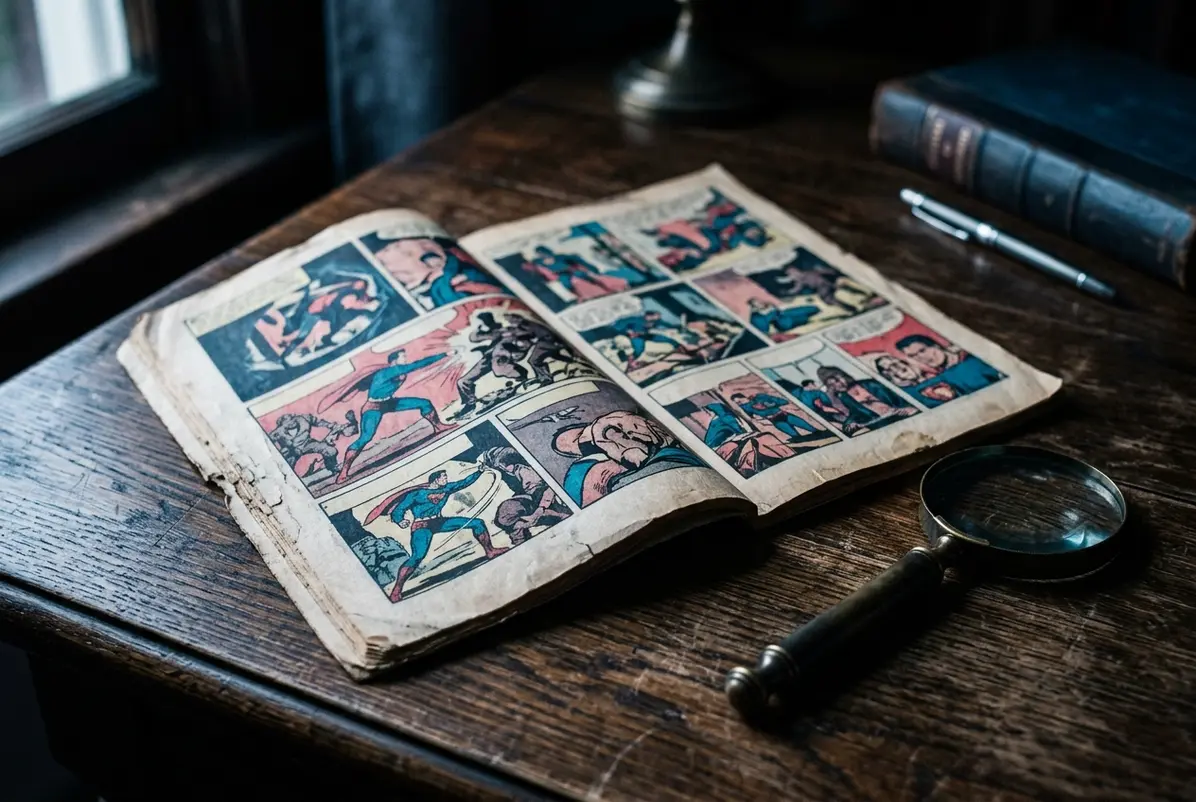
Captain America, created by Joe Simon and Jack Kirby, first appeared in Captain America Comics #1, published by Timely Publications, a corporate predecessor to Marvel. The issue carried a March 1941 cover date, and GCD lists its on-sale date as December 20, 1940. The cover, which depicted Cap punching Adolf Hitler, arrived nearly a year before Pearl Harbor. Simon later described the character as a consciously political creation, recalling, “The opponents to the war were all quite well organized. We wanted to have our say too.”
Captain America Comics #1 became a wartime phenomenon, and later accounts routinely place its sales near the million-copy mark. The book’s commercial success helped give it mythic status in collector culture. A near-mint CGC 9.4 copy sold for $3.12 million at Heritage Auctions in April 2022, after the same copy had realized $915,000 in 2019. The seal is not the whole product here. The image is. Cap hitting Hitler is still the pitch.
That is why the Fourth of July keeps pulling Captain America back into the conversation. Steve Rogers is not just a superhero in patriotic colors. He is the question of whether patriotic colors can be separated from the state using them. The familiar defense is that Steve represents what America should be, not what it always is. The criticism is that flag imagery can become corporate packaging for moral certainty. Both readings are too easy on their own. The character works because he has to keep surviving the argument.
The conversation sharpens when Sam Wilson enters the picture. Sam’s Falcon debuted in Captain America #117 in 1969 and is often described as the first African-American superhero in mainstream comics. His stature has only grown since 2014, when Steve Rogers selected him as his successor in Captain America Vol. 7 #25, with Wilson’s run continuing in All-New Captain America. Marvel’s own account of Sam’s path to the shield frames him as a hero chosen by Steve to carry both the mission and the symbol.
Sam changes the holiday argument because he makes the promise harder to flatten. Steve can be read as the idealized American myth. Sam carries the shield as a Black hero inside a country whose promises have never landed evenly. The issue is not whether Sam is “more patriotic” than Steve. It is that Sam makes the patriotism less decorative. He forces the symbol to answer for who has been asked to believe in it.
Superman’s Shifting Slogan and the Question of Whose Way
Superman occupies a stranger position in the patriotic-hero conversation. Originally, Superman fought for “truth and justice.” According to the Smithsonian Magazine history of the slogan, the radio serial added “the American way” in 1942, during World War II. The phrase later became inseparable from the character in the public imagination, even though Superman’s relationship to it has never been stable.

The same Smithsonian account notes that the 1966 New Adventures of Superman animated series used “truth, justice and freedom,” while the 1970s Super Friends cartoon moved toward “truth, justice and peace for all mankind.” In 2021, DC announced that Superman’s motto would evolve to “Truth, Justice and a Better Tomorrow”, with DC’s Jim Lee saying the change was meant to reflect global storytelling and honor Superman’s legacy of building a better world.
That announcement drew criticism and debate because Superman is never only a fictional immigrant from Krypton. He is also a cultural measuring device. When the motto says “the American Way,” readers have to decide whether that phrase means liberty, tolerance, small-town decency, Cold War branding, or something more exclusionary. When DC removes the phrase, readers have to decide whether that is modernization, cowardice, global logic, or corporate risk management. Superman’s slogan has always been less a fixed creed than a weather vane.
Uncle Sam, Alex Ross, and the Patriotic Hero as Self-Critique
The most daring Independence Day comic may be the one least discussed at barbecues. Uncle Sam, the comic book character created by Will Eisner and Lou Fine, first appeared in National Comics #1, a July 1940 Quality Comics issue. GCD credits the issue’s Uncle Sam story to Eisner and Dave Berg, with indexer notes identifying Uncle Sam as a creation of Eisner and Fine. This is not just another flag suit. This is the national mascot turned into a comic-book body.
The character reached a creative high point decades later, when DC’s Vertigo imprint published Uncle Sam, a two-part prestige-format miniseries written by Steve Darnall with fully painted art by Alex Ross. The book has returned to print in Abrams ComicArts’ Uncle Sam: Special Election Edition, which describes it as a reissue of the classic Vertigo miniseries and a “sharp political fever dream” about a ragged, star-spangled vagrant guided by fractured memories of America’s past. DC’s own listing for the earlier deluxe edition similarly describes a star-spangled vagrant haunted by history-traveling visions.
That is the trick of the book. Darnall and Ross do not turn Uncle Sam into a cleaner superhero. They make him less clean. Their Sam wanders through American history as if the country itself has become a head injury. The costume is familiar, but the body inside it is damaged, ashamed, stubborn, and still somehow alive. Ross won the 1998 Eisner Award for Best Painter for Uncle Sam, and Comic-Con’s official 1990s Eisner records also list him as Best Cover Artist that year for Kurt Busiek’s Astro City and Uncle Sam.

The Vertigo Uncle Sam reads as the anti-fireworks patriotic comic. Where Captain America punches villains and Superman soars above Metropolis, this Sam stumbles through a nation that may have already betrayed its own founding mythology. For readers drawn to political superhero work, the miniseries belongs near Watchmen and V for Vendetta, not because it imitates them, but because it understands the same ugly truth: symbols do not become powerful because they are pure. They become powerful because people keep fighting over what they mean.
What Patriotic Superheroes Mean on the Fourth of July
The conversation around Independence Day comics tends to circle a single question: can a character draped in the flag represent ideals without endorsing the nation’s failures? That is why the jokes land. Wolverine gets posted on July 4th, and someone reminds everyone that Logan is Canadian. Captain America’s birthday gets turned into fan-argument fodder. Superman’s motto becomes a culture-war thermometer. The humor works because these characters are never just costumes. They are arguments about what the costume is supposed to mean.
The strongest patriotic comics have usually understood that tension. Simon and Kirby made Captain America political before the United States entered World War II. Darnall and Ross cast Uncle Sam as a vagrant haunted by the distance between the dream and the record. Sam Wilson carries the shield as a Black hero whose presence complicates an icon built around national promise. Superman keeps losing and regaining the country inside his slogan.
None of these stories offer comfortable patriotism. They offer something more useful: the suggestion that a country worth celebrating is one still willing to argue about what it should be. The flag is not the answer. In the best comics, the flag is the problem the hero has to carry.
FAQ: Independence Day Comics and Superheroes
Who was the first patriotic superhero in comics?
The Shield is commonly identified as one of the first superheroes, and often the first superhero, with a costume based on United States patriotic iconography. The character appeared in Pep Comics #1, a January 1940 issue from MLJ Magazines, the company that later became Archie Comics. Archie has also marketed the Shield as America’s first patriotic superhero.
When did Captain America first appear?
Captain America first appeared in Captain America Comics #1, published by Timely Publications, a corporate predecessor to Marvel. The issue has a March 1941 cover date, and GCD lists an on-sale date of December 20, 1940. The gap reflects standard comic-book cover-date practice at the time.
Where did Superman’s “Truth, Justice, and the American Way” motto come from?
The phrase evolved over time. Superman was originally associated with “truth and justice,” while the radio serial added “the American way” in 1942 during World War II. In 2021, DC announced that Superman’s motto would become “Truth, Justice and a Better Tomorrow”.
When did Sam Wilson become Captain America?
Steve Rogers selected Sam Wilson as his successor in Captain America Vol. 7 #25, after Rogers rapidly aged following a fight with the villain Iron Nail. Wilson’s time as Captain America then continued in All-New Captain America #1, as explained in Marvel’s history of Sam Wilson becoming Captain America.
What is the Alex Ross Uncle Sam comic?
Uncle Sam is a Vertigo miniseries written by Steve Darnall with painted art by Alex Ross. Abrams ComicArts’ Special Election Edition describes it as the reissue of a classic Vertigo miniseries about a star-spangled, ragged vagrant guided by voices and fractured memories of America’s past. Ross won the 1998 Eisner Award for Best Painter for Uncle Sam, according to Comic-Con’s official Eisner records.
How much is Captain America Comics #1 worth?
A near-mint CGC 9.4 copy of Captain America Comics #1 sold for $3.12 million at Heritage Auctions in 2022, after the same copy sold for $915,000 in 2019. Lower-grade copies sell for significantly less, but the issue remains one of the major Golden Age keys in the hobby.
'%3e%3cg id='Final-Copy-2_2_' transform='translate(1275.000000, 200.000000)'%3e%3cpath class='st0' d='M7.4,12.8h6.8l3.1-11.6H7.4C4.2,1.2,1.6,3.8,1.6,7S4.2,12.8,7.4,12.8z'/%3e%3c/g%3e%3c/g%3e%3c/g%3e%3cg id='final---dec.11-2020'%3e%3cg id='_x30_208-our-toggle' transform='translate(-1275.000000, -200.000000)'%3e%3cg id='Final-Copy-2' transform='translate(1275.000000, 200.000000)'%3e%3cpath class='st1' d='M22.6,0H7.4c-3.9,0-7,3.1-7,7s3.1,7,7,7h15.2c3.9,0,7-3.1,7-7S26.4,0,22.6,0z M1.6,7c0-3.2,2.6-5.8,5.8-5.8 h9.9l-3.1,11.6H7.4C4.2,12.8,1.6,10.2,1.6,7z'/%3e%3cpath id='x' class='st2' d='M24.6,4c0.2,0.2,0.2,0.6,0,0.8l0,0L22.5,7l2.2,2.2c0.2,0.2,0.2,0.6,0,0.8c-0.2,0.2-0.6,0.2-0.8,0 l0,0l-2.2-2.2L19.5,10c-0.2,0.2-0.6,0.2-0.8,0c-0.2-0.2-0.2-0.6,0-0.8l0,0L20.8,7l-2.2-2.2c-0.2-0.2-0.2-0.6,0-0.8 c0.2-0.2,0.6-0.2,0.8,0l0,0l2.2,2.2L23.8,4C24,3.8,24.4,3.8,24.6,4z'/%3e%3cpath id='y' class='st3' d='M12.7,4.1c0.2,0.2,0.3,0.6,0.1,0.8l0,0L8.6,9.8C8.5,9.9,8.4,10,8.3,10c-0.2,0.1-0.5,0.1-0.7-0.1l0,0 L5.4,7.7c-0.2-0.2-0.2-0.6,0-0.8c0.2-0.2,0.6-0.2,0.8,0l0,0L8,8.6l3.8-4.5C12,3.9,12.4,3.9,12.7,4.1z'/%3e%3c/g%3e%3c/g%3e%3c/g%3e%3c/g%3e%3c/svg%3e) Your Privacy Choices
Your Privacy Choices