


The Pitch Nobody Expected
When Takeo Suzuki, known by the nickname TKO, first proposed building a new Pentax film camera to the executives at Ricoh Imaging, the room went cold. “I just remember everyone seemed to freeze,” Suzuki later told Monocle. The reaction made sense. Ricoh had acquired Pentax from Hoya Corporation in 2011, film-camera production had long been abandoned, and there had not been a new Pentax model since 2003. The idea of sinking resources into emulsion-based photography while the rest of the industry chased mirrorless sensors looked, on paper, absurd.
Yet Suzuki won them over. In December 2022, Ricoh Imaging announced the Pentax Film Project, a research-and-development effort focused on new Pentax-branded film cameras. The announcement was careful, almost nervously so. Ricoh said it wanted to use film-camera skills and technologies built up over decades, but it also stressed that the announcement did not guarantee new camera releases and that restarting film-camera production after so many years would be difficult.
The early imagined path was still ambitious. In public coverage of the project, Suzuki’s rough sequence began with a compact camera, then moved toward a higher-end compact, an SLR, and eventually a fully mechanical SLR, while also acknowledging that the project might fail to hit its goals. What arrived in June 2024 did fit the compact-camera slot. But it did not arrive in the obvious nostalgia-safe shape many people expected. It was stranger, more polarizing, and more revealing than a simple Pentax comeback camera would have been.
Half the Frame, Twice the Argument
The Pentax 17 became the company’s first new Pentax film camera in roughly two decades. It is a half-frame camera, capturing two vertical 17 x 24mm images in the space normally used for a single 36 x 24mm frame on 35mm film. The name is not poetic. It is literal. The “17” refers to the width of the frame.
The U.S. launch price was $499.95. For that money, a buyer gets a fixed 25mm f/3.5 HD Pentax lens, equivalent to 37mm in full-frame 35mm terms, manual film advance, manual rewind, manual ISO setting, exposure compensation, seven shooting modes, and a manual zone-focusing system divided into six distances. No autofocus. No interchangeable lens. No dedicated aperture ring. No shutter-priority mode.
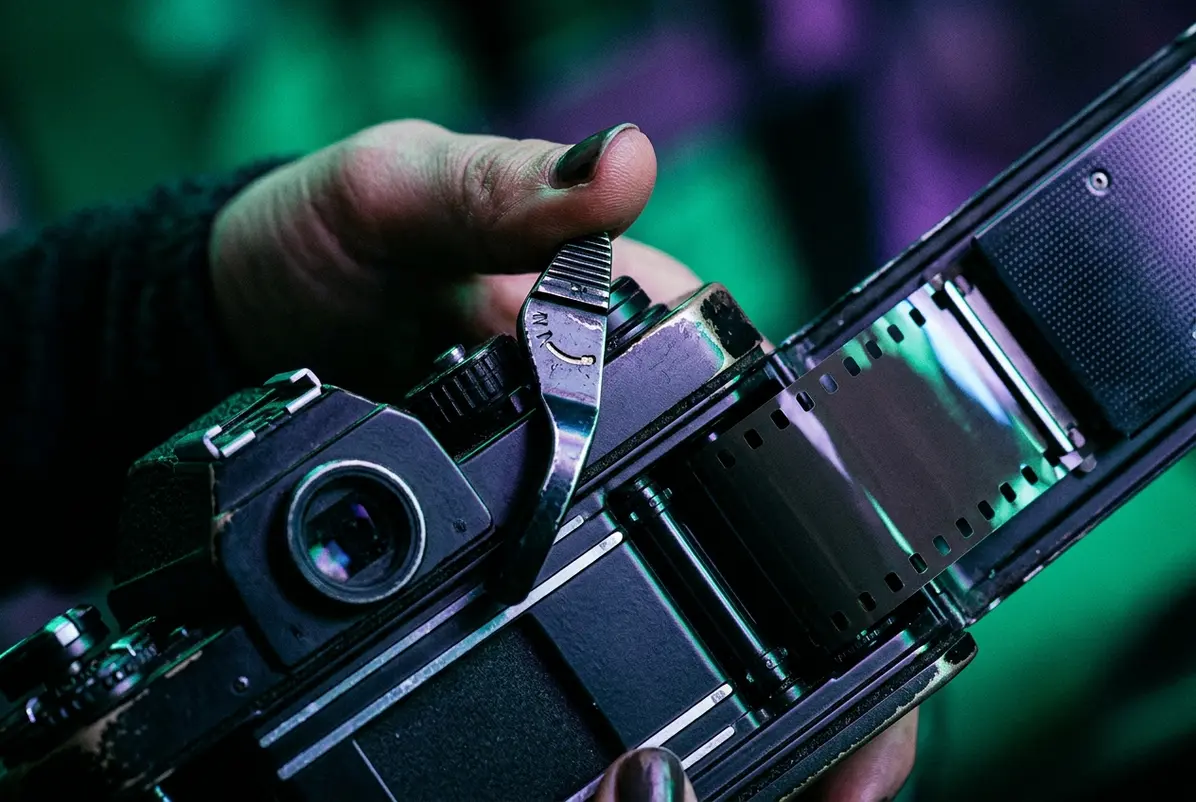
That list of absences tells the story better than the spec sheet. The Pentax 17 was not designed to be a miniature pro camera. It was designed to keep just enough friction. Ricoh described the goal as a camera that left “some room for manual operation” instead of becoming fully automatic, and the company’s own feature page frames the film-wind lever as a deliberate attempt to recreate the feel of a traditional film camera. The lever is not merely a mechanism. It is a thesis with a spring inside it.
The design reaches deep into Ricoh’s own archive. Suzuki told Monocle that he had older cameras in mind, including the Ricoh Auto Half from the 1960s and the Pentax Espio. The Auto Half matters here because it was not some obscure footnote. Ricoh introduced the Ricoh Auto Half in 1962 as a half-frame, fully automatic camera with automated exposure, focusing, and film winding; Ricoh’s own history describes it as a massive hit, especially with female consumers.
Suzuki’s move was to take that lineage and invert part of its logic. Keep the half-frame economy. Keep the compact-camera accessibility. Keep the feeling that this object can be carried without ceremony. But remove full automation just enough that the user has to participate. In a 2026 Kosmo Foto interview, Suzuki said he wanted a “classic feel” without making a simple reissue, adding that the camera had to feel “classic, yet unmistakably modern”.
That is the real design conflict. The Pentax 17 is not trying to resurrect the 1970s. It is trying to build a film camera for people whose visual grammar was shaped by phones, feeds, vertical images, and near-instant sharing. The body looks backward. The frame orientation looks forward. The contradiction is the product.
The Community Cracks Open
The argument started almost immediately because the Pentax 17 landed in a weird price-and-control zone. Enthusiast coverage noted the same friction points again and again: the $499.95 price, the half-frame negative, the lack of autofocus, and the question of whether a new compact film camera could justify costing more than many used SLR bodies. PentaxForums covered the announcement as both a major return and a spec-table provocation. The camera was not just a camera. It was a referendum on what “new film” was supposed to mean.
The obvious comparison is a serviced vintage SLR. A Canon AE-1, Pentax K1000, Nikon FM, or any number of other used bodies can offer more control, a larger negative, and the romance of the old machine. That argument has weight. But it also hides the part of the market that made the Pentax 17 necessary in the first place: old cameras break, parts are finite, repair knowledge ages out, and buying used gear often means buying somebody else’s maintenance problem.
Ricoh understood that anxiety from the beginning. Its 2022 Film Project announcement specifically mentioned that, with digital cameras now mainstream, procuring parts for film cameras can be challenging. The aftercare problem was not a side issue. It was part of the premise. The used-camera market can preserve the past, but it cannot manufacture new trust forever.
That is why the Pentax 17’s critics and defenders often seem to be arguing past each other. Skeptics are measuring it against cameras with more control. Supporters are measuring it against the anxiety of owning a 40-year-old machine with a mystery shutter and no factory behind it. The question is not simply whether $500 buys more camera elsewhere. It is whether $500 buys a different kind of peace.
Hands-on reviews complicated the early skepticism. Field Mag, after testing the camera for months, described the Pentax 17 as a satisfying blend of physical ritual and modern usability, while still calling the price difficult and the focus system frustrating in close-range situations. The same review found that the automatic mode worked surprisingly well and that someone with little film experience could plausibly shoot a roll in auto and feel the results were worth the effort. That is not a total victory. It is something more interesting: a flawed camera that understands its user better than some technically superior cameras do.
The strongest contrarian read is that the Pentax 17 deserves more respect than its “analog Instagram” reputation allows. Yes, the vertical half-frame format plays nicely with phone screens. Yes, the camera is friendly to first-time film shooters. But that does not make it unserious. A smaller negative is not a moral failure. A zone-focus system is not automatically a toy. The Pentax 17 is not pretending to be a Leica. It is asking whether film culture can survive without making every newcomer pass through the gate of inherited expertise.
What Suzuki Built, and What He Left Behind
The attention kept arriving after launch. TIME later named the Pentax 17 one of its Best Inventions of 2025, framing the camera as a rare new 35mm film release from a major camera maker and emphasizing its vertical orientation as a fit for smartphone-era habits. Initial demand also appears to have exceeded supply. In July 2024, PetaPixel reported that Ricoh was considering increased production after temporarily suspending some orders because of supply constraints.
Then the ground shifted. In March 2025, Suzuki announced that he was leaving Ricoh Imaging. Kosmo Foto reported the departure and later corrected its own framing to clarify that the Pentax Film Project had not been officially paused. According to that correction, Ricoh Imaging Japan said the project was not paused, but was seeking further feedback before committing to additional models.
That distinction matters. “Paused” sounds like a door closing. “Seeking feedback” sounds like a company doing the math in public, slowly and awkwardly. Ricoh Imaging Europe’s comments to Kosmo Foto were careful: the company wanted time to learn what users appreciated, what they felt was missing, and how the Pentax 17 might shape a longer-term approach to film photography. It was not a triumphant declaration of the next SLR. It was not a funeral. It was a company standing in the fog after doing something unexpectedly brave.
Later coverage also pushed back on rumors that the camera itself had vanished from production. In a September 2025 review, Field Mag wrote that reports of an actual production pause seemed exaggerated and quoted a Pentax representative saying the company had available inventory and production to fulfill Pentax 17 orders. That does not answer the larger question of what comes next. It only keeps the first camera from being prematurely turned into a ghost.

Clever or Compromised
So which is it? Clever or compromised? The Pentax 17 sits in the middle ground where clean verdicts go to die. At roughly $500, it can feel like a camera without a natural buyer. The veteran may want more dials. The bargain hunter may want a cheaper half-frame. The beginner may wonder why a camera without autofocus costs this much. Every criticism lands somewhere real.
But the stronger reading is that Suzuki built something more deliberate than a compromise. The Pentax 17 preserves the rituals of film photography: the lever wind, the zone-focus guess, the finite roll, the strange trust placed in a latent image no one can see yet. Then it strips away enough intimidation to make those rituals available to people who did not inherit them.
That is different from nostalgia. Nostalgia wants the past restored as a stage set. The Pentax 17 wants the past reworked as a usable behavior. It is not trying to be the best camera for any single audience. It is trying to keep the act of shooting film alive as a shared cultural practice rather than a specialist test.
The unresolved question is whether Ricoh can build a future around that insight. Suzuki’s exit left the project’s next chapter less certain, and the early dream of SLRs and fully mechanical bodies remains just that: a dream. But the Pentax 17 itself remains a strange and useful object, 72 frames at a time, asking its owner to slow down without asking them to cosplay as a purist.
The real achievement is not that the Pentax 17 brought film back. Film was already back, unevenly, expensively, romantically, annoyingly. The achievement is that it made the ritual feel newly reachable. The lever is the product. The frame is almost incidental.
FAQ
Is the Pentax 17 a full-frame 35mm camera?
No. The Pentax 17 uses standard 35mm film, but it exposes a 24 x 17mm half-frame image instead of the usual 36 x 24mm frame. That gives roughly 72 images on a 36-exposure roll, depending on loading.
Does the Pentax 17 have autofocus?
No. The Pentax 17 uses a manual zone-focus system with six focus zones, ranging from macro to far distance. The camera can be used casually, but the focus setting still matters.
Why does the Pentax 17 shoot vertical photos?
The Pentax 17 uses a horizontal film-advance mechanism, so when the camera is held normally, it captures vertical images. Ricoh explicitly connects that vertical format to the familiar proportions of smartphone photography and social sharing.
Is the Pentax 17 good for beginners?
It can be. The camera has a full-auto mode, a built-in flash, and warning lamps meant to prevent basic mistakes, but it is not completely mindless. Beginners still need to understand film speed, focus zones, and the limits of close focusing.
Is the Pentax Film Project over because Takeo Suzuki left Ricoh?
Ricoh has not said the project is over. After Suzuki’s March 2025 departure, Kosmo Foto clarified that Ricoh Imaging Japan said the Pentax Film Project was not paused, but that the company was seeking more feedback before committing to future models.

'%3e%3cg id='Final-Copy-2_2_' transform='translate(1275.000000, 200.000000)'%3e%3cpath class='st0' d='M7.4,12.8h6.8l3.1-11.6H7.4C4.2,1.2,1.6,3.8,1.6,7S4.2,12.8,7.4,12.8z'/%3e%3c/g%3e%3c/g%3e%3c/g%3e%3cg id='final---dec.11-2020'%3e%3cg id='_x30_208-our-toggle' transform='translate(-1275.000000, -200.000000)'%3e%3cg id='Final-Copy-2' transform='translate(1275.000000, 200.000000)'%3e%3cpath class='st1' d='M22.6,0H7.4c-3.9,0-7,3.1-7,7s3.1,7,7,7h15.2c3.9,0,7-3.1,7-7S26.4,0,22.6,0z M1.6,7c0-3.2,2.6-5.8,5.8-5.8 h9.9l-3.1,11.6H7.4C4.2,12.8,1.6,10.2,1.6,7z'/%3e%3cpath id='x' class='st2' d='M24.6,4c0.2,0.2,0.2,0.6,0,0.8l0,0L22.5,7l2.2,2.2c0.2,0.2,0.2,0.6,0,0.8c-0.2,0.2-0.6,0.2-0.8,0 l0,0l-2.2-2.2L19.5,10c-0.2,0.2-0.6,0.2-0.8,0c-0.2-0.2-0.2-0.6,0-0.8l0,0L20.8,7l-2.2-2.2c-0.2-0.2-0.2-0.6,0-0.8 c0.2-0.2,0.6-0.2,0.8,0l0,0l2.2,2.2L23.8,4C24,3.8,24.4,3.8,24.6,4z'/%3e%3cpath id='y' class='st3' d='M12.7,4.1c0.2,0.2,0.3,0.6,0.1,0.8l0,0L8.6,9.8C8.5,9.9,8.4,10,8.3,10c-0.2,0.1-0.5,0.1-0.7-0.1l0,0 L5.4,7.7c-0.2-0.2-0.2-0.6,0-0.8c0.2-0.2,0.6-0.2,0.8,0l0,0L8,8.6l3.8-4.5C12,3.9,12.4,3.9,12.7,4.1z'/%3e%3c/g%3e%3c/g%3e%3c/g%3e%3c/g%3e%3c/svg%3e) Your Privacy Choices
Your Privacy Choices