




Most adventure games ask the hero to move through the world. Arranger: A Role-Puzzling Adventure asks what happens when the world has to move with her.
That is the hook, the mechanic, and the secret autobiography of the whole thing. Jemma, the game’s small-town misfit, does not simply walk across a map. She drags rows, columns, objects, enemies, tools, conversations, and social order into motion every time she takes a step. The result is not just a clever puzzle system. It is a worldview: belonging is not found by fitting neatly into the grid. Sometimes the grid has to be disturbed.
Released on July 25, 2024, Arranger is the debut game from Furniture & Mattress, the indie studio built around designer-programmer Nicolás “Nico” Recabarren, artist David Hellman, writer-producer Nick Suttner, and composer Tomás Batista. The game launched on Nintendo Switch, PlayStation 5, Steam, Epic Games Store, Mac, and Netflix mobile, with Furniture & Mattress describing it as a compact adventure about “breezy, thoughtful puzzles” and self-discovery.
The Misfit Who Moves the Map
Recabarren’s résumé gives the game some useful context, but the résumé is not the story. A developer based in Mendoza, Argentina, Recabarren had already co-created ETHEREAL with Tomás Batista under the Nonsense Arts label. ETHEREAL won the Audience Award at the 2019 Independent Games Festival and was nominated for Excellence in Audio. It was abstract, wordless, and built around the pleasure of understanding a world through its rules rather than its exposition.
That lineage matters because Arranger is also obsessed with rules that feel physical before they feel verbal. Furniture & Mattress was formally announced in 2022, with GamesPress noting that Hellman, Suttner, and Recabarren began working together in 2020 and founded the studio in 2021 to self-publish their debut project. The team had the kind of indie pedigree that could have produced a tasteful little genre exercise. Instead, they built a game where every ordinary RPG behavior has to be pushed, slid, wrapped, or physically negotiated.
That is where Arranger becomes more interesting than its own elevator pitch. Jemma does not collect a sword into an inventory. The sword exists in the world. If she needs it, the player has to move it through the grid. A key is not a menu item. It is an object with a stubborn location. A sheep-shearing errand is not a quest marker. It is a spatial argument involving shears, tiles, and the awkward comedy of getting useful things where they need to go.
The game’s official description calls it a “breezy RPG without XP or inventory to manage, where everything is handled in-world.” That phrase sounds cute until the design implications land. Arranger removes the invisible abstractions that make RPGs smooth. Then it replaces them with tangible inconvenience. The friction is not decoration. The friction is the interface.
The Grid That Refuses to Sit Still
Sliding-tile puzzles have been around long enough to feel like furniture. The 15 puzzle became a craze in 1880, and the genre’s basic joke has barely changed: something is in the wrong place, the empty space is never where it needs to be, and the player must make order through constraint. Arranger takes that old logic and makes it breathe.
As Recabarren explained on PlayStation Blog, the game’s world is built on a sprawling, interconnected grid where characters, objects, puzzles, and exploration all obey the same rule: when Jemma moves, the world moves too. Step off the edge of the grid and she loops around to the opposite side. Objects can do the same. Some barriers refuse to budge. Everything else is part of the shuffle.
This is why the game’s subtitle, “A Role-Puzzling Adventure,” works better as a provocation than as a genre label. In a Thinky Games interview, Suttner described the team’s goal as using the framework of an RPG or adventure game with “the vocabulary of a puzzle game.” Recabarren was even more direct, saying the RPG part was mostly about “the vibe of an RPG” rather than a strict ruleset.
That distinction is the whole design. Arranger does not want the mathematics of an RPG. It wants the feeling of wandering from town to town, helping weird people with weird problems, learning the contours of a world, and discovering that the hero’s gift is also a social disruption. The game borrows the village, the dungeon, the boss encounter, the quest, the companion logic, and the coming-of-age arc. Then it routes all of them through spatial reasoning.
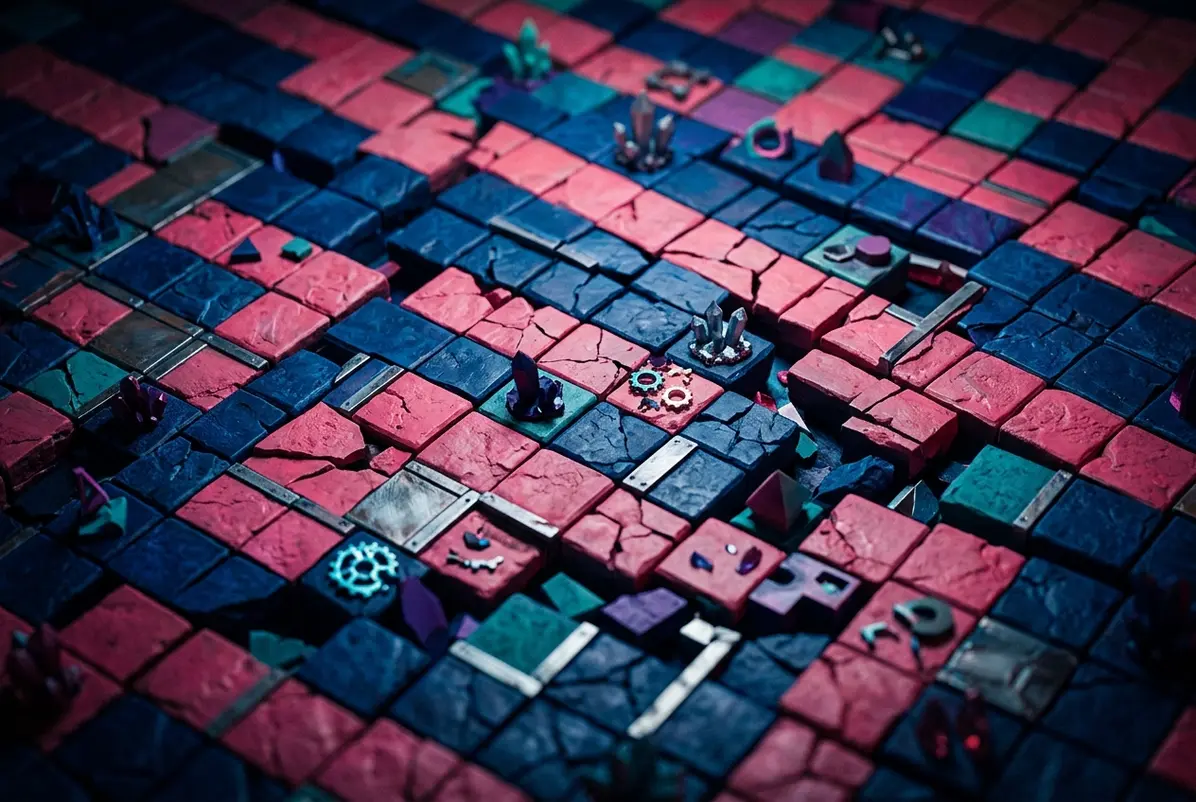
The old puzzle was about restoring order. Arranger is about making disorder legible enough to live inside.
The RPG Without the Usual Machinery
The cleanest thing about Arranger is how much it refuses. No XP ladder. No inventory screen. No loot treadmill. No elaborate skill tree pretending to be character growth. The Steam page lists a unique interconnected grid that unites movement, combat, and exploration, plus assist options so players “only get as stuck as” they want to be. That is a quiet but important promise. The game wants friction, not punishment.
That design choice makes its boss fights especially telling. On PlayStation Blog, Recabarren described the challenge of making boss encounters in a puzzle game “where you can’t die.” The bosses are not tests of reflex or attrition. They are larger puzzles with more story pressure. The threat is not death. The threat is misunderstanding the room.
That is a very different emotional contract from the traditional adventure game. Arranger is not asking whether the player is strong enough. It is asking whether the player can see the relationship between things. The sword matters, but only because its position matters. The monster matters, but only because its location can be solved. Even the immovable force known as static functions as an idea before it functions as an obstacle: stagnation made literal, fear turned into map geometry.
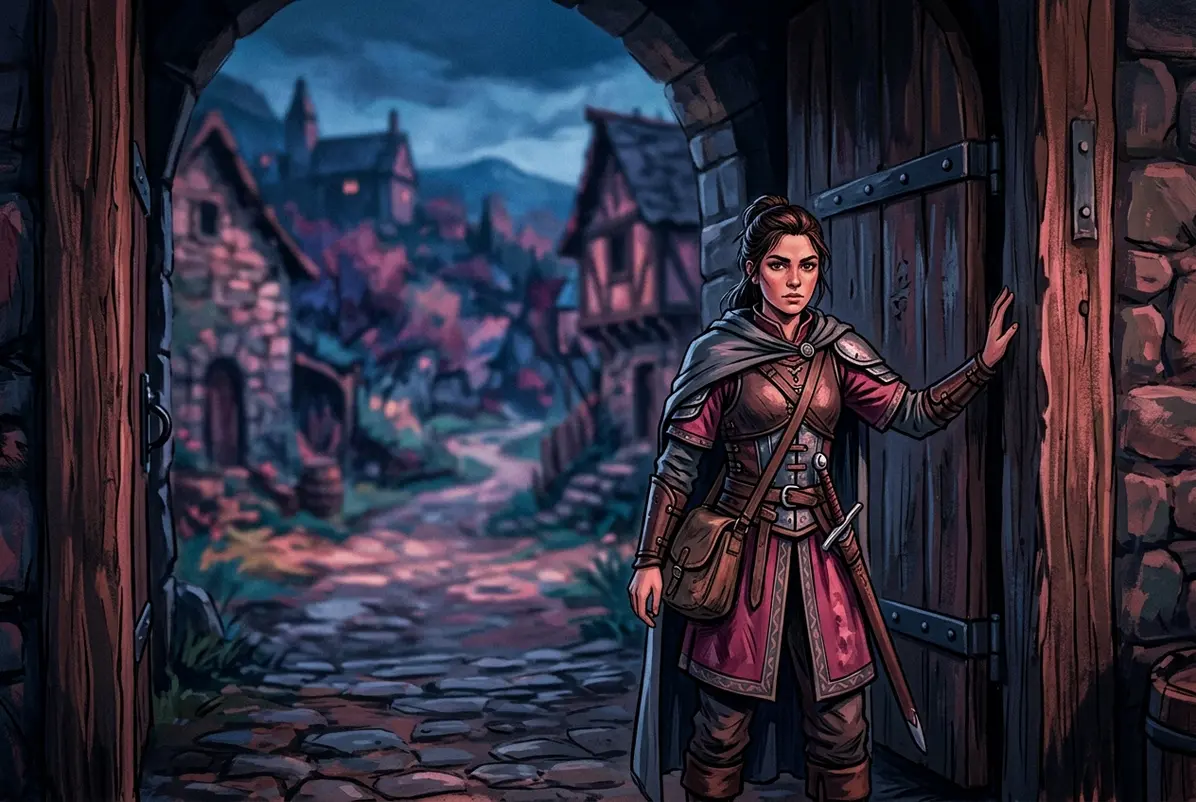
This is where the game’s misfit narrative stops being surface charm and becomes mechanical. Jemma’s difference is not expressed through cutscene speeches alone. It is expressed through the fact that she cannot enter a space without changing it. The world does not accommodate her quietly. It slides, bumps, wraps, resists, and rearranges. Her power is also her inconvenience.
The issue is not whether Arranger is “really” an RPG. The issue is whether RPG language can survive after the usual machinery has been stripped out. Arranger’s answer is yes, but only if role-playing means inhabiting a way of moving through the world, not managing a spreadsheet of improvement.
The Compactness Problem
Arranger was warmly received, though not without caveats. On Steam, it carries a “Very Positive” user rating and a displayed Metacritic score of 82, while the store page also highlights praise from EDGE, Eurogamer, and Kotaku. EDGE gave it a 9/10, and Eurogamer called it “compact and playful and ingenious” in the excerpt featured on Steam.
The praise makes sense. The game is bright, readable, clever, and unusually confident about its central idea. But the most interesting criticism is also fair: for some players, Arranger feels small enough that its ending arrives just as the system seems ready to deepen. That compactness can read as elegance or limitation depending on what someone wanted from it.
Reviews split around that tension. The Guardian described the game as pushing the sliding-block idea impressively far, while also arguing that its coming-of-age story feels more cerebral than emotionally rich. Nintendo World Report, in a more enthusiastic review, still noted the surprise of feeling the ending approach when the adventure seemed to be opening up. Those reactions are not contradictions. They identify the same pressure point.
Arranger is not underdesigned. It is tightly designed. But tight design creates its own hunger. The game keeps introducing new twists, then moving on before any single gimmick curdles into homework. That generosity is part of its charm. It is also why some players may leave wanting the larger, messier, more exhaustive version that Arranger pointedly refuses to become.
That restraint may be the hidden lesson Recabarren carried forward from ETHEREAL. In a Game Developer interview, he described ETHEREAL as a game built around a world with its own universal rules, something that made sense on its own terms rather than through inherited genre grammar. Arranger feels like the more approachable version of that philosophy. It is warmer, funnier, more legible, and more interested in people. But it still believes that a game’s world should be understood by touching its rules.
The Warmth Around the Machine
The danger with a game like Arranger is that it could have become a dry systems exercise: clever rooms, clean logic, no pulse. Furniture & Mattress avoids that by surrounding the grid with softness. Hellman’s painterly art gives the world a handmade looseness, and Batista’s music makes the spaces feel lived-in rather than solved. The grid may be rigid, but the presentation keeps it from feeling sterile.
There is a useful tension there. Arranger is mechanically strict and emotionally goofy. It is a game about constraint that presents itself as a ramble. It has the temperament of a bedtime story and the internal logic of a puzzle box. That combination is why the game’s small errands matter. Delivering objects, helping townspeople, pushing tools through impossible little corridors: these are not side activities. They are the way the world becomes social.
Thinky Games’ interview gets close to the heart of it when Suttner says the team wanted the art and story to give players reasons to keep moving, not just reasons to solve. Arranger understands that puzzle satisfaction can be cold if nothing in the world seems to care that the puzzle was solved. Its best moments make spatial clarity feel like social repair.
Jemma does not just arrange blocks. She rearranges conditions. She moves objects into usefulness, people out of stuckness, and communities away from static. The mechanic is not a metaphor pasted onto the game after the fact. The mechanic is the thing doing the emotional work.
The Awards, the Afterlife, and the Object
Arranger did not become the loudest indie game of 2024, but it quietly accumulated the kind of recognition that suggests the design landed. It won Best Game: Latin America at gamescom LATAM BIG Festival 2024, was nominated for Excellence in Game Design at BitSummit Drift, and won the top Best Game prize at the EVA Awards 2024, along with Best Audio and the press award.
The game’s platform story has also kept shifting. Arranger was originally available to mobile players through Netflix Games, but in March 2026 Furniture & Mattress released a standalone mobile version for iOS and Android. The App Store listing shows the non-Netflix version as a free download with a $9.99 full-game unlock, while COGconnected reported that the updated mobile release runs at 60 frames per second by default, compared with 30fps for the earlier Netflix version.
That standalone release matters because it makes Arranger less dependent on a subscription relationship. A game about finding a place to fit became, in a small but meaningful way, easier to place. It could live as a purchase, not just as a perk.
Then came the more charming reversal: the digital puzzle game became a physical object. Lost in Cult lists physical PS5 and Nintendo Switch editions of Arranger, along with a vinyl soundtrack release featuring Tomás Batista’s music. For a compact game built around grids, loops, and frictionless digital movement, the physical edition gives the whole thing a different afterlife. It turns the little adventure about rearranging space into something that can occupy space.

What Arranger Really Proves
Arranger’s lasting contribution is not that it invented a new genre label. “Role-puzzling” is cute, but the term is less important than the design discipline underneath it. The game proves that a single spatial mechanic, applied with enough confidence, can carry the emotional structure of an adventure without borrowing the usual RPG machinery.
That is harder than it sounds. Many games have one good trick. Fewer games understand how to turn that trick into grammar. Arranger does. It makes movement, combat, conversation, delivery, navigation, and character identity obey the same logic. Nothing feels bolted on because everything has to pass through the grid.
The result is not flawless. The story may feel too light for players who want the emotional force of its premise to fully detonate. The campaign may feel too compact for players who want the system to unfold into something grander. But those are problems of appetite, not confusion. Arranger knows what it is.
Recabarren’s design does something rare: it makes an old puzzle form feel socially alive. The sliding tile, one of games’ most ancient little annoyances, becomes a language for misfit movement, community repair, and the strange labor of making room for oneself. Jemma does not conquer the map. She disturbs it until it admits another arrangement is possible.
That is the real trick. In Arranger, the puzzle is not what blocks the path. The puzzle is the path refusing to stay still.
Frequently Asked Questions About Arranger and Nico Recabarren
What is Arranger: A Role-Puzzling Adventure?
Arranger: A Role-Puzzling Adventure is a 2024 puzzle-adventure game developed and published by Furniture & Mattress. It follows Jemma, a small-town misfit, across a grid-based world where movement, exploration, combat, and puzzles all use the same sliding-tile logic.
Who is Nico Recabarren?
Nicolás “Nico” Recabarren is the lead designer and programmer behind Arranger and a co-founder of Furniture & Mattress. Before Arranger, he co-created ETHEREAL with Tomás Batista; ETHEREAL won the Audience Award at the 2019 Independent Games Festival and was nominated for Excellence in Audio.
What platforms is Arranger available on?
Arranger launched on July 25, 2024, for Nintendo Switch, PlayStation 5, Steam and Epic Games Store for PC and Mac, and Netflix mobile on iOS and Android. A standalone non-Netflix mobile version later launched on iOS and Android with a free trial and a $9.99 full-game unlock.
How long does Arranger take to complete?
Furniture & Mattress’s press materials describe Arranger as taking roughly five to ten hours to complete. The exact time depends on how many optional challenges a player pursues and whether they use assist options to bypass puzzles.
Is Arranger actually an RPG?
Arranger borrows the structure and feeling of an RPG more than its traditional systems. It has towns, quests, characters, bosses, and a journey of self-discovery, but it does not use XP, inventory management, or skill trees. The “role-puzzling” label describes a puzzle game wearing the shape of an adventure RPG.
Did Arranger win any awards?
Yes. Arranger won Best Game: Latin America at gamescom LATAM BIG Festival 2024, won Best Game at the EVA Awards 2024, and was nominated for Excellence in Game Design at BitSummit Drift 2024.


'%3e%3cg id='Final-Copy-2_2_' transform='translate(1275.000000, 200.000000)'%3e%3cpath class='st0' d='M7.4,12.8h6.8l3.1-11.6H7.4C4.2,1.2,1.6,3.8,1.6,7S4.2,12.8,7.4,12.8z'/%3e%3c/g%3e%3c/g%3e%3c/g%3e%3cg id='final---dec.11-2020'%3e%3cg id='_x30_208-our-toggle' transform='translate(-1275.000000, -200.000000)'%3e%3cg id='Final-Copy-2' transform='translate(1275.000000, 200.000000)'%3e%3cpath class='st1' d='M22.6,0H7.4c-3.9,0-7,3.1-7,7s3.1,7,7,7h15.2c3.9,0,7-3.1,7-7S26.4,0,22.6,0z M1.6,7c0-3.2,2.6-5.8,5.8-5.8 h9.9l-3.1,11.6H7.4C4.2,12.8,1.6,10.2,1.6,7z'/%3e%3cpath id='x' class='st2' d='M24.6,4c0.2,0.2,0.2,0.6,0,0.8l0,0L22.5,7l2.2,2.2c0.2,0.2,0.2,0.6,0,0.8c-0.2,0.2-0.6,0.2-0.8,0 l0,0l-2.2-2.2L19.5,10c-0.2,0.2-0.6,0.2-0.8,0c-0.2-0.2-0.2-0.6,0-0.8l0,0L20.8,7l-2.2-2.2c-0.2-0.2-0.2-0.6,0-0.8 c0.2-0.2,0.6-0.2,0.8,0l0,0l2.2,2.2L23.8,4C24,3.8,24.4,3.8,24.6,4z'/%3e%3cpath id='y' class='st3' d='M12.7,4.1c0.2,0.2,0.3,0.6,0.1,0.8l0,0L8.6,9.8C8.5,9.9,8.4,10,8.3,10c-0.2,0.1-0.5,0.1-0.7-0.1l0,0 L5.4,7.7c-0.2-0.2-0.2-0.6,0-0.8c0.2-0.2,0.6-0.2,0.8,0l0,0L8,8.6l3.8-4.5C12,3.9,12.4,3.9,12.7,4.1z'/%3e%3c/g%3e%3c/g%3e%3c/g%3e%3c/g%3e%3c/svg%3e) Your Privacy Choices
Your Privacy Choices