


Side A. Baraboo, Wisconsin, sometime in 1996. A seven-year-old kid sits in a tiny theater watching Batman Forever with her dad and her uncle Chaz. The neon is ridiculous. Nicole Kidman is radiant. Something fundamental shifts. Batman Forever was the first PG-13 movie Vera Drew saw in theaters, and it was one of the early moments where she realized she was trans. She didn’t have the language for it at the time. She wouldn’t for years. But the image stuck: a Schumacher frame so saturated it practically hummed, a woman onscreen who felt like a mirror (as Drew later discussed in a Letterboxd interview).
Vera Drew was born in 1989, raised in the south suburbs of Chicago. She studied improv as a teenager through a Second City youth program. By 2019 she’d been working in TV for years as an editor and producer, having done “so many cool things” without really telling her own story “in any big, creative way.” That restlessness would soon produce one of the most debated independent films of the decade.
The Editing Bay as Film School
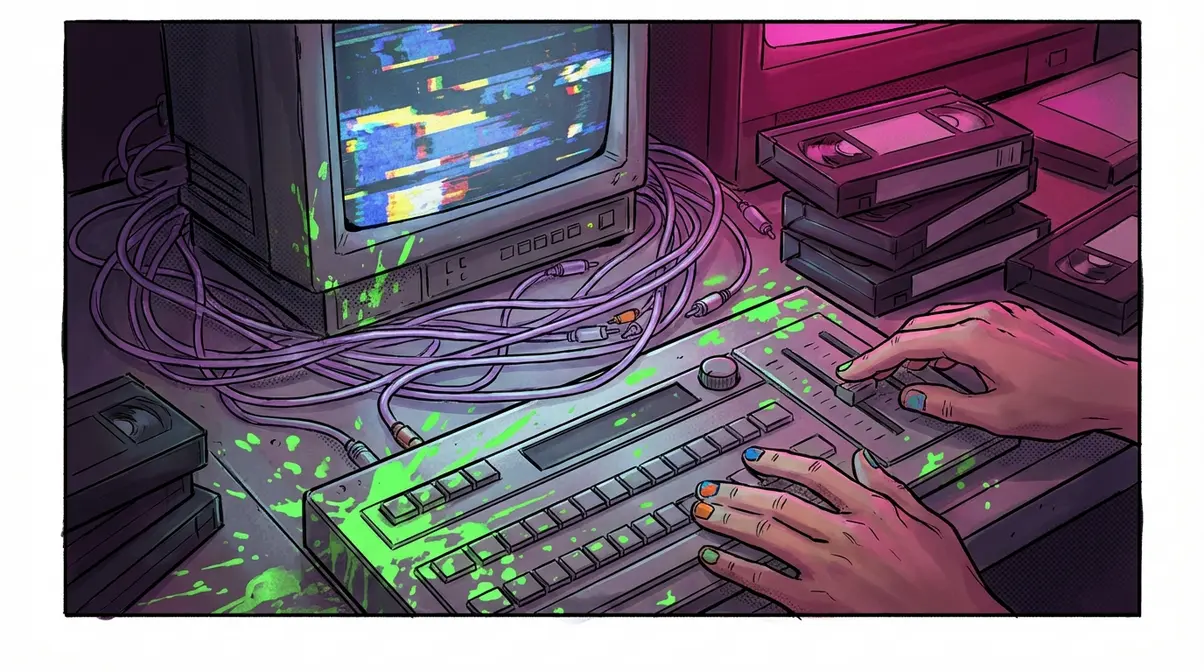
Before she ever directed a frame, Drew was one of the sharpest editors in alt-comedy. She edited a number of Adult Swim shows, honing her instincts at Tim Heidecker and Eric Wareheim’s production company Abso Lutely Productions. Her credits read like a syllabus for anyone who cares about comedy craft: Check It Out With Dr. Steve Brule, The Birthday Boys, I Think You Should Leave, Comedy Bang! Bang!, and On Cinema. She was also an editor and executive producer on Tim and Eric’s Beef House (see IMDb).
In 2019, she earned an Emmy nomination for Outstanding Picture Editing for Variety Programming for her work on Sacha Baron Cohen’s Who Is America? (per the Television Academy). The gig came through director Dan Longino, a fellow traveler from the Tim and Eric orbit. Drew has talked about what she learned from Baron Cohen, and what she needed to unlearn. She told Letterboxd that Baron Cohen would tell her, “You have too many jokes happening at once.” She found it maddening. She stored it away.
Drew came out as a trans woman while still at Abso Lutely. That experience crystallized something. She told Letterboxd it “made me realize that I need to [make my movie] no matter what.”
The Movie That Shouldn’t Exist
In late 2019, co-writer Bri LeRose encouraged Drew to re-edit the film Joker. While working on the re-edit, Drew began to think about how the characters reflected her own life, stating “I knew I needed to do some sort of big creative project around gender, comedy, and mom issues” (as she later told The Film Stage). LeRose had sent Drew twelve dollars over Venmo to commission the gag. But soon it got serious. Drew reached out to LeRose to co-write, and The People’s Joker was born.
The production that followed was genuinely unprecedented. Drew never really had a budget or a roadmap. She crowdsourced both the budget and the artwork; more than 100 artists provided backdrops and character animation for the film. They raised just shy of $25,000 through crowdfunding. Live-action sequences were captured over five days, nearly all performances shot in front of green screens (details discussed in The Film Stage). They had someone who makes low-poly models that look like old PlayStation games, so they used that for the Batcave and Batmobile. The aesthetic wasn’t just artistic. It was born of constraint and collaboration, shaped by whoever showed up.
Drew told The Film Stage that she wanted to “invent new colors” with the movie, the way Schumacher invented new colors in his films. That was a big influence: “I wanted to invent new colors with this movie, because I feel like he invents new colors in his films.” The result is a 95-minute hallucination that moves through 2D animation, 3D rendering, stop-motion, and green-screened live action like someone flipping channels on a television that only receives transmissions from a better universe.
The Letter, the Hashtag, the Limbo
Here’s where the story splits into two camps, and this is the debate worth having.
The film premiered on September 13, 2022, at the Toronto International Film Festival, programmed in the Midnight Madness section (TIFF). The next day, Warner Bros. objected to her use of the media giant’s intellectual property. Drew has been precise about what actually happened: “We never got an official cease and desist, it was misreported. What I did get was a strongly worded letter, an email basically, from Warner Bros.’ legal department” (as clarified in interviews summarized by IndieWire). The hashtag #FreeThePeoplesJoker trended on Twitter. On September 21, Drew pulled the film from other film festivals where it had been slated to screen (reported by Variety).
On one side: Warner Bros. Discovery, which never publicly commented or filed a lawsuit, but whose legal team argued the film reproduced protected character likenesses, names, and trademarks without authorization. They had a point, technically. These are registered trademarks. The Joker was introduced in 1940, and if copyright hadn’t been extended far beyond its initial intent, he’d have long since entered the public domain. But the law is the law as it currently stands, and Warner Bros. was within its rights to object.
On the other side: Drew and her team, who had worked with lawyers from the very start. They combed through every element of the film, identifying how each aspect could be characterized as parody and fair use. Drew’s legal guidance was clear: “it needs to be very autobiographical. It needs to be 100% my life, but told using these characters.” The clearest pathway was making all the art entirely original, remixing the trademarks rather than reproducing them, bringing her own perspective and commentary to every character design.
I’ll take my editorial position here: the film is obviously transformative. It is not a bootleg. It is not a knockoff. It is a woman telling her own story through characters that have become, whether Warner Bros. likes it or not, a kind of modern mythology. Drew herself has argued that “myth belongs to the people” and that the purpose of myth is to learn about the human experience. Katie Rife of Polygon put it best, calling it “a blasphemous Molotov cocktail of a movie.” The fact that a $30,000 green-screen film made by 200 queer artists could rattle one of the largest media conglomerates on Earth tells you everything about who actually understands these characters and who merely owns them.
The Triumph
The first American showing occurred at the 2023 Outfest film festival in Los Angeles on July 15, 2023 (Outfest). The People’s Joker was released theatrically in the United States on April 5, 2024, advertised as “A Fair Use Film by Vera Drew.” Distributor Altered Innocence later released it on VOD platforms and on Blu-ray, DVD, and VHS (official site). Yes, VHS. Of course VHS.
On Rotten Tomatoes, 96% of 115 critics’ reviews are positive, with an average rating of 8.0/10. Richard Brody of The New Yorker wrote that it has “more energy, audacity, originality, and righteous rage than most of this spring’s festival-honored art-house-auteur films.” Drew won Breakthrough Director at the 34th Gotham Awards. The film was nominated for the John Cassavetes Award at the 40th Independent Spirit Awards.
Trans People Deserve to Be Villains Too
The most charged conversation around the film isn’t legal. It’s representational. Drew made a deliberate choice: her protagonist is not a role model. She’s a drug addict. She literally betrays her friends. Drew wanted to portray a trans person “finally, as a human and as somebody with both the beautiful parts and the ugly parts.”
This is the argument that matters most, and it’s the one that splits even sympathetic audiences. Some feel that in a political climate this hostile to trans people, making a trans villain is reckless. Others, and I count myself among them, believe that sanitized representation is its own kind of cage. Drew told IndieWire that “part of the reaction we’re seeing from people who just outright hate queer people comes from them getting this distilled corporate version of it, where it’s ‘queer people are just like us’ and we’re not. Everybody’s different” (IndieWire).
She wanted the film to be “very irreverent and rude, because I feel like that kind of comedy has really been stolen by the wrong kind of people. That kind of comedy has its earliest roots in queer cinema like John Waters.” She’s right. Transgression was queer before it was a brand. Drew is simply taking it back.
Side B. What Comes Next
Drew’s next project is called Dead Name, about a trans woman who goes home for the first time since coming out and, through sex magic mishaps, conjures her pre-transition doppelganger. There will be weird visual effects, monsters, and bonkers shit. And they’re her characters, so she won’t get sued. She’s also talked about her dream Hellraiser project: a movie about Butterball, her favorite cenobite, going to a theme park one day. “He’s the best cenobite.”
She recently edited and handled VFX for Alice Maio Mackay’s holiday horror slasher Carnage for Christmas. The hands stay busy. The instincts stay sharp.
What Drew has built is not a career so much as a proof of concept. She proved that a trans woman from Chicago’s south suburbs, armed with editing-bay discipline, a $12 Venmo payment, and an unshakable love for Joel Schumacher’s neon, could hijack the most recognizable villain in American pop culture and turn him into her. She proved that fair use is not just a legal doctrine but an artistic philosophy. She proved that the people’s myth belongs to the people.
The film is available from Altered Innocence on Blu-ray, DVD, VHS, and streaming. You should own it on at least two of those formats. Put the VHS on the shelf where visitors can see it. Let it start a conversation.

'%3e%3cg id='Final-Copy-2_2_' transform='translate(1275.000000, 200.000000)'%3e%3cpath class='st0' d='M7.4,12.8h6.8l3.1-11.6H7.4C4.2,1.2,1.6,3.8,1.6,7S4.2,12.8,7.4,12.8z'/%3e%3c/g%3e%3c/g%3e%3c/g%3e%3cg id='final---dec.11-2020'%3e%3cg id='_x30_208-our-toggle' transform='translate(-1275.000000, -200.000000)'%3e%3cg id='Final-Copy-2' transform='translate(1275.000000, 200.000000)'%3e%3cpath class='st1' d='M22.6,0H7.4c-3.9,0-7,3.1-7,7s3.1,7,7,7h15.2c3.9,0,7-3.1,7-7S26.4,0,22.6,0z M1.6,7c0-3.2,2.6-5.8,5.8-5.8 h9.9l-3.1,11.6H7.4C4.2,12.8,1.6,10.2,1.6,7z'/%3e%3cpath id='x' class='st2' d='M24.6,4c0.2,0.2,0.2,0.6,0,0.8l0,0L22.5,7l2.2,2.2c0.2,0.2,0.2,0.6,0,0.8c-0.2,0.2-0.6,0.2-0.8,0 l0,0l-2.2-2.2L19.5,10c-0.2,0.2-0.6,0.2-0.8,0c-0.2-0.2-0.2-0.6,0-0.8l0,0L20.8,7l-2.2-2.2c-0.2-0.2-0.2-0.6,0-0.8 c0.2-0.2,0.6-0.2,0.8,0l0,0l2.2,2.2L23.8,4C24,3.8,24.4,3.8,24.6,4z'/%3e%3cpath id='y' class='st3' d='M12.7,4.1c0.2,0.2,0.3,0.6,0.1,0.8l0,0L8.6,9.8C8.5,9.9,8.4,10,8.3,10c-0.2,0.1-0.5,0.1-0.7-0.1l0,0 L5.4,7.7c-0.2-0.2-0.2-0.6,0-0.8c0.2-0.2,0.6-0.2,0.8,0l0,0L8,8.6l3.8-4.5C12,3.9,12.4,3.9,12.7,4.1z'/%3e%3c/g%3e%3c/g%3e%3c/g%3e%3c/g%3e%3c/svg%3e) Your Privacy Choices
Your Privacy Choices