


The Illustrator Who Wouldn’t Render
There’s a version of Hades II that doesn’t exist. One where every god and monster was modeled in a standard 3D pipeline, lit with global illumination, and shipped looking like everything else on the shelf. That version would have been fine. It also would have been forgettable. What Supergiant Games shipped instead is something stranger and more alive, and the reason traces back to a single person’s refusal to let the illustration die on the way to the screen.
Jen Zee is an American artist and the art director for Supergiant Games, having joined the studio in March 2010 as a contractor on Bastion before quickly being brought on as the full-time art director. Since then, she has been the visual signature on every game the studio has released. Zee has defined the studio’s visual style since its first release, Bastion, hit the shelves in 2011, and her distinctive character designs for Hades have been central to its success. To me, her career reads like a masterclass in creative stubbornness: the insistence that hand-painted 2D illustration should lead the process, not be subordinated to it.
Zee was inspired to become an artist by Tetsuya Nomura’s character art for Final Fantasy VII at an early age. That detail matters. Nomura’s ink-and-watercolor portraits for FF7 were never meant to be the game itself; they were the key art that sold you on the world before the polygons loaded. Zee took that inspiration and built a career on closing the gap between concept and final product. In her hands, the illustration isn’t promotional material. It is the game.
From Pen and Ink to Living Screen
Before moving to work at Supergiant Games, Zee worked for Gaia Online in her first job and made isometric environmental designs. It was a humble start, but the isometric perspective turned out to be excellent training for what came next. After seeing Zee’s work where she drew “The Bastion” for the game, the two co-founders at Supergiant immediately asked her to join the project full time. Zee later called it “serendipitous” as she was considering a career change, and her artwork for Bastion often went straight into the game. That directness, concept art appearing in the final build without being filtered through a conventional rendering pipeline, became a defining trait of Supergiant’s visual identity.
The process evolved game by game. Zee described her work on Transistor as a love-letter to William Waterhouse, Gustav Klimt and other classical work, while intentionally eschewing Cyberpunk aesthetics despite the game’s futuristic setting. For Hades, at the inception of the project, the team thought the art style would be painterly, but they ended up pivoting to pen and ink when the narrative and tone changed drastically during preproduction. Zee said she was inspired by the work of comics artist Mike Mignola and Fred Taylor, a 19th-century poster artist. It feels like the kind of pivot that only works when the art director has enough conviction, and enough institutional trust, to change direction mid-flight.
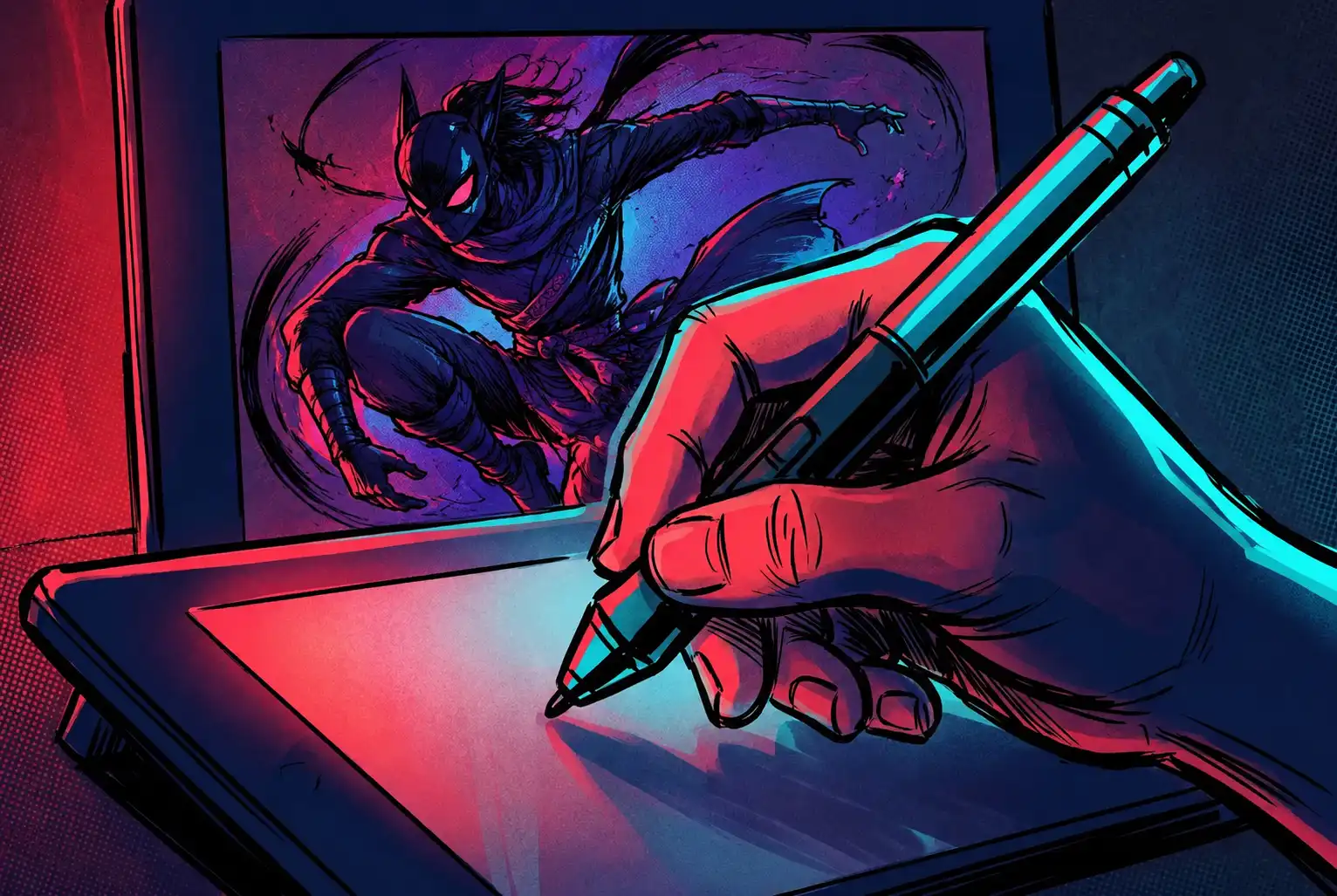
What strikes me about the Hades art pipeline is how deliberately it resists the path of least resistance. According to a Supergiant developer, the first Hades didn’t use real-time 3D rendering; during development, they 3D-rendered and animated many characters like Zagreus, then generated thousands upon thousands of frames of rendered animation from many different angles, which is what players ended up seeing in the game. Most of the environment art was hand-painted 2D artwork, and character portraits were all hand-painted 2D. The result was a game that felt like a moving illustration rather than a rendered scene.
The Hades II Leap
Hades II’s full version was released for Nintendo Switch, Nintendo Switch 2, and Windows on September 25, 2025 , with PlayStation 5 and Xbox Series X/S versions following in April 2026. The sequel marked a significant technical shift. Supergiant describes its approach as “rich, atmospheric presentation and storytelling fused with responsive action,” with “vivid new hand-painted environments, even smoother real-time 3D characters.” That phrase, “real-time 3D characters,” is new for the studio. In the first Hades, characters were pre-rendered sprite sheets. In the sequel, developed by a small team of fewer than 30 people , the characters now run as actual 3D models in the engine.
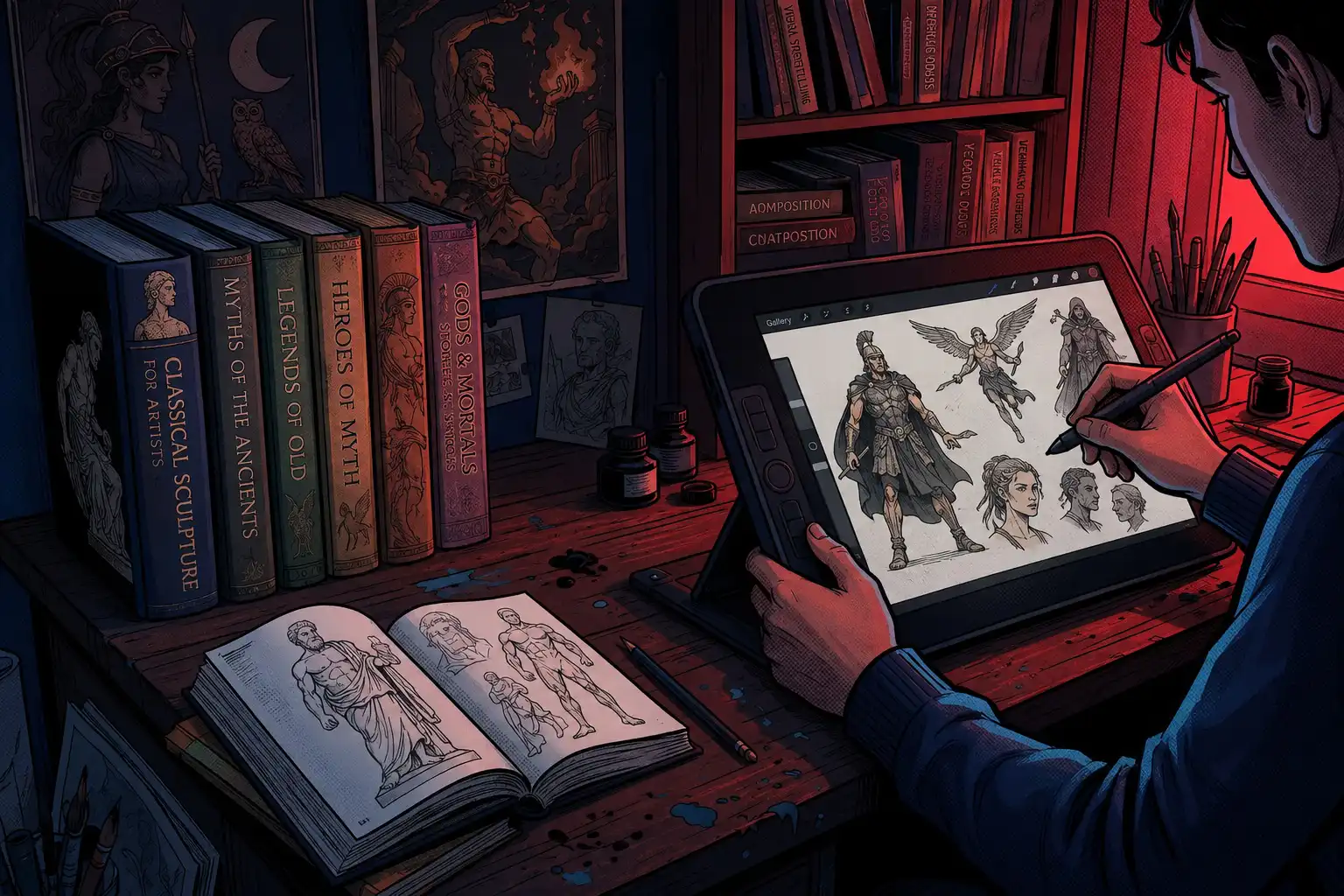
But here’s what matters: the 3D models still serve the 2D illustration, not the other way around. In the first game, 3D artist Paige Carter would put Zee’s portrait art behind her ZBrush file while working, using the sculpting tool’s “see-through” function to compare the facial features of both the 2D artwork and 3D model in close detail, transporting all the nuance and personality of the 2D model into her 3D sculpture. After establishing base colors, Carter would “hand paint all of the black linework to try and match the 2D look of the character as much as possible.” In my view, this is the key to the whole operation. The 3D geometry exists to carry the illustration, like a frame exists to carry a painting. The painting is still the point.
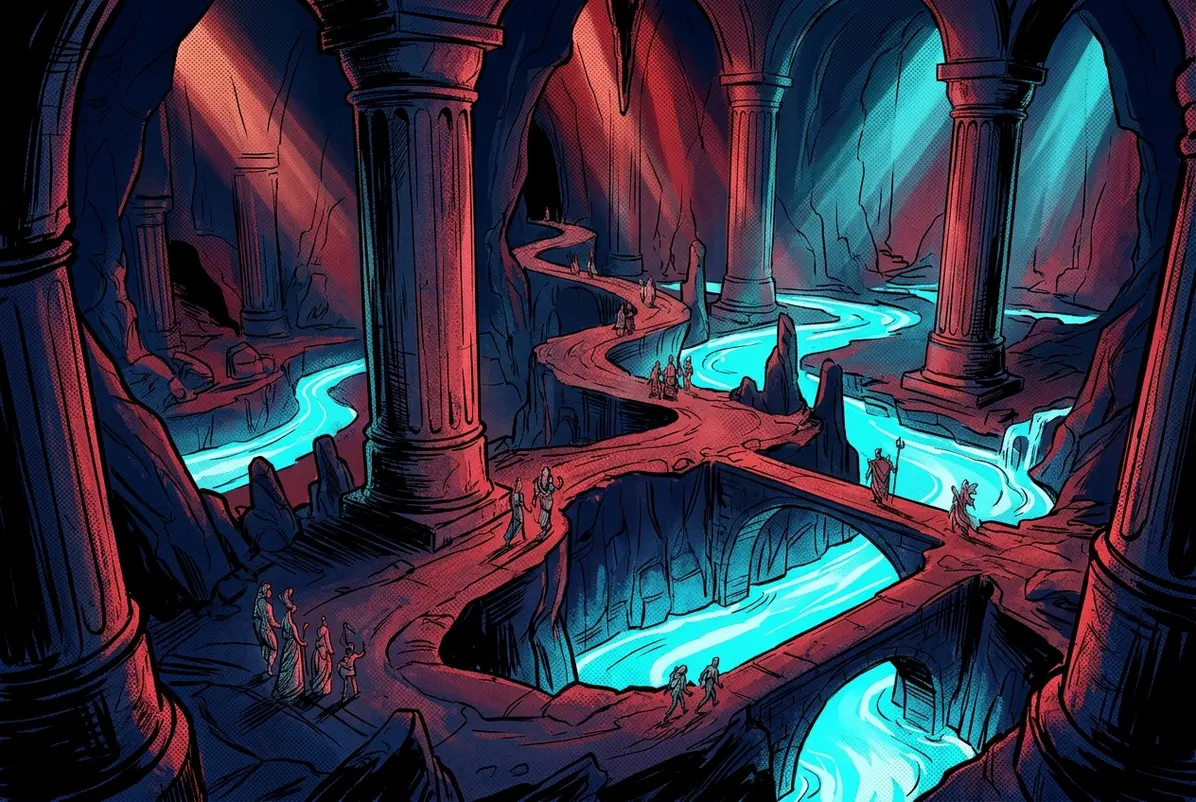
Fan communities have noticed. Online discussions about Hades II’s visual approach regularly circle back to the same observation: the game looks like nothing else in the action-roguelike space. Players talk about pausing the game just to study the character portraits, about how the environments feel painted rather than assembled. There’s a case to be made that this is exactly what happens when you let an illustrator lead a game’s visual identity from start to finish, rather than handing concept art to a 3D team and hoping the essence survives the translation.
The Scale of Craft
Consider the numbers from the first game alone. Supergiant shipped 59 portraits, 68 models, 194 boon icons, 1,400 environment textures, 32,494 FX animation frames, and 942,489 character and enemy animation frames. That is a staggering volume of hand-touched assets from a core art team of just six people: Zee handling characters, environments, and concept; Josh Barnett on FX art, UI design, and animations; Joanne Tran on environments; Paige Carter on 3D models; Thinh Ngo as animator; and Camilo Vanegas on animation and models. Zee noted that pen and ink goes much faster than painterly work, and she knew they were going to make the biggest game Supergiant had ever produced, so the style she was personally curious about aligned with their experiential and technical goals.
My take is that this is what separates a genuine art direction from a style guide. Zee didn’t just pick a look and hand it off. She found a visual language that was both personally meaningful and production-viable, then executed it at massive scale. The pen-and-ink approach wasn’t a compromise. It was a solution that happened to also be beautiful.
Zee received the 2020 BAFTA Games Award for Artistic Achievement for the work of her and her art team. Hades II became the best-reviewed game of 2025 according to Metacritic and OpenCritic , carrying a 96% positive rating from over 63,000 user reviews on Steam. Game designer Greg Kasavin said that the reason the characters in the game were so attractive was “Because Jen Zee” and credited Zee’s respect for the classical tradition as being key to honoring the source material.
Why It Matters Now
The games industry loves to talk about visual fidelity as a function of polygon counts and ray tracing. Hades II pushes back against that assumption without ever making a fuss about it. As Zee told MCV/Develop, “We value artistic integrity and excellence in artistic craft at Supergiant, however we’re first and foremost a game design-led team.” That framing lands as both humble and quietly radical. The art isn’t decoration. It isn’t a tech demo. It’s in service of the game, and the game is better because the art was never asked to be anything other than illustration.
Reasonable people might disagree, but I think Jen Zee’s body of work at Supergiant Games represents one of the strongest arguments in modern gaming for letting a single artistic vision run unbroken from first sketch to final frame. Zee and creative director Greg Kasavin have developed a process that provides just enough creative boundaries to make appealing characters that fit the story, constantly referring to the original, oldest myths they can find. Five games. Fifteen years. One throughline: the illustration is the game, and the game is the illustration.
That’s not nostalgia for 2D. It’s a philosophy. And as Zee herself put it, the work comes from the heart. You can see it in every frame.
'%3e%3cg id='Final-Copy-2_2_' transform='translate(1275.000000, 200.000000)'%3e%3cpath class='st0' d='M7.4,12.8h6.8l3.1-11.6H7.4C4.2,1.2,1.6,3.8,1.6,7S4.2,12.8,7.4,12.8z'/%3e%3c/g%3e%3c/g%3e%3c/g%3e%3cg id='final---dec.11-2020'%3e%3cg id='_x30_208-our-toggle' transform='translate(-1275.000000, -200.000000)'%3e%3cg id='Final-Copy-2' transform='translate(1275.000000, 200.000000)'%3e%3cpath class='st1' d='M22.6,0H7.4c-3.9,0-7,3.1-7,7s3.1,7,7,7h15.2c3.9,0,7-3.1,7-7S26.4,0,22.6,0z M1.6,7c0-3.2,2.6-5.8,5.8-5.8 h9.9l-3.1,11.6H7.4C4.2,12.8,1.6,10.2,1.6,7z'/%3e%3cpath id='x' class='st2' d='M24.6,4c0.2,0.2,0.2,0.6,0,0.8l0,0L22.5,7l2.2,2.2c0.2,0.2,0.2,0.6,0,0.8c-0.2,0.2-0.6,0.2-0.8,0 l0,0l-2.2-2.2L19.5,10c-0.2,0.2-0.6,0.2-0.8,0c-0.2-0.2-0.2-0.6,0-0.8l0,0L20.8,7l-2.2-2.2c-0.2-0.2-0.2-0.6,0-0.8 c0.2-0.2,0.6-0.2,0.8,0l0,0l2.2,2.2L23.8,4C24,3.8,24.4,3.8,24.6,4z'/%3e%3cpath id='y' class='st3' d='M12.7,4.1c0.2,0.2,0.3,0.6,0.1,0.8l0,0L8.6,9.8C8.5,9.9,8.4,10,8.3,10c-0.2,0.1-0.5,0.1-0.7-0.1l0,0 L5.4,7.7c-0.2-0.2-0.2-0.6,0-0.8c0.2-0.2,0.6-0.2,0.8,0l0,0L8,8.6l3.8-4.5C12,3.9,12.4,3.9,12.7,4.1z'/%3e%3c/g%3e%3c/g%3e%3c/g%3e%3c/g%3e%3c/svg%3e) Your Privacy Choices
Your Privacy Choices