




Marjane Satrapi (November 22, 1969 – June 4, 2026) was a French-Iranian graphic novelist, film director, painter, and activist. Born in Rasht, Iran, she became internationally known for Persepolis, the autobiographical graphic memoir that transformed her childhood under the Islamic Republic into one of the most widely read works in modern comics. Her body of work also included Embroideries, Chicken with Plums, the collaborative anthology Woman, Life, Freedom, and films including Persepolis, The Voices, Radioactive, and Dear Paris.
Marjane Satrapi’s Early Life and the Road Out of Tehran
Satrapi was born in Rasht, Iran, in 1969 and grew up in Tehran. An only child, she was raised by politically engaged parents in a family shaped by both aristocratic memory and leftist conviction. According to Satrapi, her maternal great-grandfather was Naser al-Din Shah Qajar, the shah of Iran from 1848 to 1896. That lineage did not make the family loyal to monarchy. Her parents opposed the Shah and supported progressive political causes.
Her childhood unfolded inside the turbulence of the Iranian Revolution and the repression that followed. Family members and friends were persecuted, imprisoned, and killed. One of the central figures in her life was her uncle Anoosh, a political prisoner and former exile in the Soviet Union who became a hero to the young Satrapi. After his return to Iran, he was arrested again and executed. In Persepolis, his death becomes one of the book’s defining wounds: a child’s first intimate encounter with the machinery of the state.
By 1984, as life in Iran grew increasingly dangerous for a rebellious teenage girl from a politically marked family, her parents sent her to Austria to continue her education. The Vienna years were punishing. Satrapi later described isolation, a failed relationship, homelessness, and drug use before returning to Tehran at 19. Back in Iran, she studied art, married briefly, divorced, and eventually left again for Europe.
In the 1990s, Satrapi moved to France and entered the world of French comics. She studied in Strasbourg before settling in Paris, where she joined l’Atelier des Vosges, an underground group of new wave comic artists. Around that circle, she began telling stories of her childhood in Iran and her years in Vienna. Those stories would become Persepolis.
Persepolis and Marjane Satrapi’s Breakthrough in Comics
Encouraged by fellow artists, Satrapi began drawing her memoir in 1999. French comics publisher L’Association released Persepolis in four volumes between 2000 and 2003. The title refers to the ancient capital of the Persian Empire, a name that quietly frames the book’s modern political violence against a much longer Iranian history.
Pantheon Books published the English-language editions in North America, with Persepolis: The Story of a Childhood appearing in 2003 and Persepolis 2: The Story of a Return following in 2004. The book became an international landmark, selling more than two million copies worldwide and becoming widely taught in schools and universities. Penguin Random House Speakers Bureau describes Persepolis as having sold over two million copies worldwide.
The force of Persepolis lies in its refusal to flatten life under authoritarianism into a single mood. The book moves between childhood comedy, political terror, family intimacy, exile, grief, and adolescent rebellion without treating any of those registers as contradictions. Satrapi’s black-and-white style made the story feel both personal and iconic: a child’s face, a veil, a cigarette, a bomb, a party, a prison. Everything reduced to the minimum number of lines necessary to make it unforgettable.
Satrapi preferred the term “comic book” to “graphic novel,” partly because she disliked the cultural embarrassment that surrounded comics as a form. That refusal mattered. She did not need comics to be renamed in order to be serious. She proved they were already capable of carrying history, politics, witness, and autobiography.
Her later books expanded that range. Embroideries gathered intimate stories from women in her family about love, marriage, sex, and disappointment in Iran. Chicken with Plums, which won the Angoulême Album of the Year award, told the tragicomic story of a musician who decides to die after losing the instrument that gave his life meaning. Across those works, Satrapi kept returning to the same territory: private lives under public pressure, people making jokes in the shadow of grief, and bodies trying to remain free inside systems designed to contain them.
Marjane Satrapi’s Film Career and the Animated Persepolis
The animated adaptation of Persepolis, co-written and co-directed by Satrapi and Vincent Paronnaud, premiered at the 2007 Cannes Film Festival, where it shared the Jury Prize with Carlos Reygadas’s Silent Light. The film preserved the graphic clarity of the book while giving Satrapi’s memories movement, voice, and music. The French-language version featured Chiara Mastroianni, Catherine Deneuve, and Danielle Darrieux; the English-language version included Gena Rowlands, Sean Penn, and Iggy Pop.
Persepolis was nominated for Best Animated Feature at the 80th Academy Awards. The Academy Museum notes that Satrapi became the first woman in Oscar history to receive a nomination in the Animated Feature Film category, alongside co-director Vincent Paronnaud. The distinction remains a major landmark in animation history.
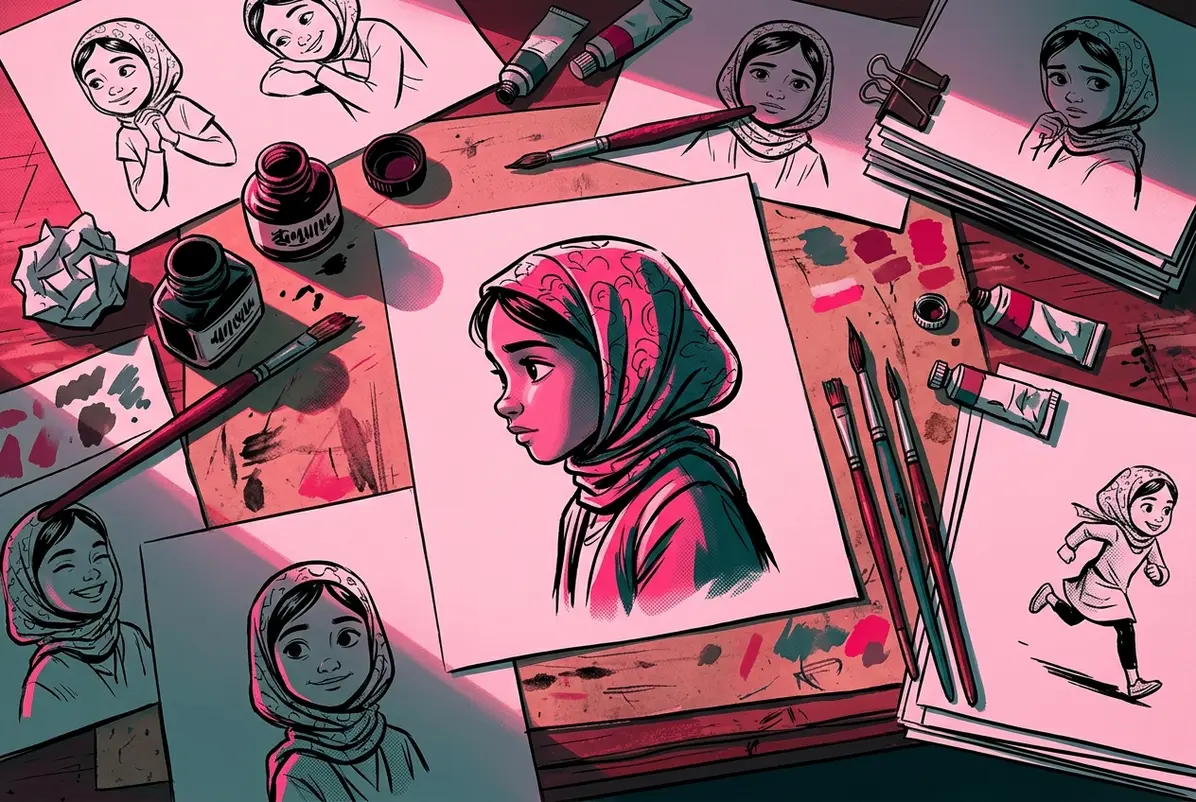
The Iranian government denounced the film, and its festival presence became politically charged. That response only underlined the central fact of Satrapi’s career: her art made private memory publicly dangerous. Persepolis was not propaganda. It was worse, from the point of view of authoritarian power. It was a person remembering clearly.
Satrapi’s film career continued beyond animation. She directed the crime comedy La bande des Jotas in 2012, the horror-comedy The Voices in 2014, and the Marie Curie biopic Radioactive in 2019. Radioactive, starring Rosamund Pike, was written by Jack Thorne and adapted from Lauren Redniss’s graphic biography of Curie. Satrapi’s later film Dear Paris (Paradis Paris), starring Monica Bellucci, premiered at the Torino Film Festival in 2024.
Marjane Satrapi’s Activism and the Woman, Life, Freedom Anthology
Satrapi never treated art and politics as separate territories. Throughout her life, she remained an outspoken critic of the Iranian government and a defender of women’s rights, freedom of expression, and secular democracy. Her work was rooted in Iran, but it was never reducible to nationalism. It was animated by the larger question of what people are allowed to remember, say, draw, wear, and become.
Following the protests that erupted after the 2022 death of Mahsa Amini in police custody, Satrapi helped create Woman, Life, Freedom, a collaborative anthology of comics and graphic reportage about the uprising and its historical context. Seven Stories Press describes the book as a collaboration among artists, activists, journalists, and academics depicting the movement in solidarity with the Iranian people and in defense of feminism. The English-language edition was published by Seven Stories Press on March 19, 2024.
In 2024, Satrapi received the Princess of Asturias Award for Communication and Humanities. The jury described her as “an essential voice in the defence of human rights and freedom.” That same year, she was elected to the French Academy of Fine Arts.
In January 2025, Satrapi refused France’s Légion d’honneur, criticizing what she described as France’s lack of solidarity with Iranians, especially women and young people, as well as French citizens held hostage in Iran. ArtReview reported that she emphasized the refusal was not an act against France, a country she said she deeply loved. Her refusal was consistent with a career built around refusing symbolic comfort when the political reality underneath remained unresolved.
Marjane Satrapi’s Censorship Battles and Persepolis in American Schools
Persepolis also became a recurring target in American school censorship fights. In March 2013, Chicago Public Schools instructed schools to remove the book from seventh-grade classrooms, with CPS CEO Barbara Byrd-Bennett citing graphic language and images as inappropriate for that grade level. Publishers Weekly reported that Byrd-Bennett ordered principals to pull copies from seventh-grade classrooms while the district reviewed how the book should be taught.
The decision triggered protest from students, teachers, librarians, and free-speech advocates. At Lane Tech High School, students demonstrated after the book was pulled from classrooms. The controversy turned Persepolis into exactly the kind of object censorship often creates: a book more urgent because someone tried to make it disappear.
In 2014, Persepolis was listed as the second most challenged book in the United States by the American Library Association. TIME reported that the ALA’s 2014 list identified Persepolis as the No. 2 most challenged book that year, citing objections including offensive language, political viewpoint, and graphic depictions.
The irony was impossible to miss. A book about growing up under repression became controversial in American classrooms because it showed repression too plainly. Satrapi’s work had entered the canon, but it had not become harmless. That was part of its power.
Marjane Satrapi’s Death and Legacy
Marjane Satrapi died in Paris on June 4, 2026, at age 56. Her family said in a statement that she had “died of sadness” a little over a year after the death of her husband, Mattias Ripa, a Swedish producer, actor, and screenwriter who died on April 8, 2025. The Guardian and other outlets reported the family statement following her death.
After Ripa’s death, Satrapi founded the Mattias and Marjane Ripa-Satrapi Cinema Foundation at the Académie des Beaux-Arts in Paris to support foreign students studying film in the city. Following Satrapi’s death, the French presidency called her a leading figure of French culture and described her as an artist devoted to freedom whose work carried a universal message.
Satrapi’s legacy is not only that she made comics respectable to readers who had underestimated the form. It is that she showed what comics could do without asking permission from literature, cinema, or politics. She drew history at the scale of a child. She made exile funny, grief legible, authoritarianism absurd, and memory impossible to confiscate.
Persepolis endures because it refuses the easy version of every story it tells. Iran is not reduced to oppression. The West is not reduced to rescue. Childhood is not reduced to innocence. Revolution is not reduced to slogans. Satrapi’s work insists that freedom begins with the right to complexity.
That insistence became her signature. A black-and-white line, drawn simply enough for a child to recognize, carrying enough force for governments, school boards, and readers across the world to feel its pressure.
Frequently Asked Questions About Marjane Satrapi
What is Persepolis about?
Persepolis is Marjane Satrapi’s autobiographical graphic memoir about her childhood and early adulthood in Iran and Austria during and after the Iranian Revolution. The title refers to the ancient capital of the Persian Empire.
How many copies has Persepolis sold?
Persepolis has sold more than two million copies worldwide. It has been translated into many languages and is widely taught in schools and universities.
Was the Persepolis film nominated for an Oscar?
Yes. The animated film adaptation of Persepolis, co-directed by Marjane Satrapi and Vincent Paronnaud, was nominated for Best Animated Feature at the 80th Academy Awards. Satrapi became the first woman nominated in that category.
Why did Marjane Satrapi refuse the Légion d’honneur?
In January 2025, Satrapi refused France’s Légion d’honneur, criticizing what she described as France’s lack of solidarity with Iranians, especially women and young people, and with French citizens held hostage in Iran. She emphasized that the refusal was not an act against France, which she described as her country.
What was Woman, Life, Freedom?
Woman, Life, Freedom is a collaborative anthology of comics and graphic reportage about the Iranian protest movement that followed the death of Mahsa Amini in 2022. The English-language edition was published by Seven Stories Press in March 2024.
How did Marjane Satrapi die?
Marjane Satrapi died in Paris on June 4, 2026, at age 56. Her family said in a statement that she had “died of sadness” following the death of her husband, Mattias Ripa, in 2025.



'%3e%3cg id='Final-Copy-2_2_' transform='translate(1275.000000, 200.000000)'%3e%3cpath class='st0' d='M7.4,12.8h6.8l3.1-11.6H7.4C4.2,1.2,1.6,3.8,1.6,7S4.2,12.8,7.4,12.8z'/%3e%3c/g%3e%3c/g%3e%3c/g%3e%3cg id='final---dec.11-2020'%3e%3cg id='_x30_208-our-toggle' transform='translate(-1275.000000, -200.000000)'%3e%3cg id='Final-Copy-2' transform='translate(1275.000000, 200.000000)'%3e%3cpath class='st1' d='M22.6,0H7.4c-3.9,0-7,3.1-7,7s3.1,7,7,7h15.2c3.9,0,7-3.1,7-7S26.4,0,22.6,0z M1.6,7c0-3.2,2.6-5.8,5.8-5.8 h9.9l-3.1,11.6H7.4C4.2,12.8,1.6,10.2,1.6,7z'/%3e%3cpath id='x' class='st2' d='M24.6,4c0.2,0.2,0.2,0.6,0,0.8l0,0L22.5,7l2.2,2.2c0.2,0.2,0.2,0.6,0,0.8c-0.2,0.2-0.6,0.2-0.8,0 l0,0l-2.2-2.2L19.5,10c-0.2,0.2-0.6,0.2-0.8,0c-0.2-0.2-0.2-0.6,0-0.8l0,0L20.8,7l-2.2-2.2c-0.2-0.2-0.2-0.6,0-0.8 c0.2-0.2,0.6-0.2,0.8,0l0,0l2.2,2.2L23.8,4C24,3.8,24.4,3.8,24.6,4z'/%3e%3cpath id='y' class='st3' d='M12.7,4.1c0.2,0.2,0.3,0.6,0.1,0.8l0,0L8.6,9.8C8.5,9.9,8.4,10,8.3,10c-0.2,0.1-0.5,0.1-0.7-0.1l0,0 L5.4,7.7c-0.2-0.2-0.2-0.6,0-0.8c0.2-0.2,0.6-0.2,0.8,0l0,0L8,8.6l3.8-4.5C12,3.9,12.4,3.9,12.7,4.1z'/%3e%3c/g%3e%3c/g%3e%3c/g%3e%3c/g%3e%3c/svg%3e) Your Privacy Choices
Your Privacy Choices