

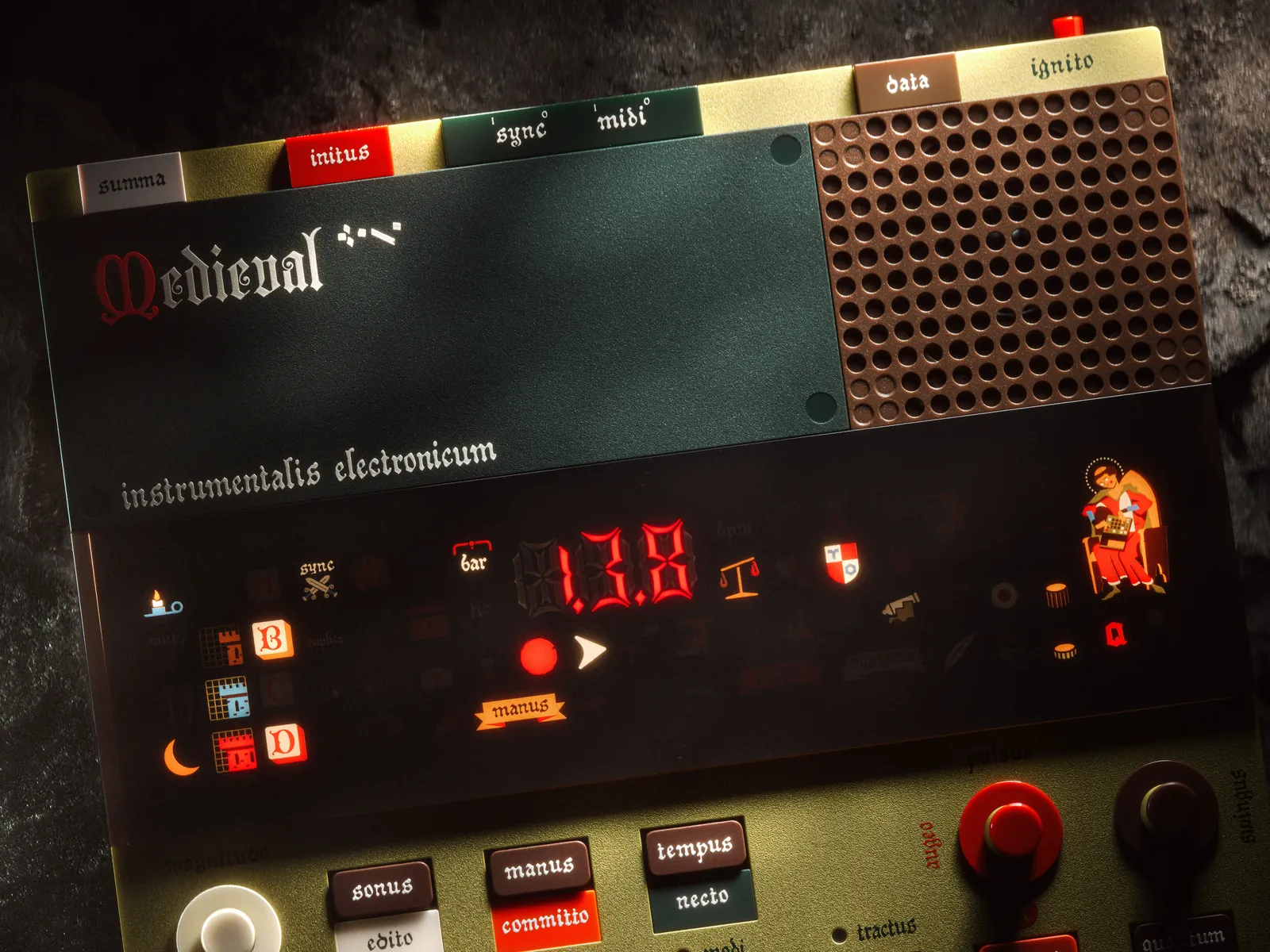

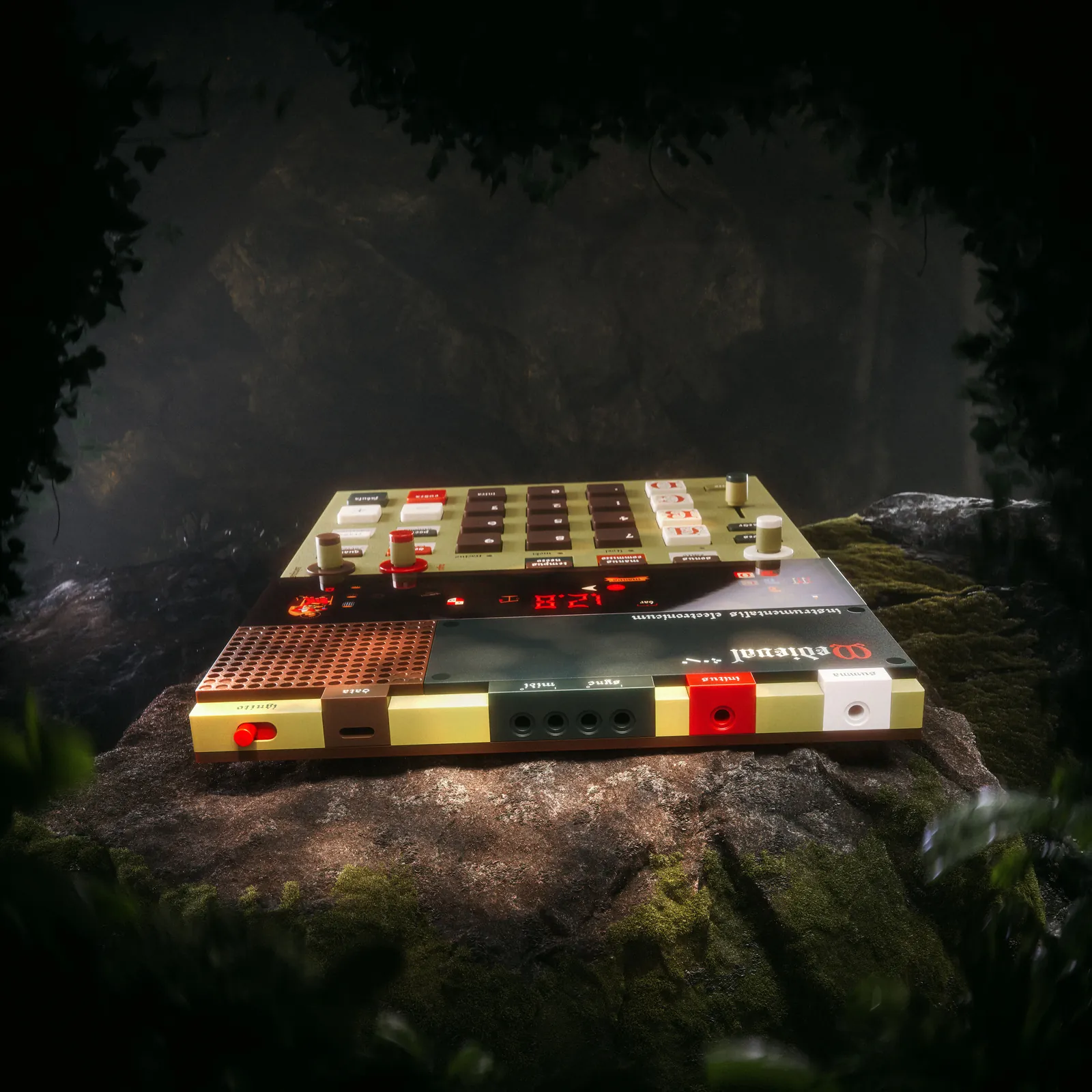
The Teenage Engineering EP-1320 Medieval is a portable sampler, sequencer, and composer loaded with 96 megabytes of hardwired medieval sounds and 32 megabytes of user sample storage. Released by Stockholm-based Teenage Engineering , the company describes it as “the ultimate, and only, medieval beat machine.” It is available for $299/€349 , and it is exactly as absurd and exactly as functional as that sounds.
What the EP-1320 Medieval Actually Is
The EP-1320 is a sound sampler and groove box, functionally the same as the EP-133 K.O. II, but with a Middle Ages twist. Teenage Engineering was founded in 2007 by Jesper Kouthoofd, David Eriksson, Jens Rudberg, and David Möllerstedt in Stockholm , and over the past two decades the company has become synonymous with products that blur the line between serious music tool and designer art object. The EP-1320 is their most committed bit yet.
The device is decked out in gold, with button labelling translated to Latin and printed in a decidedly Dark Ages font. In addition to its new design, the sampler has been kitted out with redesigned effects, including Dungeon Echo, Bardic Ensemble, Medieval Punch-in Pocus, Dimension Expander, and Torture Chamber Reverb, plus a new arpeggiator. The sound bank covers farm animals, witches, “rowdy peasants,” and “an actual dragon,” alongside multi-sampled medieval instruments such as the hurdy gurdy, gittern, citole, and bowed harp. Oh, and the sampler’s buttons have been purposely scented with cocoa.
To me, this is one of the most fascinating product decisions in recent music hardware. Not because it’s practical. Because it’s brazenly, hilariously specific.
The EP-1320 Medieval as Design Philosophy
The EP-1320 Medieval comes packed with 128MB total storage, 96MB of which is hardwired medieval sounds. That leaves users with just 32MB for their own samples, half the user sample memory of the K.O. II. Teenage Engineering’s web-based sample tool shows that all factory sounds are locked to the device , meaning you can’t clear the medieval bank to repurpose the storage. You’re committed. The hurdy gurdy stays.
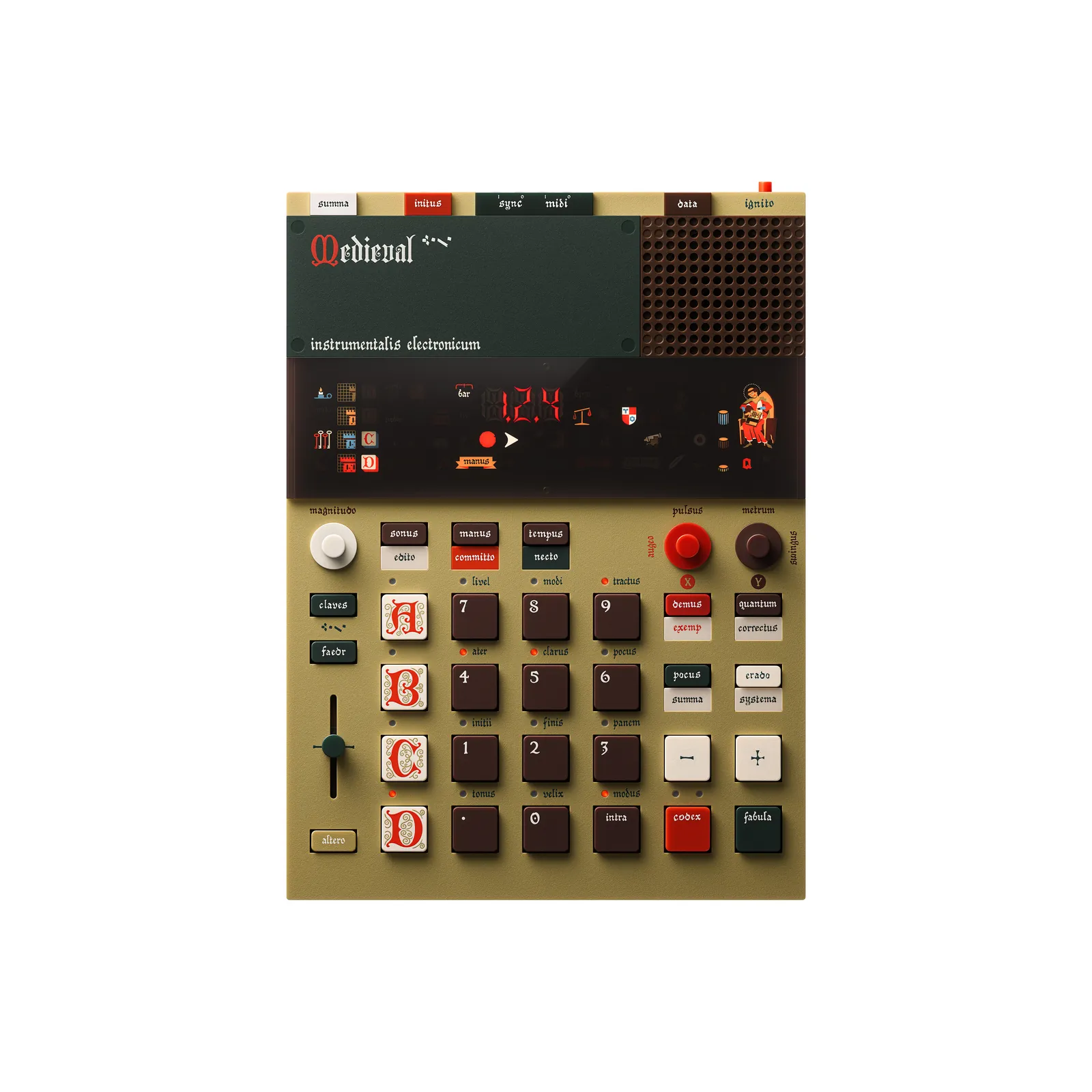
What strikes me is how the EP-1320 represents something bigger than a novelty reskin. Since it was founded in 2007, Teenage Engineering has developed numerous products that reimagine music production by making synthesizers and samplers more accessible and appealing. The EP-1320 takes that ethos and pushes it past accessibility into pure aesthetic maximalism. Every element serves the theme. The effects aren’t just renamed for laughs; the biggest advancements over the EP-133 include a new arpeggiator, the ability to properly loop samples with crossfade, and new send effects , all wrapped in the medieval conceit.
There’s a case to be made that this is the logical endpoint of what Teenage Engineering has always done. The company’s history includes designing the Playdate handheld game console with Panic, featuring a mechanical crank , partnering with Nothing to produce the design aesthetic of that brand , and co-designing the Rabbit r1 pocket AI device . They’ve always treated constraint and personality as features, not bugs. The Medieval just happens to take that instinct to its most ridiculous conclusion.
The Fadergate Shadow and the Trust Economy
The EP-1320 didn’t arrive in a vacuum. Its predecessor, the EP-133 K.O. II, launched in late 2023 to enormous demand, but was quickly dogged by quality issues. Co-founder David Eriksson addressed “Fadergate,” a term coined online after users reported problems with the fader of the EP-133 K.O. II sampler. Eriksson acknowledged packaging dimension mistakes and a design flaw: “The size of the box is 10 inches, so some stores thought it was a 10-inch vinyl package and so shipped it without padding. But it was also our little design flaw.”
Online music-making communities were split. Some users reported receiving units dead on arrival. Others shrugged and called it the cost of buying from a company that prizes design over durability. I think the EP-1320 is, in part, Teenage Engineering’s answer to that controversy: the same platform, refined, but deliberately positioned as a collector’s piece rather than a workhorse. If the K.O. II was a tool that happened to look cool, the Medieval is a cool object that happens to be a tool. The distinction matters.
Who Actually Buys a Medieval Beat Machine
The community response to the EP-1320 has been genuinely fascinating to watch. In online forums, reactions ranged from immediate preorders to bewildered disbelief. Some producers pointed out that you could just load medieval samples onto a standard K.O. II. Others declared it an instant buy precisely because of the absurdity. One self-described professor of medieval literature admitted to being, in their words, torn between scholarly obligation and synth-collector impulse.
Teenage Engineering even announced that anyone spending over $999 in its online store would receive a free EP-1320 Medieval sampler worth $299 , as part of a series of attention-grabbing promotions under the banner of Flipped Out ’25. It reads like the company knows the Medieval is less a mass-market instrument and more a loyalty reward, a wink to the faithful.
My take is that the EP-1320 isn’t really competing with the Roland SP-404 or an Akai MPC. It’s competing with limited-edition sneakers, art toys, and collector vinyl pressings. It lives in the space where music gear becomes merch, where the purchase is as much about identity as it is about function. As one reviewer put it, this is “something absolutely no one asked for” and yet “utterly compelling.”

The Hyper-Niche as Product Strategy
The EP-1320 Medieval lands as something more interesting than a gimmick. It feels like a thesis statement about where boutique hardware is headed. Instead of building one sampler and hoping it appeals to everyone, Teenage Engineering built one platform and gave it radical personality. This isn’t the first time the company has done this: in 2020, they gave two Pocket Operators a retro Capcom theme, drawing from Street Fighter and Mega Man. The Medieval is that same playbook, scaled up.
Reasonable people might disagree, but I think the fetishization of the hyper-niche is actually a healthy development for music hardware. The sampler market has spent years converging on the same feature sets, the same matte-black aesthetic, the same YouTube demo culture. A machine that ships with coconut horse hooves and two separate witch samples is, at minimum, an argument that instruments can have a point of view. Whether you think that point of view is worth $299 is between you and your lute.
Frequently Asked Questions
What is the Teenage Engineering EP-1320 Medieval?
The EP-1320 Medieval is the world’s first electronic medieval sampler, high-resolution sequencer, and powerful composer packed with hundreds of medieval sounds. It is functionally the same as the EP-133 K.O. II, but with expanded memory (128MB) and artisanal medieval samples.
How much does the EP-1320 Medieval cost?
The EP-1320 is available for $299 in the US and €349 in Europe. Some retailers, including Perfect Circuit, list it at $329.
Is the EP-1320 Medieval just a reskin of the EP-133 K.O. II?
Mostly, but not entirely. The biggest advancements include a new arpeggiator, the ability to properly loop samples with crossfade, and new send effects not found on the original EP-133. However, 96MB of the 128MB total storage is used for the hardwired medieval samples, leaving only 32MB for user sounds.
What kinds of sounds come preloaded on the EP-1320?
Stringed instruments include hurdy gurdy, citole, bowed harp, and gittern. Reeds and brass include bagpipes, shawm, flutes, and trumpets. Drums and percussion include frame drums, tambourines, chain rattles, battle toms, and coconut horse hooves. Foley and sound effects include swords, arrows, farm animals, two separate witches, rowdy peasants, and an actual dragon.
Do the buttons really smell like chocolate?
Yes. There is a lot of talk that the sampler’s buttons had been purposely scented with cocoa, and reviewers have confirmed this is actually true. The relevance to medieval Europe remains, by everyone’s admission, unclear.
Who founded Teenage Engineering?
Teenage Engineering was founded in 2007 by Jesper Kouthoofd, David Eriksson, Jens Rudberg, and David Möllerstedt in Stockholm, Sweden. Their first product, the OP-1, was introduced at the NAMM Show in 2010.
'%3e%3cg id='Final-Copy-2_2_' transform='translate(1275.000000, 200.000000)'%3e%3cpath class='st0' d='M7.4,12.8h6.8l3.1-11.6H7.4C4.2,1.2,1.6,3.8,1.6,7S4.2,12.8,7.4,12.8z'/%3e%3c/g%3e%3c/g%3e%3c/g%3e%3cg id='final---dec.11-2020'%3e%3cg id='_x30_208-our-toggle' transform='translate(-1275.000000, -200.000000)'%3e%3cg id='Final-Copy-2' transform='translate(1275.000000, 200.000000)'%3e%3cpath class='st1' d='M22.6,0H7.4c-3.9,0-7,3.1-7,7s3.1,7,7,7h15.2c3.9,0,7-3.1,7-7S26.4,0,22.6,0z M1.6,7c0-3.2,2.6-5.8,5.8-5.8 h9.9l-3.1,11.6H7.4C4.2,12.8,1.6,10.2,1.6,7z'/%3e%3cpath id='x' class='st2' d='M24.6,4c0.2,0.2,0.2,0.6,0,0.8l0,0L22.5,7l2.2,2.2c0.2,0.2,0.2,0.6,0,0.8c-0.2,0.2-0.6,0.2-0.8,0 l0,0l-2.2-2.2L19.5,10c-0.2,0.2-0.6,0.2-0.8,0c-0.2-0.2-0.2-0.6,0-0.8l0,0L20.8,7l-2.2-2.2c-0.2-0.2-0.2-0.6,0-0.8 c0.2-0.2,0.6-0.2,0.8,0l0,0l2.2,2.2L23.8,4C24,3.8,24.4,3.8,24.6,4z'/%3e%3cpath id='y' class='st3' d='M12.7,4.1c0.2,0.2,0.3,0.6,0.1,0.8l0,0L8.6,9.8C8.5,9.9,8.4,10,8.3,10c-0.2,0.1-0.5,0.1-0.7-0.1l0,0 L5.4,7.7c-0.2-0.2-0.2-0.6,0-0.8c0.2-0.2,0.6-0.2,0.8,0l0,0L8,8.6l3.8-4.5C12,3.9,12.4,3.9,12.7,4.1z'/%3e%3c/g%3e%3c/g%3e%3c/g%3e%3c/g%3e%3c/svg%3e) Your Privacy Choices
Your Privacy Choices