

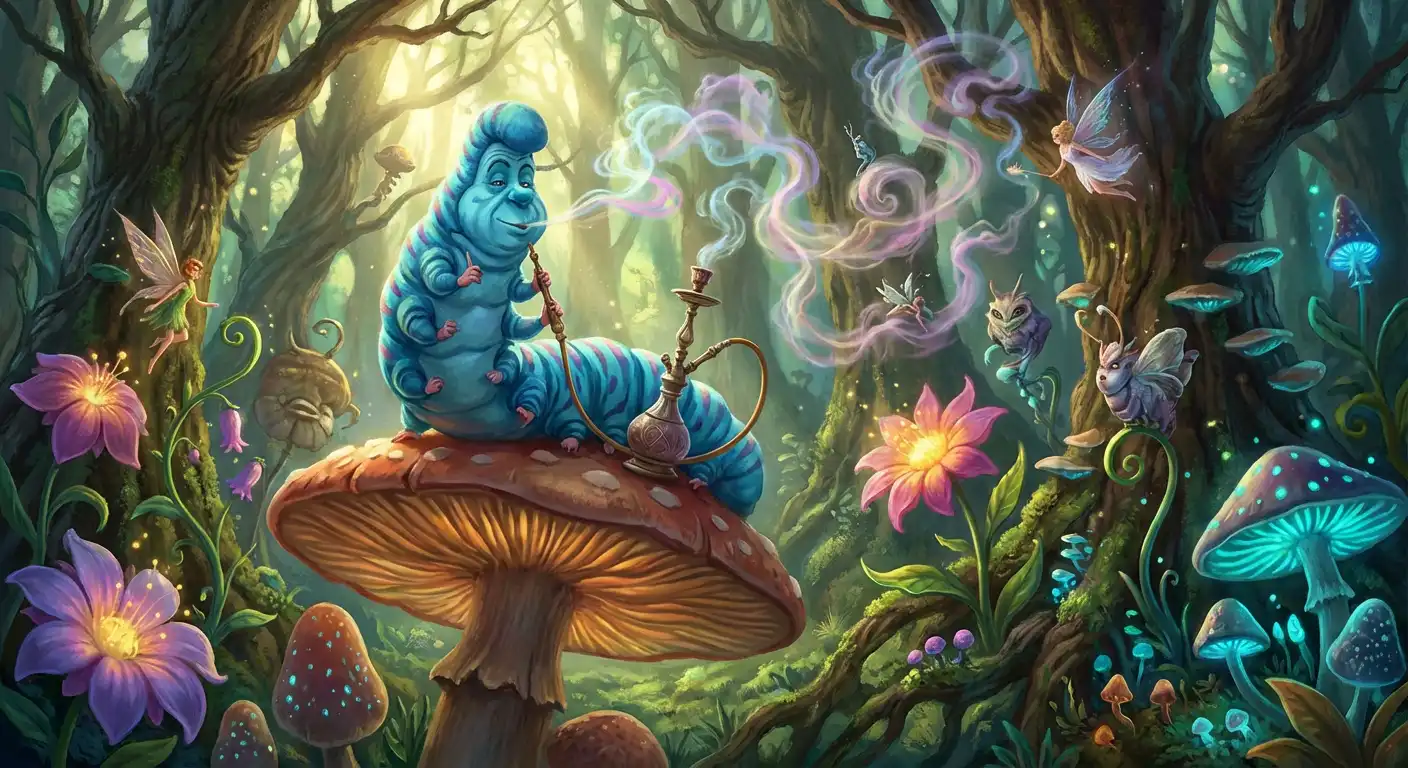


A blue caterpillar perched atop a mushroom, languidly puffing on an elaborate hookah while interrogating a confused little girl about her identity. It’s one of the most iconic images in children’s literature, yet it’s sparked decades of debate, speculation, and wild theories. So where did Lewis Carroll get this bizarre idea, and what was actually going on with that hookah?
The Victorian Smoking Culture Nobody Talks About
When Lewis Carroll published Alice’s Adventures in Wonderland in 1865, Victorian England had a smoking culture that might surprise modern readers. By 1700, England was importing more than 17 million kilograms of tobacco annually (enough for every person to smoke a pipeful daily). Opium use was equally widespread, with five out of six families using it habitually for everything from teething babies to treating coughs.
The hookah itself had traveled from India and Persia to England during British colonial expansion. For Victorian writers, this exotic smoking device symbolized Eastern wisdom and contemplation rather than recreational drug use. Carroll wasn’t making some edgy statement about substance abuse; he was tapping into contemporary associations between hookah smoking and philosophical thought.
The Mystery of Two Different Pipes
Here’s where things get interesting. Carroll originally drew his own illustration of the Caterpillar, depicting it with a long, thin pipe similar to opium pipes. However, John Tenniel’s published illustration (the one we all know and love) shows an elaborate, Eastern-inspired hookah surrounded by tobacco plant flowers. This discrepancy has fueled endless speculation in fan communities about what Carroll originally intended.
Online discussions often circle back to this question: was it tobacco, opium, or something else entirely? The tobacco flowers in Tenniel’s illustration suggest a straightforward answer, but enthusiast groups continue debating whether Carroll’s original vision was more provocative.
What Carroll Actually Meant
Despite persistent theories connecting Alice in Wonderland to drug culture, there’s zero evidence that Carroll used drugs. His position at Christ Church, Oxford, and his constant work with children make recreational drug use highly unlikely. The mushroom-eating and hookah-smoking scenes weren’t coded messages about getting high; they were about transformation and identity.
The Caterpillar serves as a kind of Zen master figure, pushing Alice to confront the fundamental question: “Who are you?” The hookah creates an atmosphere of contemplation, not intoxication. Many literary analysts point out that the Caterpillar appears precisely when Alice is struggling with her changing size and sense of self, representing the confusing, sometimes uncomfortable process of growing up.
How the 1960s Changed Everything
The drug association didn’t really take hold until the 1960s counterculture movement rediscovered Disney’s 1951 film. Suddenly, Alice in Wonderland was screening at “trip festivals” alongside lava lamps and psychedelic rock. Jefferson Airplane’s “White Rabbit” cemented the connection in popular culture, and the Caterpillar became an accidental icon of mind expansion.
A common sentiment in fan forums is that this 1960s reinterpretation, while culturally significant, somewhat obscures Carroll’s original intent. The Victorian audience would have seen the Caterpillar as representing wisdom, transformation, and the philosophical journey of self-discovery.
Modern Adaptations and Censorship
Fast forward to today, and the hookah has become controversial. Some modern adaptations replace it with a bubble-blowing device to avoid depicting smoking in children’s media. This sparks heated debates in enthusiast communities about whether such censorship respects the original work or unnecessarily sanitizes a classic character.
Tim Burton’s 2010 adaptation kept the hookah and named the character Absolem (voiced by Alan Rickman in his final film role). This version honored the original while adding depth to the character’s role as a guide through transformation.
The Bottom Line
The Caterpillar’s hookah isn’t about drugs, rebellion, or hidden adult messages. It’s about creating a moment of stillness and contemplation in the chaos of Wonderland. Carroll used a culturally familiar symbol of Eastern wisdom to mark a pivotal moment in Alice’s journey toward understanding herself.
'%3e%3cg id='Final-Copy-2_2_' transform='translate(1275.000000, 200.000000)'%3e%3cpath class='st0' d='M7.4,12.8h6.8l3.1-11.6H7.4C4.2,1.2,1.6,3.8,1.6,7S4.2,12.8,7.4,12.8z'/%3e%3c/g%3e%3c/g%3e%3c/g%3e%3cg id='final---dec.11-2020'%3e%3cg id='_x30_208-our-toggle' transform='translate(-1275.000000, -200.000000)'%3e%3cg id='Final-Copy-2' transform='translate(1275.000000, 200.000000)'%3e%3cpath class='st1' d='M22.6,0H7.4c-3.9,0-7,3.1-7,7s3.1,7,7,7h15.2c3.9,0,7-3.1,7-7S26.4,0,22.6,0z M1.6,7c0-3.2,2.6-5.8,5.8-5.8 h9.9l-3.1,11.6H7.4C4.2,12.8,1.6,10.2,1.6,7z'/%3e%3cpath id='x' class='st2' d='M24.6,4c0.2,0.2,0.2,0.6,0,0.8l0,0L22.5,7l2.2,2.2c0.2,0.2,0.2,0.6,0,0.8c-0.2,0.2-0.6,0.2-0.8,0 l0,0l-2.2-2.2L19.5,10c-0.2,0.2-0.6,0.2-0.8,0c-0.2-0.2-0.2-0.6,0-0.8l0,0L20.8,7l-2.2-2.2c-0.2-0.2-0.2-0.6,0-0.8 c0.2-0.2,0.6-0.2,0.8,0l0,0l2.2,2.2L23.8,4C24,3.8,24.4,3.8,24.6,4z'/%3e%3cpath id='y' class='st3' d='M12.7,4.1c0.2,0.2,0.3,0.6,0.1,0.8l0,0L8.6,9.8C8.5,9.9,8.4,10,8.3,10c-0.2,0.1-0.5,0.1-0.7-0.1l0,0 L5.4,7.7c-0.2-0.2-0.2-0.6,0-0.8c0.2-0.2,0.6-0.2,0.8,0l0,0L8,8.6l3.8-4.5C12,3.9,12.4,3.9,12.7,4.1z'/%3e%3c/g%3e%3c/g%3e%3c/g%3e%3c/g%3e%3c/svg%3e) Your Privacy Choices
Your Privacy Choices