

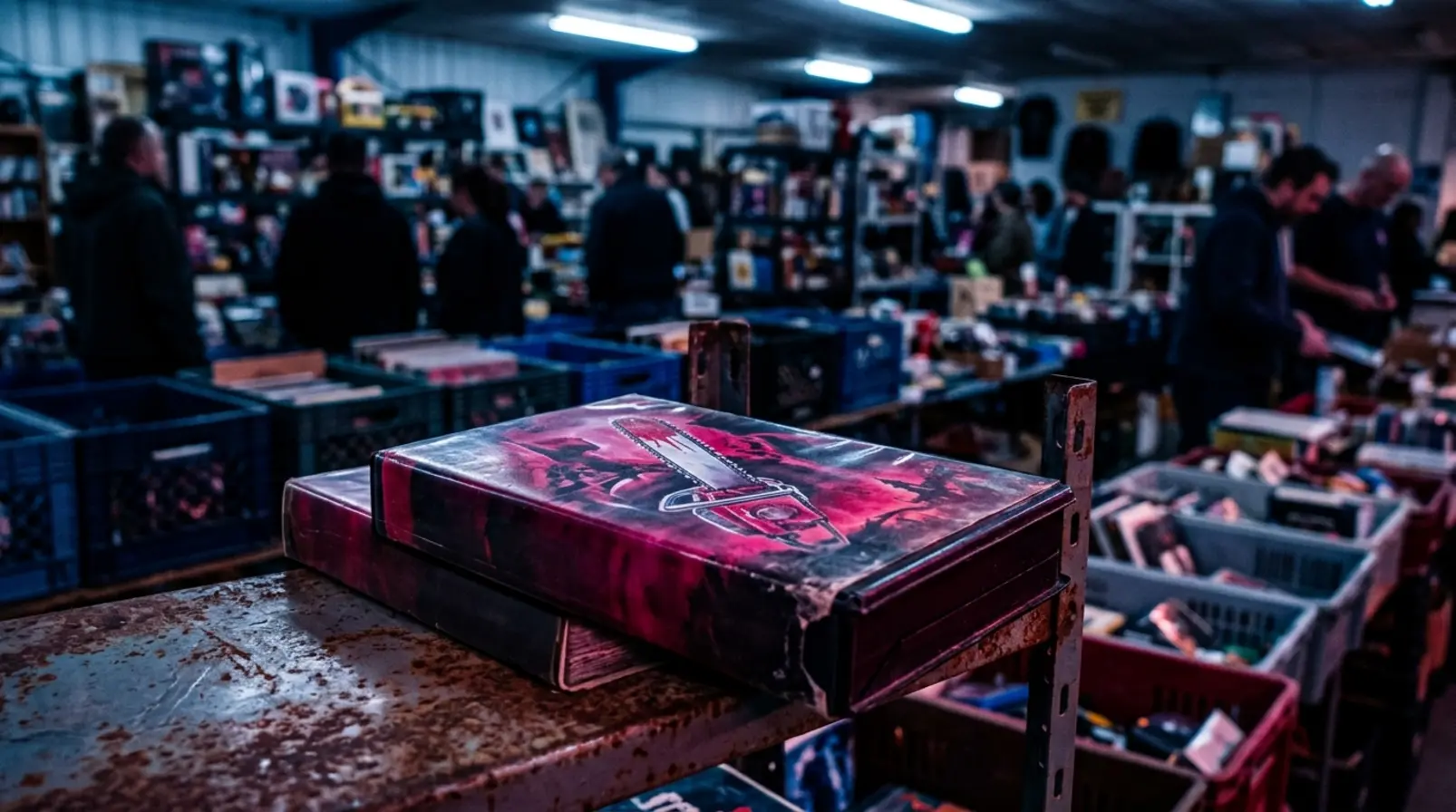


The movie escaped the cassette decades ago. The panic stayed in the box.
On a British pre-cert horror release, an oversized rental case can give almost its entire surface to one lurid promise: a drill entering a forehead, a corpse rising from the ground, a woman fleeing something the artwork refuses to show. The painting does not merely identify the film. It announces what kind of forbidden object the customer is about to carry home.
The same movie may now exist in cleaner editions, restored transfers, and streams that begin playing without a trip to the high street. None of them reproduces that original encounter. The distributor name, the oversized case, the painted threat, and the absence of a BBFC classification mark identify a particular release from a particular moment.
The tape contains the film. The box contains the conditions under which Britain first met it.
The Box Was the Billboard
Home video arrived in Britain before the industry around it had settled into respectability. The BBFC says major film distributors were initially wary of releasing their libraries on video, leaving room for smaller companies that often worked with low-budget horror, exploitation films, and material that had never been submitted for British cinema classification during the format’s early unregulated period.
Those companies could not rely on theatrical campaigns or familiar studio brands. In a rental shop crowded with unfamiliar titles, the case had to perform the work of a poster, trailer, and sales pitch at once.
Specialist archive VHS Collector describes big-box packaging as a way to enlarge the artwork and catch customers’ attention, particularly for films with limited distribution and little conventional marketing money in its history of the format. Wired similarly notes that garish illustrations helped low-budget releases compete for attention on densely packed video-store shelves and sometimes became more memorable than the films themselves.
The paintings did not have to explain the movie accurately. They had to win the rental before the customer reached the next case.
The box was not decoration around the product. On the shelf, the box was the product’s loudest available form.

Visibility Became Liability
The same packaging that helped obscure films become visible also made them easy symbols for a growing campaign against home video.
The BBFC dates the escalation of public and political concern to 1982. It notes that, apart from the content of controversial releases such as SS Experiment Camp, Cannibal Holocaust, Snuff, and The Driller Killer, their advertising appeared designed to provoke offense and controversy as anxiety around unclassified videos intensified.
The sleeves mattered because they were public. A person did not need to rent a film, watch it, or know what it contained to encounter its most violent image in a shop window, trade advertisement, or row of rental cases.
That does not mean Britain created a separate legal ban on horror paintings. Enforcement under the Obscene Publications Act concerned allegedly obscene works and their distribution. The later Video Recordings Act regulated the classification and supply of video works. The cover art helped make certain releases conspicuous, but the legal target was not illustration as an independent category.
The distinction matters. The artwork did not cause the entire video-nasty panic, and the panic cannot be reduced to a few outrageous sleeves. But the covers gave an unfamiliar technology a face, and that face was often carrying a knife.
The Director of Public Prosecutions assembled an evolving list of titles considered liable for action under obscenity law. Seventy-two videos appeared on that changing list over time, and 39 were successfully prosecuted according to the BFI. It was not a stable catalogue of 72 films issued once and preserved unchanged.
It was a moving enforcement tool, assembled amid pressure, complaints, seizures, court decisions, and confusion over what exactly qualified as a “nasty.”
The Law Physically Changed the Box
Parliament passed the Video Recordings Act in 1984, but its requirements did not transform every shelf overnight.
The government brought the criminal provisions into force on September 1, 1985, for works not previously sold, rented, or offered to the British public. Existing releases entered the system through a series of later deadlines, ending on September 1, 1988, when the remaining works, including foreign-language releases, were required to comply under the implementation schedule announced to Parliament.
The Act did more than determine which versions could legally remain in circulation. It changed the visible design of home video. The BBFC says classification information had to appear on tapes, discs, and packaging, accompanied by an explanation of the certificate under the new labelling requirements.
A classification symbol therefore became more than guidance for the customer. It became part of the physical boundary between eras.
Collectors use “pre-cert” for releases associated with the period before compulsory video classification reached them. The term is useful, but the phased rollout means that the absence of a BBFC mark should be treated as evidence to examine rather than a complete history by itself. Distributor, artwork, cassette labels, case style, and release details still matter.
The law did not merely change what could be watched. It changed what the object had to say about itself before anyone pressed play.
Collectors Are Buying the Release
Modern access has separated the movie from the edition. A film once difficult to find may now be available in high definition, while the original VHS release becomes scarcer, stranger, and more culturally specific.
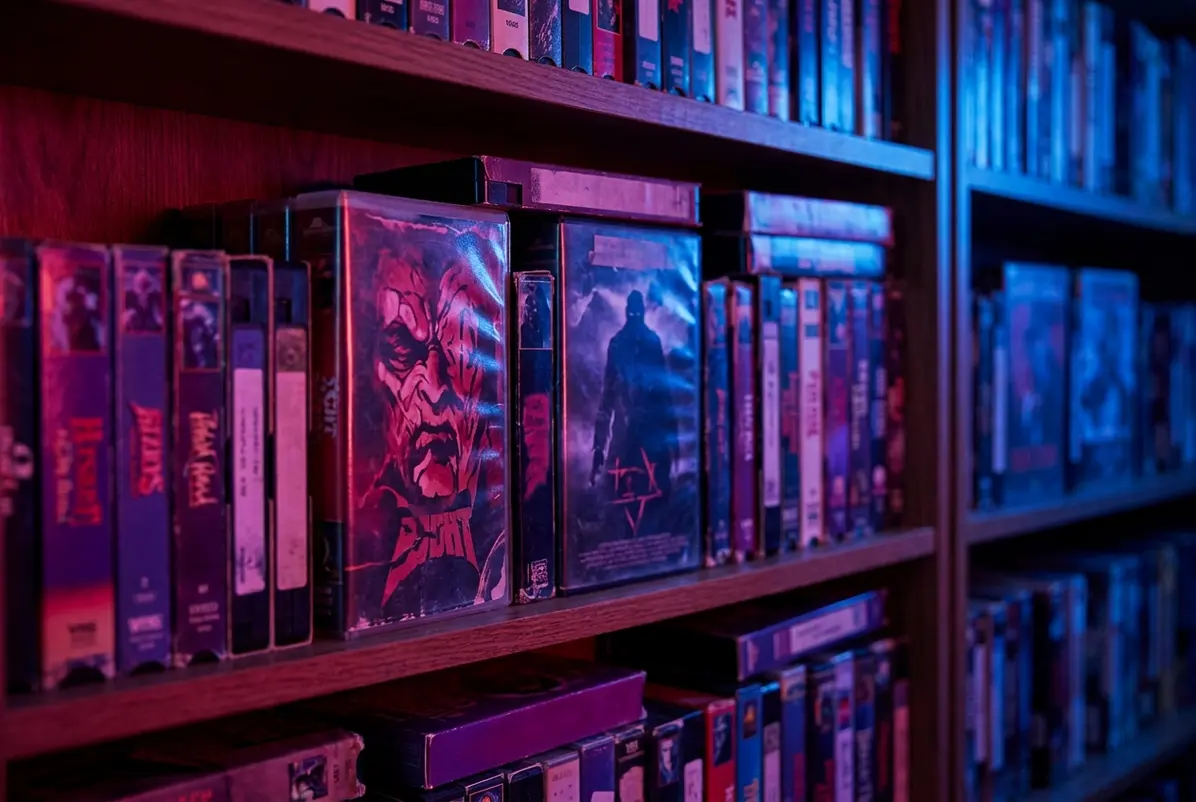
British collectors therefore distinguish among copies that contain the same film. Contemporary collecting coverage identifies rental clamshells, original artwork, distributor labels, and the absence of a BBFC mark among the features examined in pre-cert releases rather than treating every cassette of a title as interchangeable.
The exact resale value of an individual tape can fluctuate with condition, edition, completeness, provenance, and actual buyer demand. Unsupported asking prices turn VHS collecting into an attic-lottery story and obscure the more interesting point.
The package changes the identity of the object.
The distributor logo records who brought the film into the market. The artwork records how that company chose to sell it. The rental case records the commercial system it entered. A BBFC badge—or the space where one would later be required—places the release within Britain’s changing classification regime.
A restoration can preserve the image inside the movie. It cannot reconstruct the exact object that once sat on the shelf.
The List Was Never a Canon
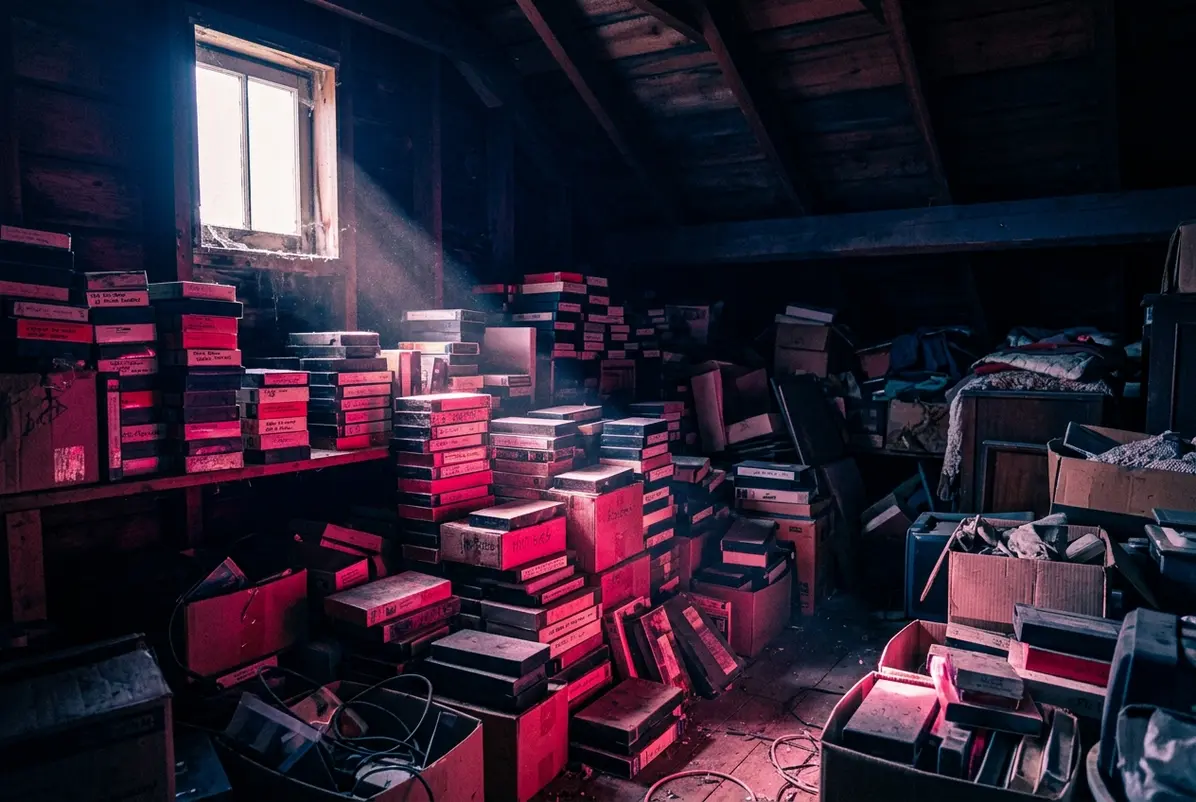
Collectibility should not be mistaken for a delayed verdict on artistic quality. The BFI describes the DPP list as arbitrary, containing films that varied sharply in subject, style, tone, budget, country of origin, and ambition. Some later became recognized genre landmarks. Others remained exploitation obscurities that happened to attract official scrutiny.
The category was created by enforcement, not aesthetics.
That arbitrary grouping nevertheless produced a culture of its own. The BFI’s history of the controversy notes that horror fans began using the list almost like a checklist, seeking out titles because official attention had connected films that were never intended to belong together and turning prohibition into a map for discovery.
The collector market inherits part of that structure. It does not necessarily declare that every listed film is great, dangerous, or unjustly condemned. It preserves the editions through which unrelated movies were made to share one notorious identity.
The irony is that classification eventually helped separate the films from the panic. Cuts changed, standards shifted, restorations appeared, and most of the titles returned through later formats. The original cases remained tied to the moment before that separation was complete.
The Box Preserved What the Transfer Could Not
The history of VHS is often reduced to picture noise, rewinding, tracking lines, and the inconvenience of magnetic tape. Big-box horror releases preserve something less technical and more difficult to reproduce: the architecture of temptation.
A customer stood in a physical shop. The number of choices was finite. The artwork occupied real space. A distributor had seconds to turn shock into curiosity. Later, campaigners and politicians used the same visibility to describe the cassette as a threat entering the home.
Streaming preserves access to the film while dissolving almost every condition around that encounter. The shelf disappears. The case becomes a thumbnail. Distributor identity recedes. Classification survives as metadata instead of a badge physically imposed on the package.
The pre-cert box matters because it preserves more than content. It preserves marketing before respectability, horror before standardized labelling, and a moral panic before it hardened into legislation and collector terminology.
The movie escaped the cassette. The release did not.
The tape carries the film. The box carries the history of what Britain feared it might do.


'%3e%3cg id='Final-Copy-2_2_' transform='translate(1275.000000, 200.000000)'%3e%3cpath class='st0' d='M7.4,12.8h6.8l3.1-11.6H7.4C4.2,1.2,1.6,3.8,1.6,7S4.2,12.8,7.4,12.8z'/%3e%3c/g%3e%3c/g%3e%3c/g%3e%3cg id='final---dec.11-2020'%3e%3cg id='_x30_208-our-toggle' transform='translate(-1275.000000, -200.000000)'%3e%3cg id='Final-Copy-2' transform='translate(1275.000000, 200.000000)'%3e%3cpath class='st1' d='M22.6,0H7.4c-3.9,0-7,3.1-7,7s3.1,7,7,7h15.2c3.9,0,7-3.1,7-7S26.4,0,22.6,0z M1.6,7c0-3.2,2.6-5.8,5.8-5.8 h9.9l-3.1,11.6H7.4C4.2,12.8,1.6,10.2,1.6,7z'/%3e%3cpath id='x' class='st2' d='M24.6,4c0.2,0.2,0.2,0.6,0,0.8l0,0L22.5,7l2.2,2.2c0.2,0.2,0.2,0.6,0,0.8c-0.2,0.2-0.6,0.2-0.8,0 l0,0l-2.2-2.2L19.5,10c-0.2,0.2-0.6,0.2-0.8,0c-0.2-0.2-0.2-0.6,0-0.8l0,0L20.8,7l-2.2-2.2c-0.2-0.2-0.2-0.6,0-0.8 c0.2-0.2,0.6-0.2,0.8,0l0,0l2.2,2.2L23.8,4C24,3.8,24.4,3.8,24.6,4z'/%3e%3cpath id='y' class='st3' d='M12.7,4.1c0.2,0.2,0.3,0.6,0.1,0.8l0,0L8.6,9.8C8.5,9.9,8.4,10,8.3,10c-0.2,0.1-0.5,0.1-0.7-0.1l0,0 L5.4,7.7c-0.2-0.2-0.2-0.6,0-0.8c0.2-0.2,0.6-0.2,0.8,0l0,0L8,8.6l3.8-4.5C12,3.9,12.4,3.9,12.7,4.1z'/%3e%3c/g%3e%3c/g%3e%3c/g%3e%3c/g%3e%3c/svg%3e) Your Privacy Choices
Your Privacy Choices