

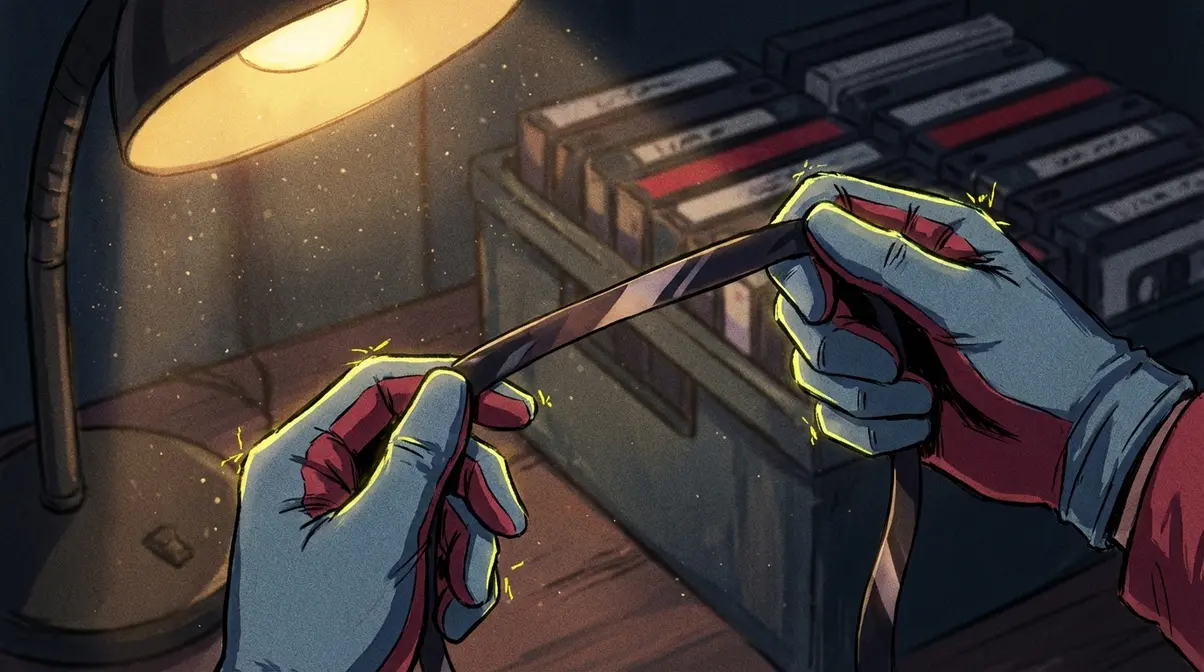

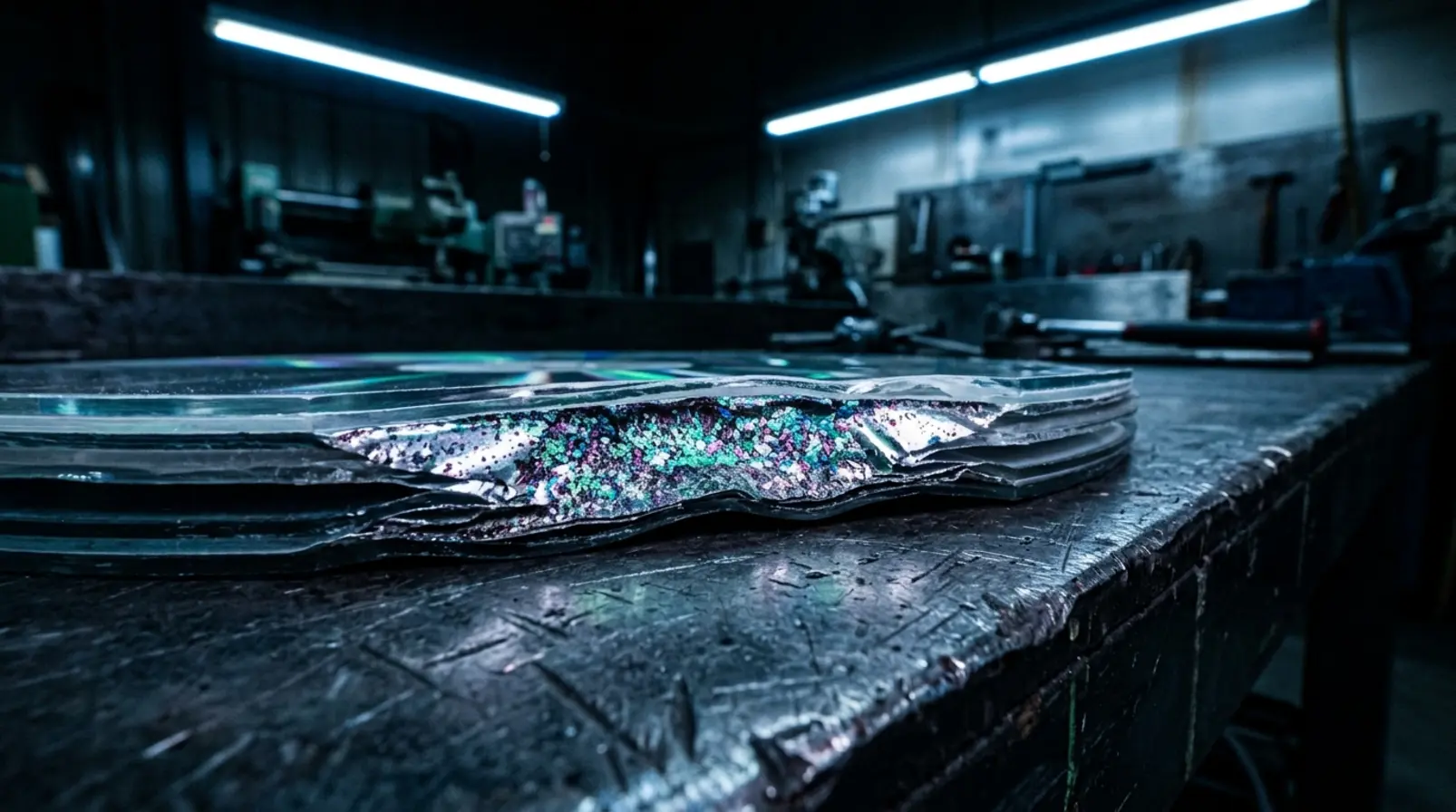
VHS tape preservation is the practice of storing, maintaining, and digitizing VHS videocassettes to prevent the permanent loss of their recorded content. Because VHS tapes rely on magnetic particles bonded to plastic substrates, they are inherently unstable and subject to chemical degradation, signal decay, and physical breakdown over time.
Why VHS Tapes Degrade and How Fast It Happens
VHS, S-VHS, VHS-C, and Hi8 video tapes are composed of three layers: the binder layer, the substrate, and the backing. The engineering of these layers is intended to help video tapes survive the friction and stress of repeated playback, winding, and rewinding. But the clock starts ticking the moment a tape is recorded.
The damage comes from multiple directions. Magnetic particles gradually lose their charge through remanence decay, which results in color shifts towards weaker hues and a loss of overall detail. Meanwhile, the lubricant in the binder layer evaporates or gets consumed with each play, and the chemical binders themselves absorb moisture and break down through hydrolysis, a process that is irreversible.
In general, VHS deterioration of 10 to 20 percent occurs over a period of 10 to 25 years. Research suggests that tapes like this aren’t going to live beyond 15 to 20 years. That means home videos shot in the late 1980s and early 1990s are already deep into the danger zone. Howard Lukk, director of standards at the Society of Motion Picture and Television Engineers (SMPTE), put it plainly in a 2017 NPR interview: “Once that magnetic field that’s been imprinted into that tape has kind of faded too much, you won’t be able to recover it back off the tape after a long period of time.” Lukk estimates there are billions of tapes sitting around.
Proper Physical Storage According to NARA and the Experts
The single biggest favor you can do for a tape you haven’t digitized yet is to control its environment. The National Archives recommends that temperature and humidity in a home storage environment should ideally not fluctuate and be within the ranges of 55 to 70 degrees Fahrenheit and 30 to 55% relative humidity. Avoid storing home collections in places with unregulated climates such as an attic or garage.
Beyond climate, the physical positioning matters. Video tapes should be stored vertically and in their boxes. Do not stack tapes on top of one another. When tapes sit flat for extended periods, the weight presses down on the ribbon, leading to stretching or warping. Store magnetic tapes away from anything that can create an electromagnetic field, including loudspeakers and other articles containing magnets, and also high voltage lines and surge protectors.
Jim Wheeler’s Videotape Preservation Handbook, published through the Association of Moving Image Archivists (AMIA) in 2002, adds several practical rules that still hold: break off the record tab to protect the recording; don’t leave tapes or tape machines in the sun or in a hot vehicle; and always eject tape at the beginning or the end. Online archiving communities also recommend rewinding tapes fully before storage and inspecting them at least every three years.
Sticky Shed Syndrome and the Baking Debate
Sticky-shed syndrome is a condition created by the deterioration of the binders in a magnetic tape, which hold the ferric oxide magnetizable coating to its plastic carrier. This deterioration renders the tape unusable. Some kinds of binder are known to break down over time, due to the absorption of moisture (hydrolysis). The phenomenon appears most common in analog audio and video tapes manufactured using polyester-urethane (PEU) binders beginning in the 1970s.
Whether VHS cassettes specifically suffer from true sticky shed is a point of contention among collectors and archivists. Some experienced preservationists argue that consumer VHS tape stock never used the problematic binder formulations, while others maintain that badly stored tapes can exhibit similar symptoms regardless. Mold, in particular, can mimic sticky shed and spread spores deeper into the reels if a contaminated tape is run through a cleaning machine.
When baking is warranted, it remains a risky but sometimes necessary intervention. There is no standard equipment or practice for baking, so each engineer is left to create their own methods and materials. Generally, tapes are baked at low temperatures for relatively long periods of time, such as 130 to 140 °F (54 to 60 °C) for 1 to 8 hours. The Library of Congress’s Preservation Research and Testing Division found that the frequently cited baking temperature of 54 °C was measurably and quantifiably important in sticky tapes, related to a physical state change of some component within these tapes. The Preservation Self-Assessment Program at the University of Illinois warns that “baking” the tape can be destructive, and it is best done by a professional AV conservator or technician using a highly precise oven.
Digitization Methods and the Signal Chain Problem
The preservation community broadly agrees that digitization is the only real long-term solution. The question is how to do it well. Among online archiving circles, the debate between DIY and professional transfer is fierce and perpetual. A basic setup with a working VCR and a USB capture device can cost as little as $30 to $50 if you already own the deck, while professional services range from roughly $13 to $35 per tape depending on the provider.
But serious archivists insist the signal chain matters enormously. The consensus among preservation-focused communities is that a prosumer S-VHS VCR with a built-in Time Base Corrector (TBC) is the gold standard for digitizing. A TBC corrects the jitter and instability common in aging tapes, producing a far cleaner digital file. The irony is that nobody cared about these features when the decks were sold new. Today, sought-after JVC S-VHS models like the HR-S9911U trade on secondary markets for $400 to over $1,000, often in rough condition.
For the truly obsessive, RF capture using tools like the Domesday Duplicator captures the raw radio signal directly from the tape before the VCR has even processed it into viewable video. It is the purest possible capture, but it demands specialized hardware and significant technical skill.
Grassroots Preservation and the XFR Collective
Not all preservation work happens in climate-controlled government vaults. XFR Collective (pronounced “Transfer Collective”) is an all-volunteer nonprofit that partners with artists, activists, and community organizations to lower the barriers to preserving at-risk audiovisual media, especially unseen, unheard, or marginalized works, through digitization, screenings, educational workshops, and pop-up events.
Members meet in a loft in Tribeca in New York City every Monday to digitize tapes. The loft has racks of tape decks, oscilloscopes, vector scopes, and waveform monitors that help ensure a quality transfer from analog to digital. Most work professionally, but they volunteer their free time to do this. All tapes come from people who want their content to be publicly available, and after the tapes are transferred, they’re stored on the nonprofit Internet Archive. As of 2017, they had transferred 155 tapes totaling 67 hours.
The XFR model represents something replicable. While the collective primarily serves the local New York City community, it represents a replicable model for community-based digitization that addresses shortages of equipment and expertise by combining resources normally spread across a community.
The End of the Hardware Pipeline
Preservation gets harder every year because the machines themselves are dying. Japan’s Funai Electric, which claims to be the world’s last VCR manufacturer, ceased production of video-cassette recorders in July 2016. Having sold nearly 750,000 units in 2015, Funai had been finding it harder to source parts. They began manufacturing VCRs in 1983 and hit a peak of 15 million units per year. In October 2024, the Tokyo District Court approved a quasi-bankruptcy proposal for Funai Electric. The company that made the world’s last VCR no longer exists.
Nobuyuki Norimatsu of A-Fun, a company of engineers who repair discontinued electronics, put it this way: “To give up on keeping such records is like denying the history of humankind. Production ending is going to present problems for some people.” Ten years later, those problems are here.
Frequently Asked Questions
How long do VHS tapes last?
Most experts suggest that consumer-grade VHS tapes have a 15 to 25 year lifespan under ideal conditions. Tapes stored in hot, humid, or fluctuating environments will degrade much faster. If your tapes are from the 1980s or 1990s, some degree of signal loss has almost certainly already occurred.
Should I store VHS tapes rewound or not?
Fully rewound. A loose or partially wound tape can develop tension spots and uneven packing, which causes playback issues and physical deformation of the ribbon over time.
Can moldy VHS tapes be saved?
Sometimes, but carefully. Running a moldy tape through a VCR can spread spores onto the heads and into the mechanism, potentially contaminating other tapes. Visible mold should be addressed by a professional before any playback attempt.
What is the best VCR for digitizing VHS tapes?
The archiving community overwhelmingly recommends a JVC S-VHS deck with a built-in Time Base Corrector. Models like the JVC HR-S9911U, HR-S9900U, and SR-V10U are considered top-tier. These are no longer manufactured and command high prices on the secondary market.
How much does professional VHS digitization cost?
Prices typically range from about $13 to $35 per tape, depending on the service, with some providers charging additional fees for DVD or USB copies. Bulk orders may bring the per-tape cost down.
Where should I store my digital files after converting?
The Library of Congress recommends saving copies on at least two different storage media and keeping them in separate physical locations. Migrate your files to current storage media approximately every five years. A 2-hour VHS tape produces roughly 1 to 4 GB of compressed digital video, or around 20 GB uncompressed.
Primary sources referenced in this article: National Archives Video Storage Guidance, Library of Congress Sticky Shed Research, AMIA Videotape Preservation Handbook (Jim Wheeler, 2002).
'%3e%3cg id='Final-Copy-2_2_' transform='translate(1275.000000, 200.000000)'%3e%3cpath class='st0' d='M7.4,12.8h6.8l3.1-11.6H7.4C4.2,1.2,1.6,3.8,1.6,7S4.2,12.8,7.4,12.8z'/%3e%3c/g%3e%3c/g%3e%3c/g%3e%3cg id='final---dec.11-2020'%3e%3cg id='_x30_208-our-toggle' transform='translate(-1275.000000, -200.000000)'%3e%3cg id='Final-Copy-2' transform='translate(1275.000000, 200.000000)'%3e%3cpath class='st1' d='M22.6,0H7.4c-3.9,0-7,3.1-7,7s3.1,7,7,7h15.2c3.9,0,7-3.1,7-7S26.4,0,22.6,0z M1.6,7c0-3.2,2.6-5.8,5.8-5.8 h9.9l-3.1,11.6H7.4C4.2,12.8,1.6,10.2,1.6,7z'/%3e%3cpath id='x' class='st2' d='M24.6,4c0.2,0.2,0.2,0.6,0,0.8l0,0L22.5,7l2.2,2.2c0.2,0.2,0.2,0.6,0,0.8c-0.2,0.2-0.6,0.2-0.8,0 l0,0l-2.2-2.2L19.5,10c-0.2,0.2-0.6,0.2-0.8,0c-0.2-0.2-0.2-0.6,0-0.8l0,0L20.8,7l-2.2-2.2c-0.2-0.2-0.2-0.6,0-0.8 c0.2-0.2,0.6-0.2,0.8,0l0,0l2.2,2.2L23.8,4C24,3.8,24.4,3.8,24.6,4z'/%3e%3cpath id='y' class='st3' d='M12.7,4.1c0.2,0.2,0.3,0.6,0.1,0.8l0,0L8.6,9.8C8.5,9.9,8.4,10,8.3,10c-0.2,0.1-0.5,0.1-0.7-0.1l0,0 L5.4,7.7c-0.2-0.2-0.2-0.6,0-0.8c0.2-0.2,0.6-0.2,0.8,0l0,0L8,8.6l3.8-4.5C12,3.9,12.4,3.9,12.7,4.1z'/%3e%3c/g%3e%3c/g%3e%3c/g%3e%3c/g%3e%3c/svg%3e) Your Privacy Choices
Your Privacy Choices