

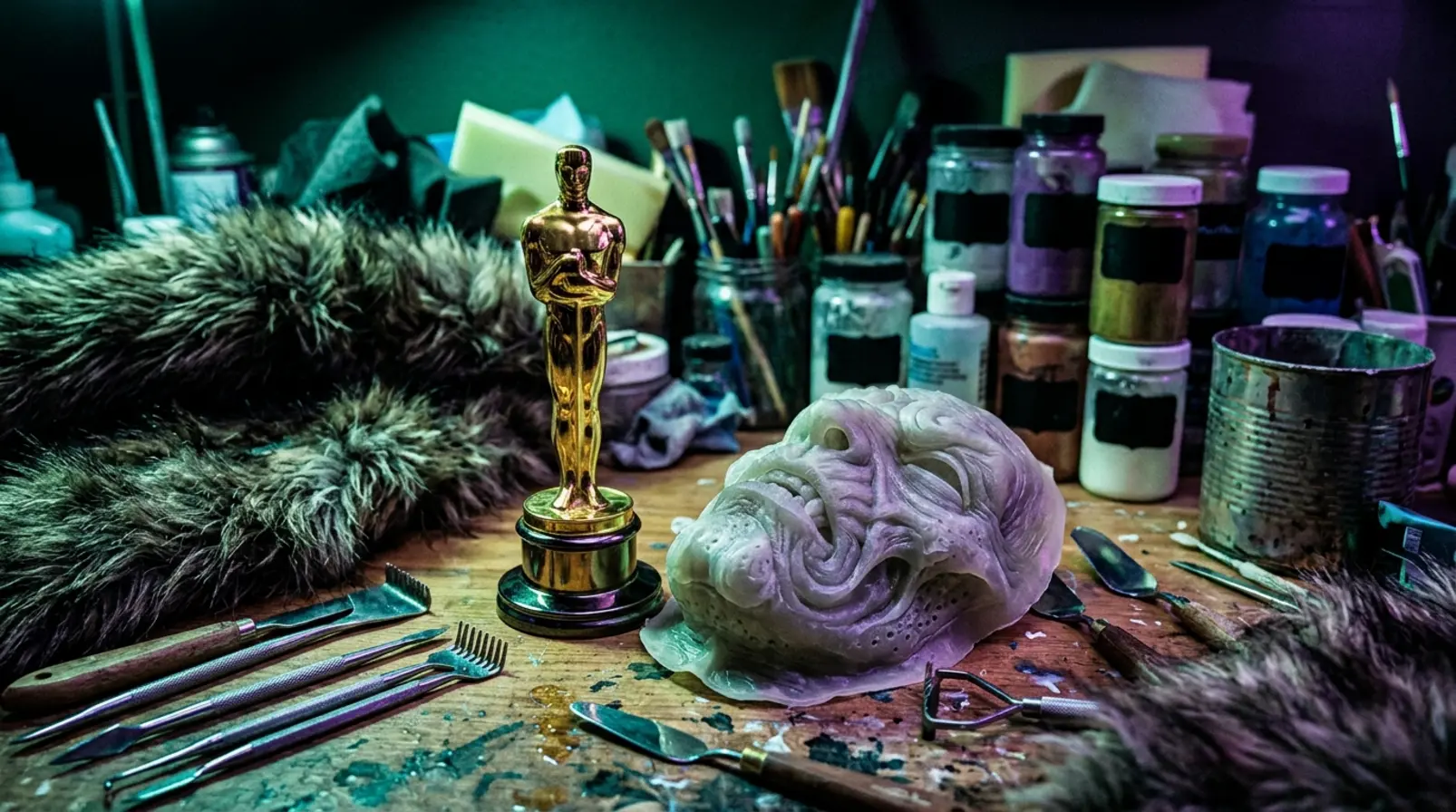


The first competitive Academy Award for makeup belongs to a werewolf. The controversy that helped create the category belongs to the Elephant Man.
John Landis’s An American Werewolf in London opened in US theaters on August 21, 1981. On March 29, 1982, Rick Baker won the first competitive Academy Award for Makeup for its transformation effects. But the category’s origin story had already begun with another film. A year earlier, The Elephant Man had received eight Academy Award nominations without any category capable of recognizing Christopher Tucker’s prosthetic makeup. The Los Angeles Times traces the creation of the makeup category to the groundswell of support that followed.
The Snub That Exposed a Missing Category
David Lynch’s The Elephant Man arrived in 1980, with Tucker’s prosthetics transforming John Hurt into John Merrick. The BFI describes the makeup as a complex arrangement applied in 15 separate sections. Tucker was not merely decorating a performance. The work had to alter Hurt’s face dramatically while allowing the actor underneath it to remain visible as an actor.
The omission became difficult to ignore. The Guardian reports that widespread criticism over Tucker’s unrecognized work helped prompt the Academy to establish a competitive makeup Oscar. The Academy had recognized extraordinary makeup before, but only occasionally: William Tuttle received an Honorary Award for 7 Faces of Dr. Lao, and John Chambers received one for Planet of the Apes. There was still no permanent competitive category for the craft.
The Award Arrived One Film Year Too Late
The timing is what makes the story crueler than a conventional Oscar snub. There was no makeup award Tucker could have lost.
The Elephant Man competed at the 53rd Academy Awards on March 31, 1981, honoring films released in 1980. The new competitive Makeup category debuted at the 54th Academy Awards on March 29, 1982, honoring films released in 1981. By then, Tucker’s film belonged to the previous eligibility cycle.
The door opened. The Elephant Man was already on the other side of it.

The Werewolf Entered Through the New Door
An American Werewolf in London happened to arrive at exactly the right moment. According to production notes preserved by the AFI, Landis wanted David Naughton’s transformation to happen visibly in front of the camera without optical effects. The result made Baker’s work impossible to separate from the film’s identity: skin stretches, bone structure changes and the human body seems to betray itself piece by piece.
Baker was hardly an overnight discovery. The Academy’s career profile notes that he had apprenticed under Dick Smith and assisted him on The Exorcist. When the Academy finally created a competitive category for makeup, Baker was standing there with precisely the kind of work the new award existed to recognize.
He won. Deservedly.
That distinction matters because Tucker’s story does not require diminishing Baker’s. The historical tension is stranger than one artist taking another’s prize. Baker won an award that did not exist when Tucker needed it.

The Record Remembers Winners Better Than Catalysts
Tucker’s relationship with the new category became even stranger almost immediately. In 1983, BAFTA’s Make-Up Artist award for Quest for Fire credited Sarah Monzani, Christopher Tucker and Michèle Burke. The same film then won the Academy Award for Makeup, but the Academy’s record names only Monzani and Burke. The Guardian reports that the Oscar rules at the time allowed only two names on the nomination.
Tucker died in 2022 without an Academy Award. Baker, meanwhile, went on to become a record-holding seven-time winner from eleven nominations.
Those facts do not produce a simple story about justice or injustice. They expose something more mechanical about awards. A trophy records a winner with extraordinary precision. It is much worse at recording the pressure, precedent and overlooked labor that made the category possible in the first place.

How an Oscar Becomes Part of a Film
Forty-five years later, Baker’s win has become part of the vocabulary used to sell An American Werewolf in London. Universal Pictures Home Entertainment announced two 45th-anniversary 4K Blu-ray editions for October 6, 2026, with promotional copy highlighting its “Academy Award-winning makeup by Rick Baker.” Earlier in the year, a Fangoria-curated Regal screening paired the film with an interview with Baker and again foregrounded the Oscar-winning transformation.
There is nothing improper about that. Baker’s Oscar belongs to the film. But that is precisely how awards simplify history. The trophy becomes metadata: a permanent adjective attached to a movie, a filmmaker or a performance. The messier chain of events that produced the category itself is harder to fit onto a disc case.
An American Werewolf in London turns 45 on August 21, 2026, and Baker’s Oscar remains part of its identity. It should. But inaugural awards create unusually tidy origin stories: a category appears, somebody wins it, history begins.
Makeup’s history is messier. Before the Academy could reward the werewolf, it first had to discover what was missing when it could not reward the Elephant Man.
'%3e%3cg id='Final-Copy-2_2_' transform='translate(1275.000000, 200.000000)'%3e%3cpath class='st0' d='M7.4,12.8h6.8l3.1-11.6H7.4C4.2,1.2,1.6,3.8,1.6,7S4.2,12.8,7.4,12.8z'/%3e%3c/g%3e%3c/g%3e%3c/g%3e%3cg id='final---dec.11-2020'%3e%3cg id='_x30_208-our-toggle' transform='translate(-1275.000000, -200.000000)'%3e%3cg id='Final-Copy-2' transform='translate(1275.000000, 200.000000)'%3e%3cpath class='st1' d='M22.6,0H7.4c-3.9,0-7,3.1-7,7s3.1,7,7,7h15.2c3.9,0,7-3.1,7-7S26.4,0,22.6,0z M1.6,7c0-3.2,2.6-5.8,5.8-5.8 h9.9l-3.1,11.6H7.4C4.2,12.8,1.6,10.2,1.6,7z'/%3e%3cpath id='x' class='st2' d='M24.6,4c0.2,0.2,0.2,0.6,0,0.8l0,0L22.5,7l2.2,2.2c0.2,0.2,0.2,0.6,0,0.8c-0.2,0.2-0.6,0.2-0.8,0 l0,0l-2.2-2.2L19.5,10c-0.2,0.2-0.6,0.2-0.8,0c-0.2-0.2-0.2-0.6,0-0.8l0,0L20.8,7l-2.2-2.2c-0.2-0.2-0.2-0.6,0-0.8 c0.2-0.2,0.6-0.2,0.8,0l0,0l2.2,2.2L23.8,4C24,3.8,24.4,3.8,24.6,4z'/%3e%3cpath id='y' class='st3' d='M12.7,4.1c0.2,0.2,0.3,0.6,0.1,0.8l0,0L8.6,9.8C8.5,9.9,8.4,10,8.3,10c-0.2,0.1-0.5,0.1-0.7-0.1l0,0 L5.4,7.7c-0.2-0.2-0.2-0.6,0-0.8c0.2-0.2,0.6-0.2,0.8,0l0,0L8,8.6l3.8-4.5C12,3.9,12.4,3.9,12.7,4.1z'/%3e%3c/g%3e%3c/g%3e%3c/g%3e%3c/g%3e%3c/svg%3e) Your Privacy Choices
Your Privacy Choices