

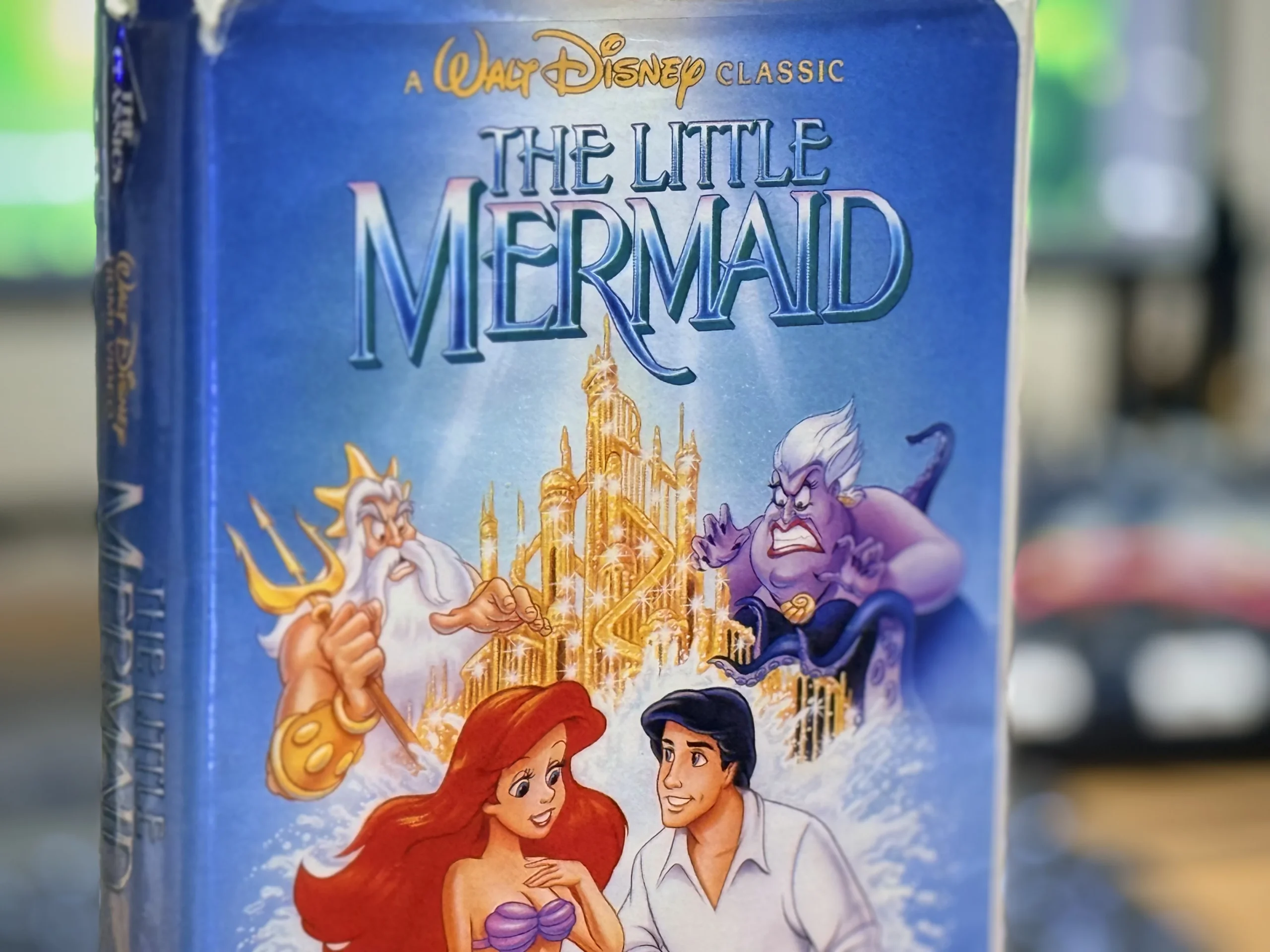

If you grew up in the 1990s, chances are you owned a VHS copy of Disney’s The Little Mermaid. What you might not have realized is that the castle on the cover art features a rather anatomically suggestive spire. This isn’t an urban legend or internet hoax; it’s real, and the story behind it is far more interesting than the conspiracy theories suggest.
The controversial cover has become one of the most talked-about pieces of Disney memorabilia, with online communities debating everything from its value to whether it was intentional. Let’s dive into the fascinating history of how exhaustion, tight deadlines, and a touch of architectural unfortunateness created a collectible that still sparks conversation three decades later.
The Artist and the All-Nighter
Bill Morrison, the illustrator behind the infamous artwork, has been remarkably open about what happened. Working at David Willardson’s illustration studio in 1990, Morrison was asked if he could complete the VHS box art for The Little Mermaid over a single weekend. Eager to prove himself on a Disney project, he said yes.
The reality of that decision hit hard. Morrison painted the castle background at approximately 3 or 4 in the morning on the day the artwork was due. Exhausted and racing against the clock, he rushed through details that would have received more attention under normal circumstances. The spire that would later cause so much controversy was simply one element in a complex illustration completed under extreme time pressure.
Morrison himself didn’t notice anything unusual about his work. In fact, he remained blissfully unaware of the controversy until a teenager in his church youth group heard about it on talk radio and called him at his studio with the news. Imagine that phone call.
The Urban Legend vs. Reality
As the controversy spread in mid-1990 (after Entertainment Weekly ran a story about it), a persistent myth emerged: a disgruntled Disney artist, angry about being fired, had deliberately drawn a penis on the cover as a final act of defiance. This story has remarkable staying power, even appearing in social media posts as recently as 2024 during The Little Mermaid‘s 35th anniversary celebrations.
The truth is far less dramatic. Morrison didn’t work directly for Disney, so he couldn’t have been “fired by Disney.” He wasn’t disgruntled. He was simply an overworked freelance artist trying to meet an impossible deadline. Disney apparently believed his explanation, because Willardson Associates continued to receive work from the studio after the incident.
However, there’s an intriguing wrinkle to this story. Some sources credit animator Ron Dias with creating the original castle artwork for theatrical promotional materials, which was then adapted for the VHS cover. According to secondhand accounts that emerged after Dias’s death in 2013, he may have included the tower shape as an inside joke, and when it was pointed out to Disney executives, they approved it anyway. The conflicting accounts add another layer of mystery to an already fascinating story.
How Long Did It Take Anyone to Notice?
Here’s what makes this story even more remarkable: the castle artwork first appeared in promotional materials and posters during the film’s original theatrical release in November 1989. The VHS launched on May 18, 1990. That means the “penis castle” was publicly visible for about a year before anyone raised concerns.
When Arizona resident Machelle Couch finally complained to Disney and the Phoenix supermarket chain Bashas’ in mid-1990, the store briefly pulled the tapes from shelves. They returned them less than 24 hours later after confirming that yes, this was indeed the official artwork, not a case of tampering.
The Collector’s Market: Hype vs. Reality
Visit online marketplaces today and you’ll find listings for the original Little Mermaid VHS ranging from $99 to an absurd $25,000. Enthusiast groups and collector circles have been vocal about the massive disconnect between asking prices and actual value.
The reality check from experienced collectors is consistent: these tapes are not particularly rare. Disney sold over 10 million copies in 1990 alone, making it the highest-selling VHS of that year. The company didn’t change the cover art until the 1997 re-release, meaning millions of copies with the controversial castle circulated for seven years.
As one frustrated collector community member pointed out, you can’t walk down the street without tripping over old Disney VHS tapes. The “banned” label is misleading; Disney never recalled the tapes. They simply created new artwork for the next release cycle, following their standard practice.
Realistic values for copies in good condition range from $7 to $300, depending on condition and whether it includes the original clamshell case. Pristine copies might fetch up to $1,000 from the right buyer, but claims of higher values are largely wishful thinking or potential price manipulation schemes.
Part of a Larger Pattern
The castle controversy didn’t exist in isolation. The Little Mermaid became associated with another controversy involving the wedding scene, where some viewers claimed the officiant had a visible erection. Disney clarified that the supposed anatomy was actually the character’s knee as he bounced while speaking, but the rumor persisted.
These incidents fed into a broader cultural fascination with supposed hidden sexual imagery in Disney films. Whether it’s the dust cloud in The Lion King or the topless woman in a window in The Rescuers, people seem eager to find adult content hidden in children’s entertainment.
The Nostalgia Factor
For many millennials, discovering the controversy as adults adds a surreal layer to childhood memories. Online communities are filled with people expressing shock and amusement: “I wish I could go back in time to check if my childhood VHS copy had the penis on it,” one person wrote, capturing the sentiment of thousands.
The clamshell VHS case itself has become a nostalgia trigger, representing a specific era of home entertainment. Even people who acknowledge the tape isn’t particularly valuable often keep it anyway. “It’s worth the conversation piece,” as collectors often note.
Bill Morrison’s Career: Beyond the Castle
Despite (or perhaps because of) the controversy, Morrison went on to have an impressive career. He co-founded Bongo Comics with Matt Groening and became executive editor of Mad Magazine. At comic book conventions, he’s frequently asked about The Little Mermaid cover, and he handles the questions with good humor and honesty.
The incident serves as a reminder that even professional artists working on major projects are human. Tight deadlines, exhaustion, and the pressure to deliver can lead to oversights that take on lives of their own.
The Verdict: Should You Keep Your Copy?
If you own one of these VHS tapes, don’t expect to fund your retirement by selling it. However, it’s genuinely a piece of pop culture history. The controversy represents a unique moment when analog media, pre-internet rumor spreading, and Disney’s carefully cultivated image collided.
The tape’s real value isn’t monetary; it’s cultural. It’s a conversation starter, a window into 1990s media controversies, and a reminder that even the most carefully managed brands can’t control everything.
So dig through your parents’ basement or your own storage boxes. If you find that clamshell case with the castle that launched a thousand debates, you’re holding a genuine artifact from a more innocent (or perhaps less observant) time. Whether it’s worth $5 or $500 matters less than the story it tells about art, commerce, exhaustion, and the human tendency to see what we want to see.
Lucky for us.. we have 2 copies in our vault 🙂
'%3e%3cg id='Final-Copy-2_2_' transform='translate(1275.000000, 200.000000)'%3e%3cpath class='st0' d='M7.4,12.8h6.8l3.1-11.6H7.4C4.2,1.2,1.6,3.8,1.6,7S4.2,12.8,7.4,12.8z'/%3e%3c/g%3e%3c/g%3e%3c/g%3e%3cg id='final---dec.11-2020'%3e%3cg id='_x30_208-our-toggle' transform='translate(-1275.000000, -200.000000)'%3e%3cg id='Final-Copy-2' transform='translate(1275.000000, 200.000000)'%3e%3cpath class='st1' d='M22.6,0H7.4c-3.9,0-7,3.1-7,7s3.1,7,7,7h15.2c3.9,0,7-3.1,7-7S26.4,0,22.6,0z M1.6,7c0-3.2,2.6-5.8,5.8-5.8 h9.9l-3.1,11.6H7.4C4.2,12.8,1.6,10.2,1.6,7z'/%3e%3cpath id='x' class='st2' d='M24.6,4c0.2,0.2,0.2,0.6,0,0.8l0,0L22.5,7l2.2,2.2c0.2,0.2,0.2,0.6,0,0.8c-0.2,0.2-0.6,0.2-0.8,0 l0,0l-2.2-2.2L19.5,10c-0.2,0.2-0.6,0.2-0.8,0c-0.2-0.2-0.2-0.6,0-0.8l0,0L20.8,7l-2.2-2.2c-0.2-0.2-0.2-0.6,0-0.8 c0.2-0.2,0.6-0.2,0.8,0l0,0l2.2,2.2L23.8,4C24,3.8,24.4,3.8,24.6,4z'/%3e%3cpath id='y' class='st3' d='M12.7,4.1c0.2,0.2,0.3,0.6,0.1,0.8l0,0L8.6,9.8C8.5,9.9,8.4,10,8.3,10c-0.2,0.1-0.5,0.1-0.7-0.1l0,0 L5.4,7.7c-0.2-0.2-0.2-0.6,0-0.8c0.2-0.2,0.6-0.2,0.8,0l0,0L8,8.6l3.8-4.5C12,3.9,12.4,3.9,12.7,4.1z'/%3e%3c/g%3e%3c/g%3e%3c/g%3e%3c/g%3e%3c/svg%3e) Your Privacy Choices
Your Privacy Choices