

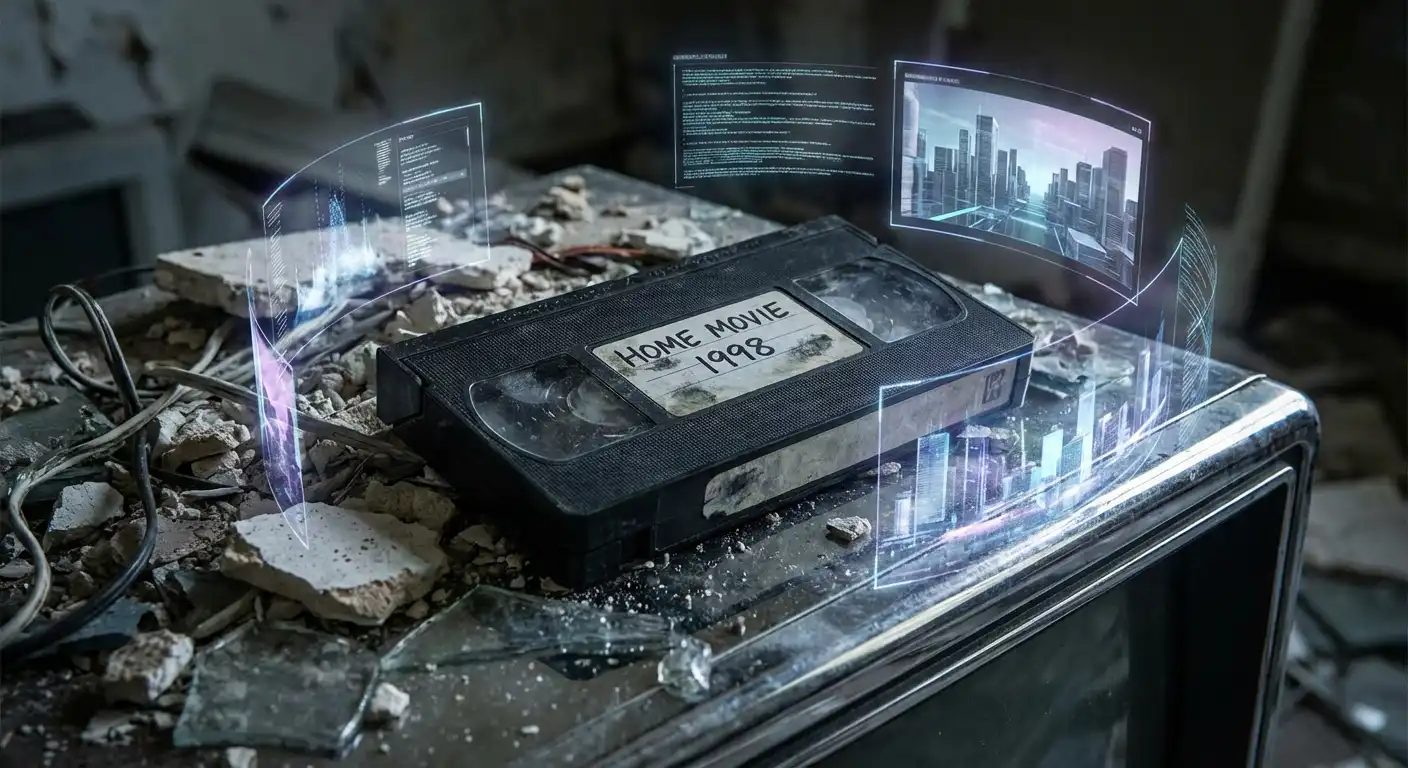

The Rise and Fall of a Media Giant
To appreciate the irony, we need to understand just how dominant VHS was when Demolition Man hit theaters in October 1993. Introduced by JVC in 1976, the Video Home System had revolutionized entertainment, giving families the unprecedented power to watch movies on their own schedule. By the time Sylvester Stallone was cryogenically frozen on screen, VHS manufacturers were selling as many as 15 million units per year.
When Warner Bros. released Demolition Man on VHS in March 1994, nobody could have imagined that within just three years, a new format called DVD would begin the format’s slow march toward extinction. The timeline of VHS’s decline reads like a countdown to obsolescence:
- 1997: DVD arrives in American homes
- 1998: VHS sales peak, then begin their irreversible decline
- 2003: DVD rentals surpass VHS for the first time
- 2006: The last major motion picture releases on VHS
- 2008: The final standalone VHS player rolls off the production line
- 2016: Funai ceases all VHS equipment production, citing falling sales and component shortages
Now nearly extinct, the VHS tape that once seemed invincible has become a relic, surviving only in the collections of nostalgic enthusiasts and the occasional thrift store bin.
A Crystal Ball Wrapped in Magnetic Tape
Here’s where the story gets fascinating. While Demolition Man was being distributed on a format destined for obsolescence, the movie itself was making predictions about 2032 that would prove eerily accurate. The film envisioned a future filled with:
- Self-driving vehicles navigating city streets without human intervention
- Video conferencing as a primary means of communication
- Voice-activated technology controlling everything from doors to information systems
- Touch-screen tablets used for everyday tasks
- Digital currency and cashless transactions
- Biometric implants and GPS tracking for security
- Social distancing and contactless greetings (which gained renewed attention during the COVID-19 pandemic)
The film even predicted Arnold Schwarzenegger’s political career, referencing a constitutional amendment allowing foreign-born citizens to become president—a joke that became reality when the Terminator star became California’s governor in 2003.
As Sylvester Stallone himself reflected in 2022: “The writers were way ahead of their time.” Futurist Amy Webb noted that the best science fiction takes signals already present in society and extrapolates them pragmatically. In 1993, early smartphones and haptic screens were emerging; Demolition Man simply connected the dots.
The Blind Spot in the Vision
So why didn’t Demolition Man predict the death of physical media? Why didn’t this prescient film show a world where movies existed as digital files rather than magnetic tape or plastic discs?
The answer reveals something beautiful about human nature: we’re remarkably good at imagining revolutionary changes in areas we’re actively thinking about, but remarkably blind to transformations in things we take for granted. In 1993, VHS was so ubiquitous, so seemingly permanent, that imagining its extinction would have seemed more far-fetched than cryogenic freezing or telepathic rat burgers.
This blind spot doesn’t diminish the film’s visionary achievements—it enhances them. It reminds us that even our most accurate predictions about the future are incomplete. We see what we’re looking for, but miss what’s right in front of us.
What This Teaches Us About Tomorrow
The parallel extinction of VHS and the old world depicted in Demolition Man offers us a powerful lesson: obsolescence comes for everything, often from directions we don’t expect. The technologies we consider permanent today—smartphones, streaming services, even the internet as we know it—will eventually join VHS in the museum of yesterday’s tomorrows.
But here’s the inspirational twist: this isn’t a story about loss. It’s a story about evolution and possibility.
VHS gave way to DVD, which gave way to Blu-ray, which gave way to streaming. Each transition felt like an ending, but each was actually a beginning. The same is true for every prediction Demolition Man made. Self-driving cars aren’t replacing human drivers to limit us—they’re freeing us to use our time differently. Video conferencing didn’t isolate us—it connected us across impossible distances.
The film’s greatest prediction might be the one it made accidentally: that the future will surprise us, that it will come in forms we can’t quite imagine, and that what seems permanent today will be tomorrow’s nostalgia.
Your Future Is Being Written Now
As you read this on a device that didn’t exist when Demolition Man was released on VHS, consider what blind spots might exist in our current vision of tomorrow. What technologies do we assume will last forever? What changes are happening right now that we’re too close to see?
The story of Demolition Man and VHS isn’t about getting predictions right or wrong, it’s about staying curious, adaptable, and open to transformation. It’s about recognizing that the future belongs to those who can imagine it, even imperfectly.



'%3e%3cg id='Final-Copy-2_2_' transform='translate(1275.000000, 200.000000)'%3e%3cpath class='st0' d='M7.4,12.8h6.8l3.1-11.6H7.4C4.2,1.2,1.6,3.8,1.6,7S4.2,12.8,7.4,12.8z'/%3e%3c/g%3e%3c/g%3e%3c/g%3e%3cg id='final---dec.11-2020'%3e%3cg id='_x30_208-our-toggle' transform='translate(-1275.000000, -200.000000)'%3e%3cg id='Final-Copy-2' transform='translate(1275.000000, 200.000000)'%3e%3cpath class='st1' d='M22.6,0H7.4c-3.9,0-7,3.1-7,7s3.1,7,7,7h15.2c3.9,0,7-3.1,7-7S26.4,0,22.6,0z M1.6,7c0-3.2,2.6-5.8,5.8-5.8 h9.9l-3.1,11.6H7.4C4.2,12.8,1.6,10.2,1.6,7z'/%3e%3cpath id='x' class='st2' d='M24.6,4c0.2,0.2,0.2,0.6,0,0.8l0,0L22.5,7l2.2,2.2c0.2,0.2,0.2,0.6,0,0.8c-0.2,0.2-0.6,0.2-0.8,0 l0,0l-2.2-2.2L19.5,10c-0.2,0.2-0.6,0.2-0.8,0c-0.2-0.2-0.2-0.6,0-0.8l0,0L20.8,7l-2.2-2.2c-0.2-0.2-0.2-0.6,0-0.8 c0.2-0.2,0.6-0.2,0.8,0l0,0l2.2,2.2L23.8,4C24,3.8,24.4,3.8,24.6,4z'/%3e%3cpath id='y' class='st3' d='M12.7,4.1c0.2,0.2,0.3,0.6,0.1,0.8l0,0L8.6,9.8C8.5,9.9,8.4,10,8.3,10c-0.2,0.1-0.5,0.1-0.7-0.1l0,0 L5.4,7.7c-0.2-0.2-0.2-0.6,0-0.8c0.2-0.2,0.6-0.2,0.8,0l0,0L8,8.6l3.8-4.5C12,3.9,12.4,3.9,12.7,4.1z'/%3e%3c/g%3e%3c/g%3e%3c/g%3e%3c/g%3e%3c/svg%3e) Your Privacy Choices
Your Privacy Choices