


The Diagnosis
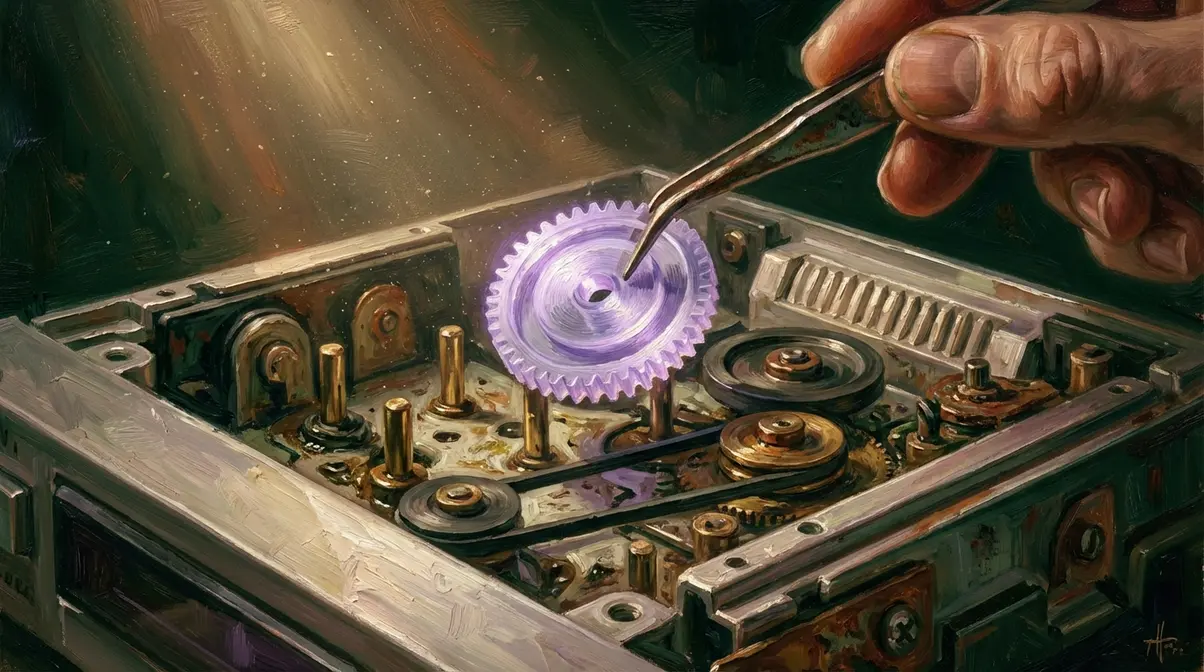
There’s a sound that vintage audio enthusiasts have learned to dread: a rhythmic ticking during playback, quiet at first, then insistent. It means the RDG5772ZC gear—approximately one centimeter in diameter, buried in the tape transport mechanism of your Technics RS-TR265 or RS-TR333—has started to fail. Two teeth missing, maybe three. The semi-flexible plastic that Panasonic used in the 1980s and 90s doesn’t age gracefully. It cracks. The deck stops working. And Panasonic stopped making replacement parts decades ago.
This is the story of what happened when the parts ran out.
What Broke
The problem isn’t limited to one model. Panasonic’s cassette deck mechanism design—used across Technics and Panasonic tape decks throughout the 80s and 90s—relied on these small gears. So did the Panasonic 3DO gaming consoles, the FZ-1 released in 1993 and FZ-10 in 1994. Different products, same engineering philosophy, same failure point. The material specification seemed sound at the time: semi-flexible, designed to absorb shock and reduce noise. But three decades later, the flexibility became brittleness.
One repair technician investigating a dead cassette deck found “one of the plastic gears, about 1 cm in diameter, in the tape transport mechanism was missing two teeth.” Another described the symptom: “You can identify a problem with this gear when you hear a ticking noise during playback.” The diagnosis became common enough that repair forums developed shorthand. On enthusiast message boards, veterans would respond to descriptions of the ticking with a single word: “Gear.”
The Scorched Earth Parts Policy
Manufacturers don’t keep inventory forever. Storage costs money, and products from the Reagan administration don’t generate much support ticket volume. One frustrated repairer put it plainly: “Im very sad when it comes to the scorched earth parts policy most companies have.” Even years before parts became completely unavailable, prices were described as “absolutely ridiculous.” The alternative was cannibalizing other broken decks, assuming you could find one with an intact gear. The repair community developed a grim term for components that couldn’t be sourced anywhere: unobtanium.
According to the Right to Repair campaign, this pattern produces 62 million tonnes of electrical waste annually. Only 22.3 percent gets recycled. The rest sits in landfills because a single small component failed.
The Workaround
Individual makers started reverse-engineering the gears. They measured surviving examples, built CAD models, and sent files to 3D printers. The parts that emerged weren’t identical to the originals—the material properties of printed plastic differ from injection-molded components—but they were close enough. “Semi-flexible durable plastic similar to original part so it works well without noise,” one seller advertised. The price: $9 to $10 per gear.
Small operations on eBay and specialized sites like FiXAMENT.com began offering the parts. Customer testimonials accumulated: “Martin’s 3-D Printed replacement gear fitted exactly and the deck now works perfectly again.” Another: “Worked beautifully, resurrected my disc drive and the 3DO is alive again.” These weren’t professional repair shops with access to manufacturer supply chains. They were hobbyists with printers, solving a problem that corporations had abandoned.
The economics were stark. Shell Nigeria reverse-engineered and printed an obsolete seal cover for a mooring buoy, cutting lead time from 16 weeks to two and reducing replacement costs by 90 percent. Another company avoided a $700 assembly pod replacement by printing the failed component for $1. The cassette deck gears represented the consumer-scale version of this equation: throw away a $300 deck, or spend $10 and an hour of labor.
The Legal Shift
In summer 2021, the European Union’s Ecodesign and Energy Labelling regulation gave consumers a legal right to repair, requiring manufacturers to make spare parts available for up to 10 years. Then in February 2024, an amendment to the Right-to-Repair directive explicitly permitted the use of 3D-printed parts by both OEMs and independent repairers. What had been a gray-market workaround became sanctioned practice.
Philips launched “Philips Fixables,” offering officially drafted 3D-printable replacement components. Mark Dickin, Additive Manufacturing & Moulding Engineering Manager at Ricoh 3D, argued that 3D printing could “reduce the need for stocking a huge physical inventory and vast warehouse space by holding less frequently required parts as digital files and reproducing them as required.” Tibor van Melsem Kocsis, Founder and CEO of DiManEx, envisioned “a digital inventory to understand which parts are the right ones to print on-demand, and ultimately make that accessible to end customers or repair shops.”
The concept sounded futuristic, but the implementation was already happening in basements and small workshops. As one enthusiast noted: “3D printing is the next industrial revolution. couple a 3D printer with a 3D scanner and you can replace any part you can manage to crazy glue back together.”
What Gets Saved
The cassette deck repair community has its own perspective on what’s worth preserving. “With the seeming resurgence of tape media and the ever increasing population of aging decks, believe me, there is no problem with competition!” one technician wrote. “Not only that, but there are ZERO quality decks being manufactured today, so if someone wants something decent, vintage is the way to go. And they will need to be serviced.”
There’s an argument that none of this matters—that cassette decks and 3DO consoles are obsolete technology, superseded by better formats. But the repair community isn’t motivated by pure nostalgia. They point out that the mechanical engineering in high-end 1980s tape decks hasn’t been replicated in modern equipment. The formats may be obsolete, but the build quality isn’t. The question isn’t whether cassettes are better than streaming. It’s whether functional equipment should become e-waste because a $10 part isn’t available.
One practical concern remains: material selection. Online discussions about 3D-printed gears consistently debate whether PLA, PETG, or nylon holds up better under stress. The original Panasonic gears lasted 30 years before failing. Whether printed replacements will match that lifespan is unknown. But the alternative—no parts at all—makes the question academic.
The International Space Station uses 3D printers to manufacture spare parts in orbit. The same technology now keeps 35-year-old cassette decks running in living rooms. The scale is different, but the principle is identical: when you can’t order a replacement, you make one.


'%3e%3cg id='Final-Copy-2_2_' transform='translate(1275.000000, 200.000000)'%3e%3cpath class='st0' d='M7.4,12.8h6.8l3.1-11.6H7.4C4.2,1.2,1.6,3.8,1.6,7S4.2,12.8,7.4,12.8z'/%3e%3c/g%3e%3c/g%3e%3c/g%3e%3cg id='final---dec.11-2020'%3e%3cg id='_x30_208-our-toggle' transform='translate(-1275.000000, -200.000000)'%3e%3cg id='Final-Copy-2' transform='translate(1275.000000, 200.000000)'%3e%3cpath class='st1' d='M22.6,0H7.4c-3.9,0-7,3.1-7,7s3.1,7,7,7h15.2c3.9,0,7-3.1,7-7S26.4,0,22.6,0z M1.6,7c0-3.2,2.6-5.8,5.8-5.8 h9.9l-3.1,11.6H7.4C4.2,12.8,1.6,10.2,1.6,7z'/%3e%3cpath id='x' class='st2' d='M24.6,4c0.2,0.2,0.2,0.6,0,0.8l0,0L22.5,7l2.2,2.2c0.2,0.2,0.2,0.6,0,0.8c-0.2,0.2-0.6,0.2-0.8,0 l0,0l-2.2-2.2L19.5,10c-0.2,0.2-0.6,0.2-0.8,0c-0.2-0.2-0.2-0.6,0-0.8l0,0L20.8,7l-2.2-2.2c-0.2-0.2-0.2-0.6,0-0.8 c0.2-0.2,0.6-0.2,0.8,0l0,0l2.2,2.2L23.8,4C24,3.8,24.4,3.8,24.6,4z'/%3e%3cpath id='y' class='st3' d='M12.7,4.1c0.2,0.2,0.3,0.6,0.1,0.8l0,0L8.6,9.8C8.5,9.9,8.4,10,8.3,10c-0.2,0.1-0.5,0.1-0.7-0.1l0,0 L5.4,7.7c-0.2-0.2-0.2-0.6,0-0.8c0.2-0.2,0.6-0.2,0.8,0l0,0L8,8.6l3.8-4.5C12,3.9,12.4,3.9,12.7,4.1z'/%3e%3c/g%3e%3c/g%3e%3c/g%3e%3c/g%3e%3c/svg%3e) Your Privacy Choices
Your Privacy Choices