

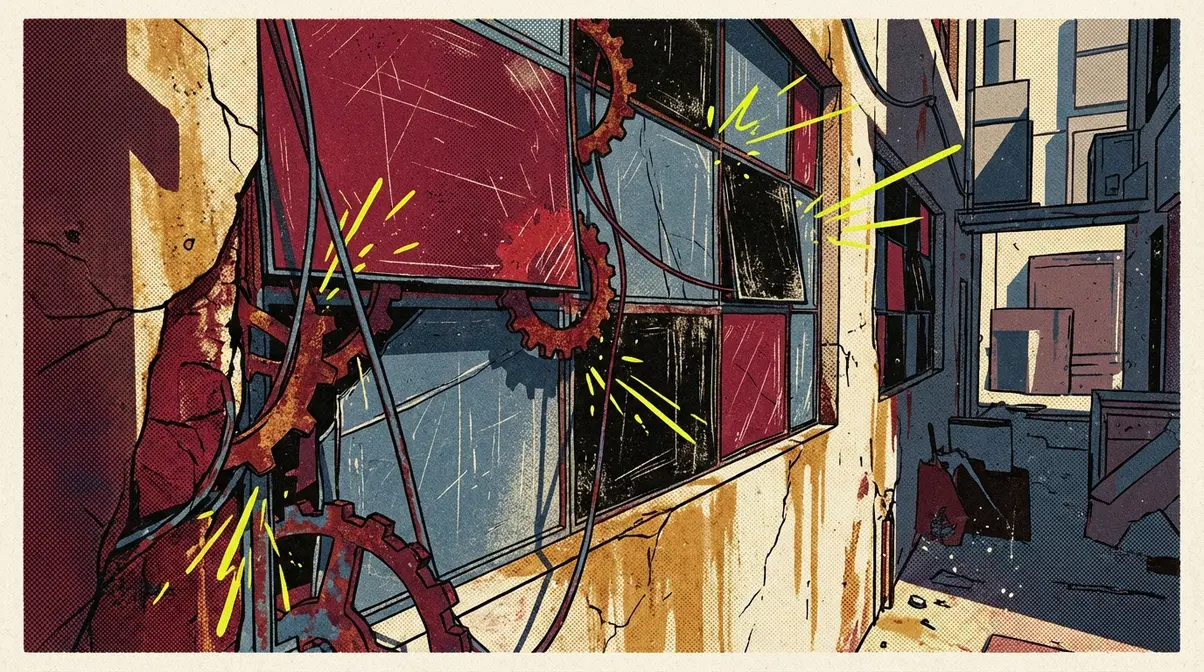

Here’s something nobody warned you about when street art started winning prizes and filling Instagram grids: the wall might not be enough anymore. Not because walls stopped mattering, but because some artists kept pulling at a thread until the whole surface unraveled into something stranger, louder, more mechanical. Something that spins.
Last week in Madrid, Gonzalo Borondo unveiled Redentora at the third edition of the LuzMadrid International Festival, and if you weren’t there between March 12 and 14, you missed it. Three days. That’s all it got. The piece was a large-scale zoetrope, that 19th-century optical drum that predates cinema, built inside a domed structure visitors could walk into. Figures of victims and executioners cycled around the interior, animated by rotation and synchronized light, while a soundscape by the brilliantly unclassifiable El Niño de Elche filled the space. Borondo described it as “a kind of automated, mechanical ritual… that plays with the dimension between the sacred and the idea of sacrifice… and at the same time the industrial side, the machine.”
The location was not incidental. It never is with Borondo. Redentora occupied the Glorieta de San Víctor in Madrid’s Pico del Pañuelo neighborhood, inside the Arganzuela district. The housing there was built in 1927 for workers at the city’s former municipal slaughterhouse. So the spinning images of slaughter and sacrifice weren’t decorative metaphor. They were memory, mechanized and set loose over the ground where it actually happened.
A Restorer’s Son Who Started Tagging
Borondo was born in Valladolid in 1989 and grew up in Segovia, where his father spent his life restoring religious art and his mother let him paint the hallway of the house. He landed in Madrid’s graffiti and activist art scene around 2003, still a teenager. By 2007 he was painting in public space. He later studied at the Academy of Fine Arts in Rome. The early work was raw and figurative, scratched into glass and layered onto decaying surfaces, portraits that looked like they were trying to claw their way out of the architecture.
That was the version of Borondo the street art world fell in love with. Goya comparisons came easy. The work was dark, physical, site-responsive, and technically ferocious. He was painting on walls and windows across Europe, and people paid attention.
Then, gradually, the walls started disappearing from the work.
From Surface to Structure
In 2017, he intervened on a cemetery chapel in Selci, Italy, with Cenere, a piece that won the Arte Laguna Award the following year. In 2018 he directed Sacrilege, an operatic performance at Théâtre Toursky in Marseille. In 2019, the Bordeaux city council handed him an old Protestant church in the Chartrons district that had been shuttered for thirty years, and he turned it into Merci, an installation featuring a motorized organ that resonated through the nave in ways it was never designed to. The CAPC Musée d’art contemporain de Bordeaux acquired the piece. In 2020, Insurrecta spread across 32 billboards at 17 locations in Segovia. Last year, Chrysalis covered over 600 square meters of scaffolding mesh at the Villa Stuck Museum in Munich with white and gold mythological figures that shifted with the light and the viewer’s angle.
Each project moved further from the spray can and closer to something architectural, theatrical, mechanical. And each one kept the thing that made the street work matter: an obsessive, almost devotional attention to place.
The Zoetrope Problem
There’s a conversation that keeps circling in online art communities, and Redentora is a perfect new case study for it. The question is simple and unanswerable: when does a street artist stop being a street artist? Borondo’s work is still public, still free, still site-specific, still temporary. But a commissioned walk-in zoetrope with engineered LED systems and a dedicated metal structure is not a stencil on a freeway overpass. The budgets are different. The access points are different. The institutional scaffolding is visible.
Borondo seems aware of this tension without being particularly troubled by it. When works he’d made in public space were removed and sold without his consent, he responded plainly: “These interventions in public space weren’t made with the intention to create objects to consume, but to dialogue and accompany their surroundings.” The implication is that the street isn’t a medium. It’s a relationship. And relationships can change shape.
Kinetic Art Came Back Through the Side Door
The term “kinetic art” has been kicking around since Naum Gabo and Antoine Pevsner used it in their Realistic Manifesto in 1920. Moholy-Nagy built his Light-Space-Modulator in 1930. Tinguely set his Homage to New York on fire in 1960. The movement peaked in visibility after the landmark Paris exhibition Le Mouvement in 1955 and then, like most movements, got absorbed into the broader contemporary art ecosystem and stopped making headlines.
What’s interesting now is where kinetic work is resurfacing: not in galleries, but in streets and festivals. Denver is launching aerial kinetic sculpture installations over public roads. Artists across disciplines are building participatory, immersive works that use motors, rotation, and physical presence instead of screens. Borondo’s zoetrope fits into this current, but it also resists it. The zoetrope is pre-digital, pre-cinematic, almost stubbornly analog. It insists that the illusion of movement is a mechanical phenomenon, not a computational one. You stand inside the drum and your own eyes do the rendering.
Three Days and Gone
Poet Ángela Segovia, who wrote the critical text accompanying Redentora, called it “a machine destined to produce redemption, but also a giant toy.” She described it as a dome that evokes classical architecture but is built like a child’s construction set. That duality feels right. There was something playful about the whole enterprise, and something dead serious.
Redentora existed for 72 hours. If you want to see what Borondo does next, you’ll have to watch his site. The wall is long gone. What replaced it keeps spinning.

'%3e%3cg id='Final-Copy-2_2_' transform='translate(1275.000000, 200.000000)'%3e%3cpath class='st0' d='M7.4,12.8h6.8l3.1-11.6H7.4C4.2,1.2,1.6,3.8,1.6,7S4.2,12.8,7.4,12.8z'/%3e%3c/g%3e%3c/g%3e%3c/g%3e%3cg id='final---dec.11-2020'%3e%3cg id='_x30_208-our-toggle' transform='translate(-1275.000000, -200.000000)'%3e%3cg id='Final-Copy-2' transform='translate(1275.000000, 200.000000)'%3e%3cpath class='st1' d='M22.6,0H7.4c-3.9,0-7,3.1-7,7s3.1,7,7,7h15.2c3.9,0,7-3.1,7-7S26.4,0,22.6,0z M1.6,7c0-3.2,2.6-5.8,5.8-5.8 h9.9l-3.1,11.6H7.4C4.2,12.8,1.6,10.2,1.6,7z'/%3e%3cpath id='x' class='st2' d='M24.6,4c0.2,0.2,0.2,0.6,0,0.8l0,0L22.5,7l2.2,2.2c0.2,0.2,0.2,0.6,0,0.8c-0.2,0.2-0.6,0.2-0.8,0 l0,0l-2.2-2.2L19.5,10c-0.2,0.2-0.6,0.2-0.8,0c-0.2-0.2-0.2-0.6,0-0.8l0,0L20.8,7l-2.2-2.2c-0.2-0.2-0.2-0.6,0-0.8 c0.2-0.2,0.6-0.2,0.8,0l0,0l2.2,2.2L23.8,4C24,3.8,24.4,3.8,24.6,4z'/%3e%3cpath id='y' class='st3' d='M12.7,4.1c0.2,0.2,0.3,0.6,0.1,0.8l0,0L8.6,9.8C8.5,9.9,8.4,10,8.3,10c-0.2,0.1-0.5,0.1-0.7-0.1l0,0 L5.4,7.7c-0.2-0.2-0.2-0.6,0-0.8c0.2-0.2,0.6-0.2,0.8,0l0,0L8,8.6l3.8-4.5C12,3.9,12.4,3.9,12.7,4.1z'/%3e%3c/g%3e%3c/g%3e%3c/g%3e%3c/g%3e%3c/svg%3e) Your Privacy Choices
Your Privacy Choices