



Somewhere inside Korg’s headquarters in Tokyo, an 85-year-old man rides the train to work. His commute takes about ninety minutes each way. He has been doing this, with variations, since roughly 1970. Sometimes on the train he thinks about new instruments. His name is Fumio Mieda, and there is a reasonable chance you have never heard of him, even though his fingerprints are on some of the most consequential synthesizers ever built.
Mieda designed or worked on the Korg MiniKorg 700 (one of Japan’s first synths), the Poly-800, the M1, and the MS-20. He has had a massive but largely unappreciated influence on dance music. As Attack Magazine noted in their 2023 interview, the list of artists who owe something to his circuits reads like a hall of fame: Daft Punk, Aphex Twin, Portishead, Jean-Michel Jarre. But Mieda never started his own company, never became a brand. He was hired by the founder of Korg, Tsutomu Katoh, back in 1967. He stayed. He kept building things.
The Wrong Way to Build a Polysynth
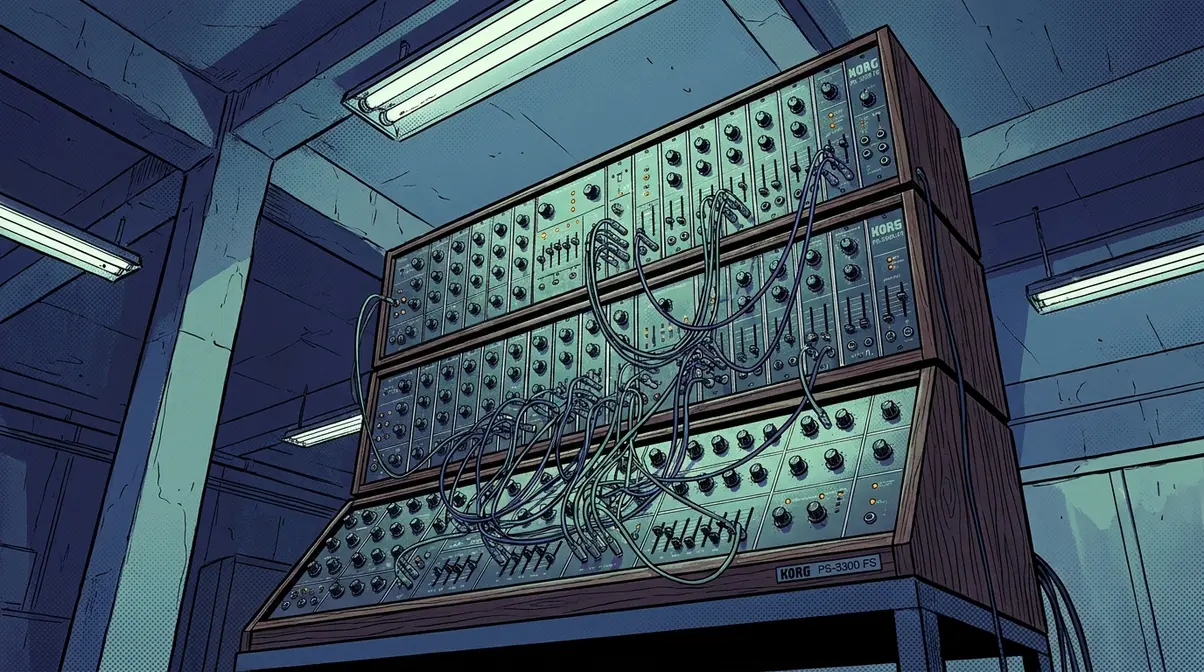
In 1977, Mieda’s most ambitious idea became real. Keio Electronic (now known as Korg) introduced the PS-3100 and PS-3300 polyphonic synthesizers, which had been developed over several years by Mieda, employing a “divide-down” oscillator architecture. The PS-3300 was, to put it bluntly, overkill. It essentially comprised three PS-3100 units, providing three independent oscillators, filters, envelopes, and amplifiers for every note, with the three modules individually adjustable and then mixed at the final output.
Read that again. Not three oscillators total. Three oscillators, three filters, three envelopes, three amplifiers per key. This design provides 144 independent voices in total, with 48 voices per layer, one dedicated voice circuit per key across the instrument’s 48-note keyboard, ensuring full polyphony without voice stealing or allocation limitations. No note priority schemes, no allocation algorithms, no compromises. Every key gets everything, all the time.
I’d argue this is one of the most beautifully irrational design decisions in the history of electronic instruments. The synthesizer industry was heading toward efficiency. The PS synthesizers quickly became overshadowed by the release of the Sequential Prophet-5 in 1978; despite the PS series’ superior polyphony and routing flexibility, the Prophet-5’s digital patch storage was seen as a groundbreaking feature. The future belonged to voice allocation, to doing more with less. Mieda went the other way. He built a synth where 144 voices sat waiting, most of them silent at any given moment, each one slightly different from the next because of the inherent variations in analog components.
Bob Moog praised the PS-3300 as “the best synthesizer for fat sounds.” Korg designer Yasuhiko Mori estimates that only 30 to 50 units of the PS-3300 were produced due to its high cost, while approximately 300 to 600 units of the PS-3100 were manufactured. Korg introduced the PS-3300 at $7,500 in 1977, and it is now so rare and coveted that one sold for nearly $100,000 in 2021.
What Mieda Actually Wanted
The common reading of the PS-3300 is that it’s a pad machine. A wall-of-sound generator. That’s true, but it misses what Mieda was actually after. On Korg’s product page for the reissue, his own words tell a different story: Mieda envisioned polyphony as more than just playing chords; it was about enabling musicians to explore any scale, including just intonation, and to experiment with clusters of notes for unique sonic possibilities.
Each of the PS-3300’s three synthesizer layers features 12 microtuning knobs, one per chromatic pitch. This temperament adjust section allows the user to independently tune each keyboard note to facilitate the creation of alternative scales. Mieda wasn’t just solving the polyphony problem. He was questioning the assumption that a keyboard should play in equal temperament at all. In my view, this is the detail that separates the PS-3300 from every other big polysynth of its era. It wasn’t trying to be a better organ. It was trying to be a different kind of instrument entirely.
In a 2023 Attack Magazine interview, Mieda revealed another piece of his philosophy. In his mind, effects pedals and synths are the same thing; synths just happen to be an extension of effects. He traced the lineage back to fuzz in the 1960s: he was surprised that distortion was allowed in music, and found that if he changed the shape of distortion over time, it sounded like a trumpet. That’s not the thinking of someone building a keyboard instrument. That’s the thinking of someone sculpting sound from raw electricity.
The Reissue, and What It Means to Rebuild a Dead End
In 2024, Korg announced plans to release a hardware reissue of the PS-3300, dubbed the PS-3300 FS, incorporating digital patch storage with 16 banks of 16 slots each, USB and MIDI connectivity, and an updated model featuring 49 keys and 49-voice analog polyphony, up from the original’s 48. Mieda serves as creator of the original and technical supervisor for the updated take.
Korg’s expert engineering team worked closely with Mieda, whose insights and guidance ensured that every aspect of the recreation stayed true to the spirit of the original. The PS-3300 FS was reincarnated by the same engineering team which brought back the MS-20, ARP Odyssey, miniKORG 700 FS, and ARP 2600. Yoshihito Yamada, Chief Engineer of Korg Analogue Synthesizers, framed the project as something more than product development. As Sound on Sound reported, Yamada said: “Bringing back to life these legendary machines is not only a process of reproducing circuits and sounds, but also of learning and embracing the essence of the philosophy and development of synthesizers.”
The challenges were real. The original cadmium sulfide circuit in the three-band resonator was replaced with modern components for safety and to comply with regulations. The keyboard was expanded from 48 keys (F to E) to 49 keys (C to C), and the original 60-pin cable was replaced with a more user-friendly 8-pin connection. The total voice count now sits at 147. That is, to my knowledge, more discrete analog voice circuits than any other keyboard synthesizer currently in production.
The anticipated price was around $13,000 at announcement, though actual retail pricing varies by dealer. Due to the intricate hand-crafted nature of the PS-3300, production capacity is naturally limited, and it is offered as a limited-edition instrument. On synth forums, the reaction has been predictably split. Some call it a vanity product for collectors. Others point out that originals go for $60,000 to $80,000 on the used market, when they appear at all.
The Paradox That Won’t Quit
There’s a tension at the heart of the PS-3300 that no reissue can resolve, and it’s the same tension that makes the instrument fascinating. It is simultaneously over-engineered and under-engineered. You get 147 separate voice circuits, but each individual voice is simpler than what you’d find on a basic monosynth. Voice circuitry in the PS-3100 (and by extension the PS-3300) was greatly simplified in many places to cut costs and make it possible to build at all. The envelope-to-filter control used a diode clipping trick instead of a proper VCA per voice. It was brute force and cost-cutting in the same box.
The PS series was quickly overshadowed by the Prophet-5, and by 1981 the PS series ceased production, leading Korg to focus on developing more conventional polysynths such as the Polysix, Poly-61, and DW synthesizers. But the technological advancements from the PS series were integrated into the Korg MS-20 monophonic synthesizer, also launched in 1978. The dead end bore fruit.
Mieda, now in his mid-eighties, seems unbothered by the market’s verdict on his most ambitious creation. In the Attack Magazine interview, he reflected on why certain instruments endure: the majority of electronic instruments are forgotten after 10 or 20 years, but those that are remade have a good and clear reason for doing so. He added, in a quote that to me captures everything about the PS-3300’s stubborn appeal: the ones that last do so “because they have something that modern instruments can’t do.”
The PS-3300 FS can’t do everything. It can’t save patches as quickly as a workstation. It can’t compete on features-per-dollar with a laptop running any of the excellent software emulations now available, from Cherry Audio’s $69 plugin to Korg’s own KORG Collection 6 software version. What it can do is sit in front of you, 147 analog circuits humming with their own individual imperfections, and dare you to play something you haven’t played before. In my view, that’s not inefficiency. That’s conviction.
Mieda told MusicTech he intends to keep developing instruments as long as he has the strength. His commute is still ninety minutes. He still rides the train.


'%3e%3cg id='Final-Copy-2_2_' transform='translate(1275.000000, 200.000000)'%3e%3cpath class='st0' d='M7.4,12.8h6.8l3.1-11.6H7.4C4.2,1.2,1.6,3.8,1.6,7S4.2,12.8,7.4,12.8z'/%3e%3c/g%3e%3c/g%3e%3c/g%3e%3cg id='final---dec.11-2020'%3e%3cg id='_x30_208-our-toggle' transform='translate(-1275.000000, -200.000000)'%3e%3cg id='Final-Copy-2' transform='translate(1275.000000, 200.000000)'%3e%3cpath class='st1' d='M22.6,0H7.4c-3.9,0-7,3.1-7,7s3.1,7,7,7h15.2c3.9,0,7-3.1,7-7S26.4,0,22.6,0z M1.6,7c0-3.2,2.6-5.8,5.8-5.8 h9.9l-3.1,11.6H7.4C4.2,12.8,1.6,10.2,1.6,7z'/%3e%3cpath id='x' class='st2' d='M24.6,4c0.2,0.2,0.2,0.6,0,0.8l0,0L22.5,7l2.2,2.2c0.2,0.2,0.2,0.6,0,0.8c-0.2,0.2-0.6,0.2-0.8,0 l0,0l-2.2-2.2L19.5,10c-0.2,0.2-0.6,0.2-0.8,0c-0.2-0.2-0.2-0.6,0-0.8l0,0L20.8,7l-2.2-2.2c-0.2-0.2-0.2-0.6,0-0.8 c0.2-0.2,0.6-0.2,0.8,0l0,0l2.2,2.2L23.8,4C24,3.8,24.4,3.8,24.6,4z'/%3e%3cpath id='y' class='st3' d='M12.7,4.1c0.2,0.2,0.3,0.6,0.1,0.8l0,0L8.6,9.8C8.5,9.9,8.4,10,8.3,10c-0.2,0.1-0.5,0.1-0.7-0.1l0,0 L5.4,7.7c-0.2-0.2-0.2-0.6,0-0.8c0.2-0.2,0.6-0.2,0.8,0l0,0L8,8.6l3.8-4.5C12,3.9,12.4,3.9,12.7,4.1z'/%3e%3c/g%3e%3c/g%3e%3c/g%3e%3c/g%3e%3c/svg%3e) Your Privacy Choices
Your Privacy Choices