


Here’s the thing about Ghost in the Shell that nobody talks about enough: most people who love it have never actually experienced the original version. They fell in love with Mamoru Oshii’s 1995 film, or with Kenji Kamiyama’s Stand Alone Complex, and they assumed that the brooding, rain-slicked philosophical tone was baked into the franchise’s DNA. It wasn’t. Masamune Shirow’s 1989 manga was weirder, funnier, and far more alive than any of its screen adaptations ever dared to be. And now, thirty-seven years later, Science Saru is finally trying to put that version on screen.
This is either the best idea anyone’s had for the franchise since Section 9, or a spectacular misread of the audience. I think it’s the former. Let me explain why.
The Adaptation Nobody Made
When Bandai Namco Filmworks announced a new Ghost in the Shell series back in May 2024, the reaction was a cocktail of hope and dread. Hope because the franchise had been dormant since Netflix’s SAC_2045 wrapped in 2022. Dread because SAC_2045 existed at all. The CG-animated series was, to put it charitably, a divisive experiment. Online fan communities were less charitable. One commenter captured the prevailing mood: the CG “sent it out to die,” and a series like this “really needs to be drawn.” Another called the 2026 project “the last opportunity for the franchise to get back some relevance after 20+ years of literal slop.”
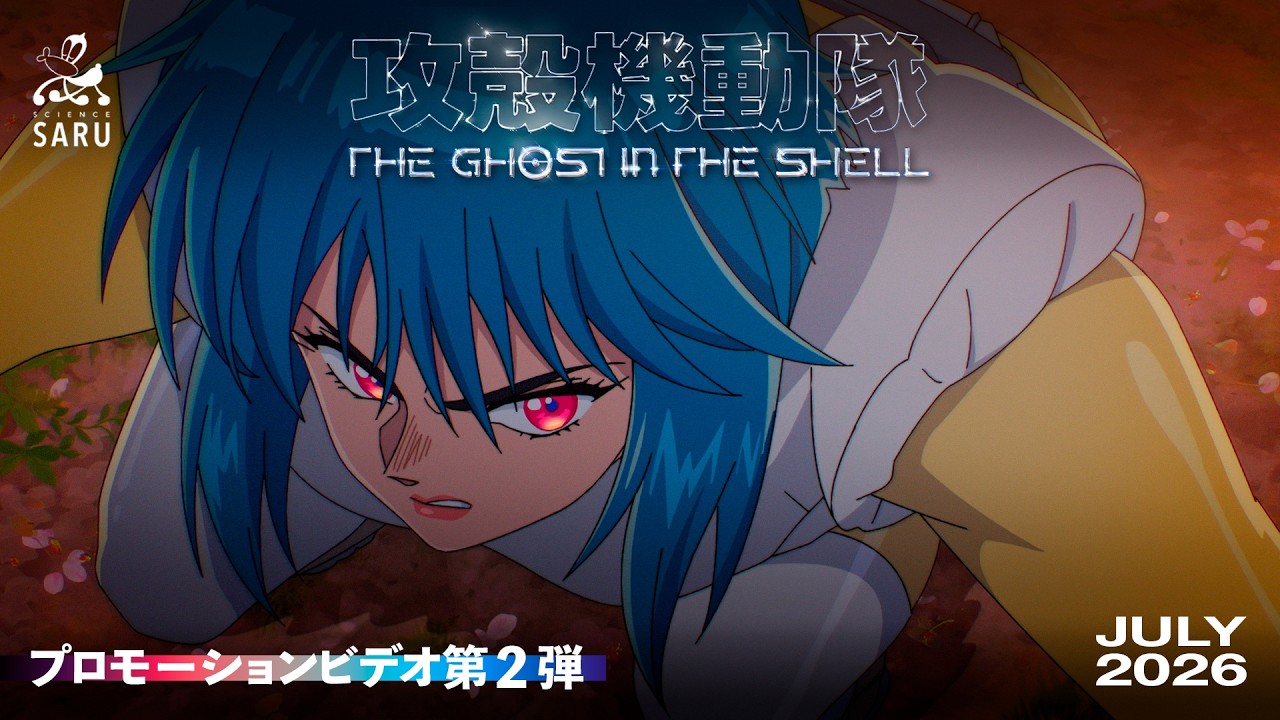
So Science Saru had to do something bold. And the boldest possible move, it turns out, was going back to the source. The promotional materials released in January 2026 made it immediately clear: this adaptation’s character designs, color palette, and overall energy are closer to Shirow’s manga than anything we’ve seen in animation before. The neon-tinted, expressive, slightly unhinged visual language of the original is finally getting its moment.
The 43-second teaser that dropped at AnimeJapan 2026 only confirmed it. Kinetic animation. A vivid, ’90s-flavored color palette. And Fuchikomas, the AI think tanks from the manga, in motion for the first time, replacing the Tachikomas that Stand Alone Complex fans know and love. This is not a remix. This is a different song entirely.
The Debate That Matters
And that’s exactly where the fault line runs. The fan community is genuinely split, and it’s one of the more interesting arguments happening in anime discourse right now.
On one side, you have the manga readers who have waited three decades for this. They’ll tell you that Shirow’s original work was action-driven, visually playful, and packed with dark humor that every prior adaptation stripped away. In 1995, character designer Hiroyuki Okiura deliberately aged Motoko up and dialed down her comedic expressions and rebellious streak to match a more serious tone. Stand Alone Complex added some levity back, but it was still a fundamentally different animal. One longtime fan put it perfectly: “It only took 30-something years, but we finally got an anime adaptation of GitS that has the same art style as the manga.”
On the other side, you have people whose entire relationship with Ghost in the Shell was forged in the blue-gray melancholy of Oshii’s film or the meticulous procedural intelligence of SAC. For them, the manga’s tone is jarring. One commenter admitted with disarming honesty that, holding the 1995 film in high regard, they were “not remotely prepared for how horny and silly the manga is.” And they’re not wrong. The manga is horny and silly. It’s also brilliant. Those things coexist.
The worry from the SAC faithful is real, though. Some fans have already predicted confusion: if Science Saru delivers a faithful adaptation, newcomers drawn in by the franchise’s serious reputation are going to be blindsided by the humor. And the hardcore SAC devotees, many of whom consider it the peak of the franchise and possibly “peak compared to any form of media,” may feel alienated.
Why This Is the Right Call
I think the SAC loyalists will survive. Here’s why.
We already have a serious, philosophical Ghost in the Shell anime. We have two of them, actually, plus a feature film that changed cinema. What we don’t have is the version Shirow actually drew. The production’s stated intent is to adapt his manga more directly than any previous screen version while introducing new storylines and case files for Section 9. That’s not a betrayal of the franchise. That’s an expansion of it.
The creative team inspires real confidence. Director Mokochan (Touma Kimura) is making a directorial debut here, but has key animation credits on Dandadan and Scott Pilgrim Takes Off. Screenwriter EnJoe Toh won a special citation at the Philip K. Dick Awards for Self-Reference ENGINE and handled scripts and SF advising on Godzilla Singular Point. The music team is stacked: Taisei Iwasaki, who won the Japan Academy Film Prize for Belle, is leading alongside Ryo Konishi, a Berklee-trained multi-instrumentalist who served as Music Director for the Opening Ceremony of the 2025 World Expo in Osaka. Konishi has spoken about the project with visible reverence, saying he’s followed “everything related to The Ghost in the Shell” since being captivated by Innocence as a middle schooler.
And then there’s the studio itself. Science Saru has built a reputation on hybrid animation that feels handmade and alive, from Devilman Crybaby to Eizouken to Dandadan. Their technique, combining hand-drawn and Flash animation in ways that weren’t previously common in Japanese animation, is uniquely suited to capturing Shirow’s dense, energetic page layouts. A nostalgic observation from one fan community stuck with me: the only prior example of the manga’s art style in motion was the obscure PlayStation 1 game’s cutscenes, amounting to maybe twelve or thirteen minutes of animation total. Science Saru is picking up a thread that’s been dangling since 1997.
A Bittersweet Premiere
There is, of course, the elephant in the room. Atsuko Tanaka, who voiced Major Motoko Kusanagi for 27 years beginning with the 1995 film, passed away in August 2024 at the age of 61. No replacement has been announced. The casting of the Major will carry enormous emotional weight, and the production team seems to understand this, given their silence on the matter. One fan’s comment echoed across every discussion thread I read: “Damn, I forgot that she’s gone. She was so iconic as the Major.”
When the series premieres on Prime Video and Fuji TV this July, it will arrive as both a fresh start and a farewell. A new generation of the franchise, as Shirow himself acknowledged. “Considering the shift in production staff,” the creator said, “one could even consider this the first installment of a second generation.”
Second generations don’t have to repeat the first. They just have to remember what made the original worth caring about. Science Saru seems to remember. And for the first time in a very long time, I’m actually excited to jack back in.
'%3e%3cg id='Final-Copy-2_2_' transform='translate(1275.000000, 200.000000)'%3e%3cpath class='st0' d='M7.4,12.8h6.8l3.1-11.6H7.4C4.2,1.2,1.6,3.8,1.6,7S4.2,12.8,7.4,12.8z'/%3e%3c/g%3e%3c/g%3e%3c/g%3e%3cg id='final---dec.11-2020'%3e%3cg id='_x30_208-our-toggle' transform='translate(-1275.000000, -200.000000)'%3e%3cg id='Final-Copy-2' transform='translate(1275.000000, 200.000000)'%3e%3cpath class='st1' d='M22.6,0H7.4c-3.9,0-7,3.1-7,7s3.1,7,7,7h15.2c3.9,0,7-3.1,7-7S26.4,0,22.6,0z M1.6,7c0-3.2,2.6-5.8,5.8-5.8 h9.9l-3.1,11.6H7.4C4.2,12.8,1.6,10.2,1.6,7z'/%3e%3cpath id='x' class='st2' d='M24.6,4c0.2,0.2,0.2,0.6,0,0.8l0,0L22.5,7l2.2,2.2c0.2,0.2,0.2,0.6,0,0.8c-0.2,0.2-0.6,0.2-0.8,0 l0,0l-2.2-2.2L19.5,10c-0.2,0.2-0.6,0.2-0.8,0c-0.2-0.2-0.2-0.6,0-0.8l0,0L20.8,7l-2.2-2.2c-0.2-0.2-0.2-0.6,0-0.8 c0.2-0.2,0.6-0.2,0.8,0l0,0l2.2,2.2L23.8,4C24,3.8,24.4,3.8,24.6,4z'/%3e%3cpath id='y' class='st3' d='M12.7,4.1c0.2,0.2,0.3,0.6,0.1,0.8l0,0L8.6,9.8C8.5,9.9,8.4,10,8.3,10c-0.2,0.1-0.5,0.1-0.7-0.1l0,0 L5.4,7.7c-0.2-0.2-0.2-0.6,0-0.8c0.2-0.2,0.6-0.2,0.8,0l0,0L8,8.6l3.8-4.5C12,3.9,12.4,3.9,12.7,4.1z'/%3e%3c/g%3e%3c/g%3e%3c/g%3e%3c/g%3e%3c/svg%3e) Your Privacy Choices
Your Privacy Choices