

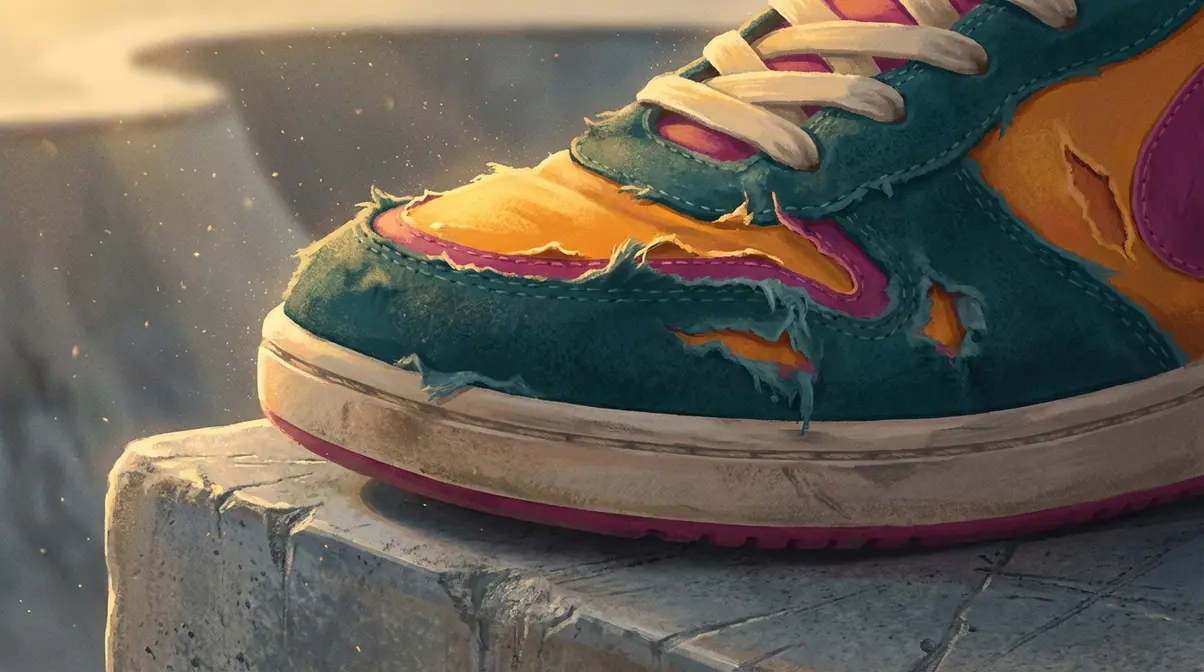

There’s a moment, maybe six sessions in, when a skate shoe stops being new and starts being yours. The suede thins out over the kickflip zone. The foxing tape peels where your heel drags on powerslides. The toe cap gets that pale, sandpapered look from griptape doing what griptape does. Most brands treat this as a problem to solve. Nike SB, at its sharpest, has treated it as a design philosophy.
The Kid from Bordentown
Ishod Wair grew up in Bordentown, New Jersey, skating the Philadelphia circuit before he was old enough to drive there himself. FDR Park, Love Park, the usual stations of the cross for any East Coast skater with serious ambitions. Real Skateboards spotted him at a Tampa AM contest and brought him into the fold. He moved to San Francisco to be closer to Deluxe Distribution. By 2011 he was pro. Two years later, at just twenty-two, he became the first Black skateboarder to win Thrasher Magazine’s Skater of the Year award.
That was 2013. He was the hottest name in skating. And he didn’t rush toward a signature shoe. “If I got a signature shoe when I won Skater Of the Year in 2013, people would want the shoe just because ‘he’s the best skater in the world,’” Wair told NikeSB.com in January 2024. “That’s not the point I’m at in my life right now.” He waited almost a decade. The patience says everything about him.
Two Shoes, One Idea
The first Nike SB Ishod arrived in late 2021. It was a sharp, vulcanized cupsole hybrid with a one-piece toebox and React foam cushioning, a shoe clearly engineered to survive griptape. The toebox had no overlapping stitched seams to rip apart. The gillies ran down inside to the sole, pulling the foot into the shoe rather than just cinching it tighter. It was built to last. It was also built to look good falling apart.
Then came the second shoe. The Nike SB Air Max Ishod, which the skate world quickly nicknamed the “Wair Max,” dropped on January 15, 2024. It carried a visible Max Air column in the heel, a suede-and-mesh upper, and the kind of layered construction that rewards months of abuse. Rubber panels hide under the suede. Raised foxing tape and double stitching provide a second line of defense. The hidden eyestays read “Ishod” and “Wairxposed.” Ishod has described the design ethos as rooted in the 1990s, when skaters in New York wore Air Max 95s to the park and nobody blinked. “I felt like moving toward a skateable Air Max was right,” he said.
The shoe has been called the most significant new skate shoe of 2024. That’s a big claim. It might also be accurate.
A Long History of Falling Apart on Purpose
Nike didn’t invent the idea of a shoe that reveals itself through wear, but they’ve spent two decades refining it. In 2003, artist Geoff McFetridge designed a Nike Vandal Supreme with an extra layer of fabric over a hidden graphic. You could cut the canvas, peel it, sand it. Each pair became a small act of destruction and creation. It was arguably the first wear-away sneaker Nike ever produced, and it lit a fuse.
A couple of years later, Nike SB applied the concept to the Dunk, releasing pairs that changed color as griptape abrasion accumulated. In 2011, the SB Dunk High “Statue of Liberty” arrived in oxidized green that wore down to copper. Todd Bratrud’s “Cheech & Chong” Dunk let you scissor or burn the white canvas toe to reveal green suede underneath.
But the landmark was Lance Mountain’s Air Jordan 1 SB, released June 7, 2014. The shoe paid tribute to The Search for Animal Chin, a 1987 skate video in which Mountain wore mismatched Jordans. Nike covered the mismatched colorways in black or white paint. As you skated them, the paint wore away. Each pair became singular, unrepeatable, a diary of how its owner moved. The insole read “Paint shoes not walls.” It remains one of the most celebrated sneaker collaborations ever made.
Ishod himself has history here. In 2021, he partnered with Magnus Walker on a Nike SB Dunk High inspired by Walker’s Porsche 277. The white leather upper was designed to peel and crack, revealing gold underneath. “I talk about how I like things to be old and beat up and have character,” Walker told Complex, “and the shoe essentially is the same thing.”
What Skaters Actually Think
The Air Max Ishod has sparked exactly the kind of argument a good skate shoe should. In online forums and skate communities, the debate runs hot. Some skaters report that the heel collar material gets chewed up by griptape fast, looking worn out before the rest of the shoe catches up. Others call that a feature. The forefoot wears down to suede quickly, but the suede itself holds up, developing a texture that’s entirely personal. One long-form wear test noted the shoe needed a session or two to break in, but once it did, the boardfeel was genuinely excellent.
There’s a deeper philosophical split at work. Do you want a shoe that performs perfectly from the jump but wears down faster? Or a thicker, stiffer shoe that takes weeks to break in but lasts longer? The Air Max Ishod answers that question decisively: it gives you performance now and lets the wear tell the story later.
Patina as Autobiography
The word “patina” gets thrown around loosely in sneaker culture, usually to justify keeping a beat pair on the shelf instead of in the trash. But the Nike SB wear-away lineage means something more specific. It’s the idea that a shoe is not finished when it leaves the factory. It’s finished when you finish it. Alexis Sablone, designing her own wear-away Nike SB Dunk Low for the 2024 Olympics, put it perfectly: “If you wore both shoes to death and had some weird, crazy flick pattern… they’d both become fully pink suede shoes.” Your trick selection literally colors the shoe.
Ishod Wair is now thirty-two years old, entering his thirteenth year as a pro for Real Skateboards, and sitting on a remarkably short list of skaters with true Nike signature models. “The number of people that have had actual signature shoes from Nike, and not just colorways,” he noted in a December 2024 interview, “that list is pretty short. I think it’s under 40 or something.” He earned his place on it by skating for over a decade without chasing the spotlight, letting the work accumulate like layers of griptape dust on suede.
That’s the real beauty of functional patina. It can’t be faked. It can’t be bought on a secondary market. It can only be earned, one kickflip at a time, until the shoe stops being Nike’s and starts being yours.
'%3e%3cg id='Final-Copy-2_2_' transform='translate(1275.000000, 200.000000)'%3e%3cpath class='st0' d='M7.4,12.8h6.8l3.1-11.6H7.4C4.2,1.2,1.6,3.8,1.6,7S4.2,12.8,7.4,12.8z'/%3e%3c/g%3e%3c/g%3e%3c/g%3e%3cg id='final---dec.11-2020'%3e%3cg id='_x30_208-our-toggle' transform='translate(-1275.000000, -200.000000)'%3e%3cg id='Final-Copy-2' transform='translate(1275.000000, 200.000000)'%3e%3cpath class='st1' d='M22.6,0H7.4c-3.9,0-7,3.1-7,7s3.1,7,7,7h15.2c3.9,0,7-3.1,7-7S26.4,0,22.6,0z M1.6,7c0-3.2,2.6-5.8,5.8-5.8 h9.9l-3.1,11.6H7.4C4.2,12.8,1.6,10.2,1.6,7z'/%3e%3cpath id='x' class='st2' d='M24.6,4c0.2,0.2,0.2,0.6,0,0.8l0,0L22.5,7l2.2,2.2c0.2,0.2,0.2,0.6,0,0.8c-0.2,0.2-0.6,0.2-0.8,0 l0,0l-2.2-2.2L19.5,10c-0.2,0.2-0.6,0.2-0.8,0c-0.2-0.2-0.2-0.6,0-0.8l0,0L20.8,7l-2.2-2.2c-0.2-0.2-0.2-0.6,0-0.8 c0.2-0.2,0.6-0.2,0.8,0l0,0l2.2,2.2L23.8,4C24,3.8,24.4,3.8,24.6,4z'/%3e%3cpath id='y' class='st3' d='M12.7,4.1c0.2,0.2,0.3,0.6,0.1,0.8l0,0L8.6,9.8C8.5,9.9,8.4,10,8.3,10c-0.2,0.1-0.5,0.1-0.7-0.1l0,0 L5.4,7.7c-0.2-0.2-0.2-0.6,0-0.8c0.2-0.2,0.6-0.2,0.8,0l0,0L8,8.6l3.8-4.5C12,3.9,12.4,3.9,12.7,4.1z'/%3e%3c/g%3e%3c/g%3e%3c/g%3e%3c/g%3e%3c/svg%3e) Your Privacy Choices
Your Privacy Choices