

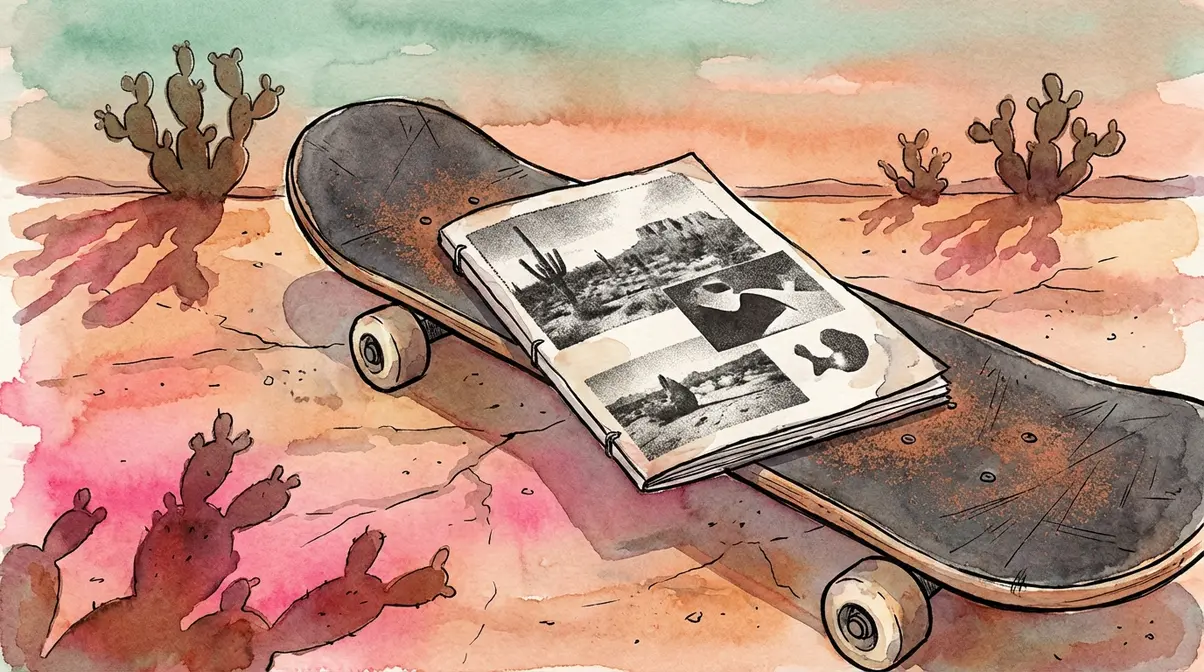

Late February, Tempe, Arizona. The sun is doing what it does out there, which is everything. Slow Impact is a multi-day skate event that involves lots of talking about, thinking about, and doing skateboarding, with skaters from around the world coming for panel discussions, street sessions, art shows, film premieres, workshops, live music, and more. It’s the fourth edition now, and this year’s gathering ran February 26 through March 1. Thrasher described it as bringing “visionary thinkers and low-profile dinkers” to Tempe, with Ted Barrow, Neen Williams, and Ronnie Kessner among the attendees. If that sounds like an unlikely cocktail, that’s the point.
The Conference That Isn’t Quite a Conference
Slow Impact is the creation of Ryan Lay, a New Balance Numeric pro skater and cofounder of the Phoenix-area nonprofit Skate After School. He threw the first edition in 2023 in his hometown of Tempe. It was not quite an academic conference but not quite a traditional skateboarding event either. Lay felt Tempe was “a weird and small enough city” that the combination of skatepark, shop, university, and good weather might make it worth visiting for a few days.
This year’s programming ran the gamut. Bryce Noe’s talk about freestyle skating being the “Bastard Child of Skateboarding” was eye-opening, and he got a warm reception that’s hard to imagine at, say, an ASR trade show in 2003. Photographer and artist Sandy Kim was in conversation with Jerry Hsu. Published author Kyle Beachy held hosting duties for the weekend. Longtime industry insider Dan Santovan spoke about spreading light in a dark world; the fact he showed up before his chemo treatments was, by all accounts, unbelievably powerful.
And then there was the question Lay really wanted to ask. He said that having self-awareness is integral to Slow Impact, and the conversation he’s been wanting to have is blunt: “Why is skateboarding so fucking old now?” But the challenge, he admitted, is that a lot of people don’t want to speak candidly about their real feelings about it. That’s the kind of sentence that would never survive the edit at a brand-funded content site. Here, in the desert, it just hung in the air.
The Zine Fest and the Magazine Mile
One of the most telling features of Slow Impact 2026 was its zine fest, a space where independent publishers set up tables and traded paper. The lineup included Noah McManus from Skate Jawn, Sam Korman from Plank, Jaime Owens from Closer, and Adam Abada with his solo zines. People made zines. They traded them. They had good conversations. That’s the whole transaction, and it works because nothing is being optimized.
Skate Jawn is a skateboarding magazine founded in Philadelphia in 2010 by Marcus Waldron, producing a bimonthly magazine and a yearly photo issue. As of 2021, it prints 5,000 copies per issue in full color. It focuses on DIY, underground, and independent projects, community initiatives, smaller skate scenes, and international stories. These numbers are modest. They are also real. People hold them, read them, keep them. While there aren’t any “major” monthly print publications in the U.S. besides Thrasher, there are a handful of independent zines and mags coming out on a regular basis across the world.
Altered Screenshots and Lost Sparks
Away from Tempe, a smaller but equally telling artifact surfaced in February. Now that skateboarding is a polished commodity, early online skatepark fight videos tether a generation to a time when the culture was more unhinged, and it’s exactly this reason Colton Abernathy created the zine “Skate Park Fights,” filled with altered screenshots of knockouts and roundhouses that distill these videos into a single moment. It was covered by Jenkem Magazine on February 9.
Abernathy said his first Thrasher subscription was around 2004, and that skateboarding has changed so much: “Change can be good, but I think the reasons why I got into it are kind of being lost.” He’s not being precious about it. He’s being specific. He has plans to make a Denver Skatepark-specific zine because he grew up there and, by his account, the stuff that went down at that park was “absolutely ridiculous and unhinged.”
The decision to put it on paper instead of just posting it is the whole argument in miniature. A zine can’t be algorithmically suppressed. It doesn’t need a content strategy. It just needs a copier and someone who cares enough to staple.
The Archiving Problem
The Skate Witches is an international gang of girl skaters founded by Kristin Ebeling and Shari White from the Pacific Northwest. They made the first zine in 2014. Ebeling, who has a degree in history and serves as executive director of Skate Like a Girl, has spoken publicly about what motivated the project: the realization that women’s skateboarding growth was happening almost entirely on Instagram, on a platform that could go the way of MySpace, and that scared her. Print is tangible. Print stays.
This concern found a larger stage at Slow Impact, where the question of archiving skate media has become a recurring theme. A Smithsonian curator was among the attendees. Panels were conceived to reconfigure skaters’ relationships with space, like “You’re Skating on Native Land,” curated by Maurice Crandall, an associate professor of history at Arizona State University. These are not casual conversations. They are arguments about what survives and what disappears.
When the Museum Comes Calling
The tension between counterculture and institution has a recent, visible case study. Copy Machine Manifestos: Artists Who Make Zines was the first exhibition dedicated to the rich history of five decades of artists’ zines produced in North America. Organized by the Brooklyn Museum and curated by art historians Branden W. Joseph and Drew Sawyer , it featured nearly one thousand zines and artworks by nearly one hundred artists. The show opened in November 2023, then traveled to the Vancouver Art Gallery.
Sawyer made the case plainly: “Zines aren’t run by organizations that use algorithms or who can censor things. They can’t be as easily surveilled or censored.” That’s why they popped up again during Black Lives Matter and other protests of 2020, he added. The accompanying Phaidon book features biographies for more than 100 zine-makers including Mark Gonzales, Raymond Pettibon, Miranda July, and Ari Marcopoulos. Skate culture sits comfortably in that lineage, even if it never asked for the museum’s approval.
The Real Argument
There is a genuine disagreement running through all of this, and it is worth naming. On one side: skateboarding is bigger, better funded, and more inclusive than it has ever been. Federations have launched in over 30 countries since Tokyo 2020. Female participation has surged. New skateparks are being built with public money. On the other: the thing that made skateboarding matter in the first place was its refusal to be managed. Its willingness to be ugly, local, broke, and weird. These two positions are not easily reconciled, and anyone who tells you they are is probably selling something.
My own view, for what it’s worth, is that the zine table at Slow Impact was more important than any Olympic podium. Not because the Olympics are bad for skating; but because a hand-stapled magazine passed between two people who actually care about each other’s local scene is an act of culture that no scoring system can replicate. The podium gives you a medal. The zine table gives you a reason to keep going.
A running theme at Slow Impact was the solace many skaters find through what one writer called “this wooden toy.” That’s the whole thing, really. A plank of maple, seven plies, four wheels, and the stubborn insistence on documenting what happens when you ride it, by hand, on paper, for no money, forever.
'%3e%3cg id='Final-Copy-2_2_' transform='translate(1275.000000, 200.000000)'%3e%3cpath class='st0' d='M7.4,12.8h6.8l3.1-11.6H7.4C4.2,1.2,1.6,3.8,1.6,7S4.2,12.8,7.4,12.8z'/%3e%3c/g%3e%3c/g%3e%3c/g%3e%3cg id='final---dec.11-2020'%3e%3cg id='_x30_208-our-toggle' transform='translate(-1275.000000, -200.000000)'%3e%3cg id='Final-Copy-2' transform='translate(1275.000000, 200.000000)'%3e%3cpath class='st1' d='M22.6,0H7.4c-3.9,0-7,3.1-7,7s3.1,7,7,7h15.2c3.9,0,7-3.1,7-7S26.4,0,22.6,0z M1.6,7c0-3.2,2.6-5.8,5.8-5.8 h9.9l-3.1,11.6H7.4C4.2,12.8,1.6,10.2,1.6,7z'/%3e%3cpath id='x' class='st2' d='M24.6,4c0.2,0.2,0.2,0.6,0,0.8l0,0L22.5,7l2.2,2.2c0.2,0.2,0.2,0.6,0,0.8c-0.2,0.2-0.6,0.2-0.8,0 l0,0l-2.2-2.2L19.5,10c-0.2,0.2-0.6,0.2-0.8,0c-0.2-0.2-0.2-0.6,0-0.8l0,0L20.8,7l-2.2-2.2c-0.2-0.2-0.2-0.6,0-0.8 c0.2-0.2,0.6-0.2,0.8,0l0,0l2.2,2.2L23.8,4C24,3.8,24.4,3.8,24.6,4z'/%3e%3cpath id='y' class='st3' d='M12.7,4.1c0.2,0.2,0.3,0.6,0.1,0.8l0,0L8.6,9.8C8.5,9.9,8.4,10,8.3,10c-0.2,0.1-0.5,0.1-0.7-0.1l0,0 L5.4,7.7c-0.2-0.2-0.2-0.6,0-0.8c0.2-0.2,0.6-0.2,0.8,0l0,0L8,8.6l3.8-4.5C12,3.9,12.4,3.9,12.7,4.1z'/%3e%3c/g%3e%3c/g%3e%3c/g%3e%3c/g%3e%3c/svg%3e) Your Privacy Choices
Your Privacy Choices