

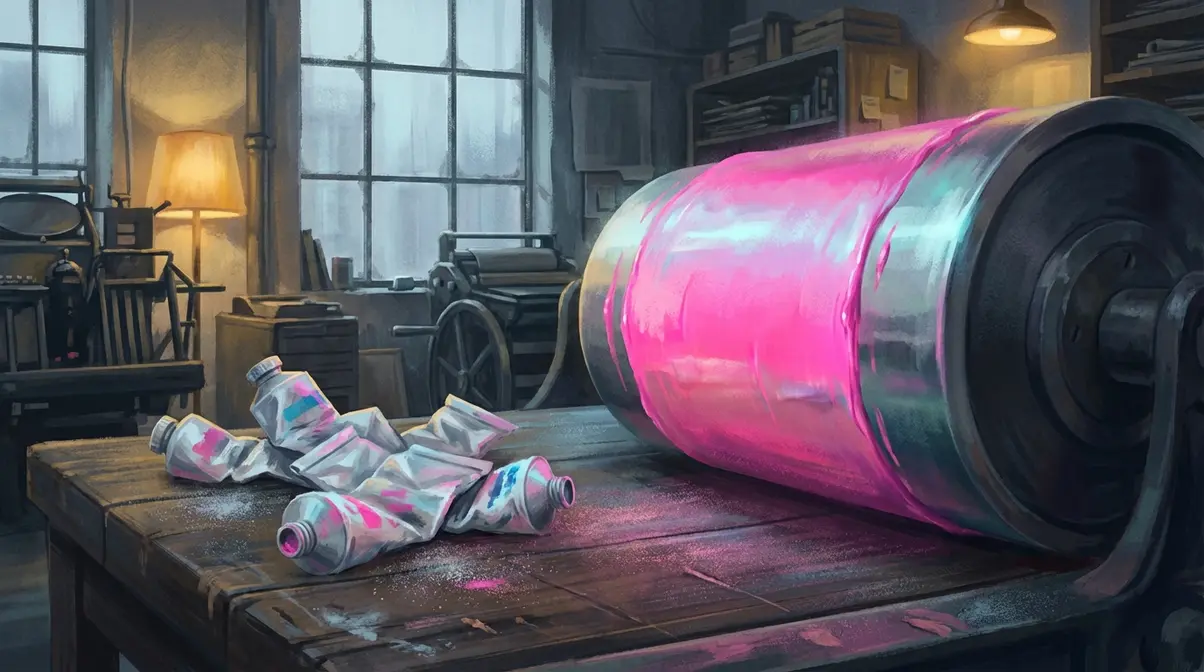

Let me tell you about a color. Pantone 806 U. Hex code #FF48B0. In the Risograph world, it goes by Fluorescent Pink, and it is the single most important ink in the American riso scene. Fluorescent Pink is hands down the most consistently popular Riso color, one of only two fluorescent colors available in the U.S., and its vibrant hue is classically Riso. It is the color that makes zine covers glow under bodega fluorescents. It is the color that turns a two-tone print into something that makes you stop flipping through a stack at a book fair. And in early 2026, it started getting hard to find.
The Machine That Won’t Die
To understand why this matters, you need to understand the machine. Riso, the world leader in digital duplicating technology, presented the GR3770 as the first 600 dpi digital duplicator. It was introduced in November 1997. That’s twenty-eight years ago. The GR3770 was the last and best of the GR line, the top of Riso’s analog-era mountain, and it remains in daily use at studios that treat it with the devotion other people reserve for vintage Fender amps.
Diskette Press, a small Risograph printing operation based out of Ann Arbor, Michigan, uses a GR3770 connected to a Windows XP computer to do all of their printing. With 600 dpi printing and the ability to interface with a computer, the GR3770 was ahead of its time, and their machine has printed over 4.4 million sheets of paper. A 1998 machine running on a 2001 operating system, producing work that people line up for at art book fairs. That’s not nostalgia. That’s infrastructure.
The GR3770 scans at 600 x 600 dpi, prints at five selectable speeds up to 120 sheets per minute, and handles paper sizes from 4″ x 6″ up to 11″ x 17″. It is built like a photocopier crossed with a screen printing press, and the people who keep them running treat maintenance like a sacred obligation. They scrape ink ridges off pressure rollers by hand. They 3D-print replacement parts. New rollers haven’t been available from Riso dealers for years.
A Company Called Ideal
On September 2, 1946, Noboru Hayama opened his own mimeography printing company: RISO-SHA. “RISO,” meaning “Ideal,” was chosen under the strong impression of the war. The founder wanted ideals to be preserved in his company. He saw no future for the people of Japan without ideals. He mixed his first inks at his kitchen sink. Eighty years later, the firm remains headquartered in Tokyo, with sales in over 150 countries and revenue in the billions.
1980 is the birth year of the Risograph. By the mid-2010s, artists had fully repurposed what was always intended as an institutional workhorse. The Risograph is a stencil duplicator, a business machine reminiscent of a mimeograph that was meant for small institutions to produce in-house copies, which has been replaced by copiers and in turn repurposed by the arts community for edition printing. Brooklyn became the American capital of this repurposing. TXTbooks, an artist-run independent publishing initiative and risograph print studio based in Brooklyn, has worked with artists and writers across many disciplines since 2014. Studios like Lucky Risograph in DUMBO and Authorized to Work in the US in Park Slope built entire creative practices around the machine’s limitations.
The Trouble With Pink
Here is where the story tightens. Fluorescent Pink isn’t just popular. It is structurally essential. Studios running faux-CMYK separation use Aqua, Fluorescent Pink, Yellow, and Black as their standard palette. Remove one of those four and you lose the ability to reproduce full-color images. Remove the most requested one and you lose your clients.
Due to unexpected supply and shipping delays, some inks are currently out of stock or running low and may not be available for printing, with restock expected by end of February or early March 2026. That’s from Moniker Press in Canada, one of the more transparent studios about their supply situation. Their list of colors running low or unavailable includes Black, Bright Red, and Fluorescent Pink. On Amazon, the Riso S-7211 Fluorescent Pink Ink for EZ, MZ, and RZ Series Duplicators is listed as “Currently Unavailable.”
This is not a dramatic factory fire. It is not a corporate betrayal. It is the slow, grinding reality of a community that depends entirely on a single manufacturer in Tokyo for every tube of ink it uses. Fluorescent Pink is a high-quality, semi-transparent ink specifically designed for Risograph Duplicators, manufactured by RISO in Tokyo, Japan. There is no aftermarket. There is no generic. You buy from Riso or you don’t print.
Brooklyn Feels It First
Brooklyn’s riso studios sit at the intersection of every pressure point in this story. They run aging machines. They serve a client base that overwhelmingly requests Fluorescent Pink. They operate on margins so thin that a delayed ink shipment can mean pausing client work for weeks.
TXTbooks, founded in 2014 and maintained by Robert Blair, Thomas Colligan, Nichole Shinn, Rose Wong, and Kurt Woerpel, has temporarily paused printing services. Their FAQ still lives on their site like a museum exhibit, a detailed guide to a service they can no longer reliably offer. They are not alone. Outlet PDX notes they try to keep their ink list as up-to-date as possible but can’t guarantee colors are available, with some inks currently unavailable or drums down for maintenance.
I want to be precise about what I’m calling a crisis. There is no single event. Nobody issued a press release. But across the community, in studio updates and forum threads and cautiously worded Instagram stories, the same anxiety surfaces again and again: the pink is running out, the machines are getting older, and the supply chain has exactly zero redundancy.
Imperfection Was Always the Point. Until It Wasn’t.
There is a philosophical rift in the riso community that this supply crunch has split wide open. On one side: the people who fell in love with the Risograph precisely because of its unpredictability. Risograph printing is never going to be perfectly exact, and there will always be a certain amount of drift and misregistration. The more colors printed, the worse that misregistration can potentially become. That drift is the whole aesthetic. That slight wobble between layers is what separates a riso print from a laser copy.
On the other side: a growing number of studios and clients who need reliable output. They need Fluorescent Pink to arrive on schedule. They need drums that don’t develop ridges after a few thousand sheets. They need parts that aren’t extinct. The charm of imperfection hits different when you’ve got a print run of 500 zines due next week and your pink drum is bleeding out its last tube.
My position, for what it’s worth: both sides are right, and that’s exactly the problem. The riso community built something beautiful on a foundation of repurposed office equipment and a manufacturer that never designed its supply chain for artists. Studios like TXTbooks acknowledge they use these machines in ways they were never really intended, creating printed material that the machine’s original target consumer would never seek out. That contradiction was charming for a decade. Now it’s becoming existential.
What Happens Next
The GR3770 will keep dying. One machine at a time, one cracked roller at a time, one failed circuit board at a time. The drum cover on the GR3770 differs in shape so that its dedicated drum can’t be inserted into a GR3750 by mistake, though a GR3750 drum can be inserted into the GR3770. That kind of proprietary specificity was fine when the machines were current. Nearly three decades later, it’s a trap.
Fluorescent Pink will keep shipping from Tokyo. Slowly. In its own time. Through a supply chain built for institutional buyers who order in bulk, not for a studio in Bushwick running editions of 200. The genuine OEM Fluorescent Pink Type FII Ink comes in boxes of two 1000ML tubes , and when those tubes are gone, you wait. The ink, made from rice bran oil, is a liquid-based ink that requires a drying period to absorb into uncoated paper. It is a beautiful, temperamental, irreplaceable substance.
I don’t have a solution. I don’t think anyone does. But I think the Brooklyn riso community, and by extension every small studio running these machines, deserves to name what’s happening to them. It’s a slow-motion supply crisis built on devotion to a color, a machine, and a process that a billion-dollar company in Tokyo views as a footnote in its product history. The studios treat Fluorescent Pink like it’s sacred. Riso’s own U.S. dealers call it the most popular color they sell. Somewhere between those two facts is a gap wide enough to lose an entire creative community.
Keep your pink drums clean. Hoard your tubes. And if you’re printing a zine this spring, maybe call your ink supplier before you finalize the color palette. Pantone 806 U isn’t going anywhere. But it might not be arriving on time, either.
'%3e%3cg id='Final-Copy-2_2_' transform='translate(1275.000000, 200.000000)'%3e%3cpath class='st0' d='M7.4,12.8h6.8l3.1-11.6H7.4C4.2,1.2,1.6,3.8,1.6,7S4.2,12.8,7.4,12.8z'/%3e%3c/g%3e%3c/g%3e%3c/g%3e%3cg id='final---dec.11-2020'%3e%3cg id='_x30_208-our-toggle' transform='translate(-1275.000000, -200.000000)'%3e%3cg id='Final-Copy-2' transform='translate(1275.000000, 200.000000)'%3e%3cpath class='st1' d='M22.6,0H7.4c-3.9,0-7,3.1-7,7s3.1,7,7,7h15.2c3.9,0,7-3.1,7-7S26.4,0,22.6,0z M1.6,7c0-3.2,2.6-5.8,5.8-5.8 h9.9l-3.1,11.6H7.4C4.2,12.8,1.6,10.2,1.6,7z'/%3e%3cpath id='x' class='st2' d='M24.6,4c0.2,0.2,0.2,0.6,0,0.8l0,0L22.5,7l2.2,2.2c0.2,0.2,0.2,0.6,0,0.8c-0.2,0.2-0.6,0.2-0.8,0 l0,0l-2.2-2.2L19.5,10c-0.2,0.2-0.6,0.2-0.8,0c-0.2-0.2-0.2-0.6,0-0.8l0,0L20.8,7l-2.2-2.2c-0.2-0.2-0.2-0.6,0-0.8 c0.2-0.2,0.6-0.2,0.8,0l0,0l2.2,2.2L23.8,4C24,3.8,24.4,3.8,24.6,4z'/%3e%3cpath id='y' class='st3' d='M12.7,4.1c0.2,0.2,0.3,0.6,0.1,0.8l0,0L8.6,9.8C8.5,9.9,8.4,10,8.3,10c-0.2,0.1-0.5,0.1-0.7-0.1l0,0 L5.4,7.7c-0.2-0.2-0.2-0.6,0-0.8c0.2-0.2,0.6-0.2,0.8,0l0,0L8,8.6l3.8-4.5C12,3.9,12.4,3.9,12.7,4.1z'/%3e%3c/g%3e%3c/g%3e%3c/g%3e%3c/g%3e%3c/svg%3e) Your Privacy Choices
Your Privacy Choices