


Secrets of the Bees landed on Disney+ and Hulu this morning. By tonight, most viewers will be talking about the bees. The ones paying closer attention will be talking about the cameras.
The Man Who Builds His Own Rigs
John Brown is a wildlife cinematographer based in Oxfordshire, England, with roughly 30 years of experience, much of it spent doing “very detailed macro photography.” His credits read like a BBC Natural History Unit greatest hits reel: key sequences for Frozen Planet, which won Best non-fiction Cinematography at the Emmys in 2012 , plus contributions to Planet Earth II, Green Planet, Seven Worlds: One Planet, and Our Planet II. He directed and shot Meerkat Manor Season 1, which won “Gold Statue” for cinematography at the Omni Awards in 2006. He has reached the finals of BBC Wildlife Photographer of the Year eight times. He owns a RED Weapon Helium 8K. He is, by any measure, a professional.
He is also, by temperament, a tinkerer. And this is where the story gets interesting.
Rather than buying a commercial motion control system, Brown designed and built his own. From scratch. His custom rig is a high-precision six-axis macro motion control system, designed to carry cameras up to RED DMSC2 size, and it works perfectly with the Laowa 24mm scope. It runs off 12V DC, V-lock batteries, or standard AC power. It uses Dragonframe software for programmed moves and can also be driven live via joystick. Moves are repeatable within millimeters. The whole thing is modular, quick to assemble, and designed to function in the field as easily as in a studio. Think of it as a Technocrane for the insect world, built by one person in an Oxfordshire workshop.
The maker community online would recognize the DNA instantly. DIY motion control rigs using stepper motors, 3D-printed housings, and Arduino boards are a thriving subculture. People build them in garages and basements, post their showreels, argue about belt tension. Brown’s rig sits at the apex of that impulse: the same instinct to solve a problem with your own hands, but refined over decades of professional deployment into something genuinely singular. It operates wirelessly, with motor commands transmitted over WiFi and camera monitoring over RF. No tethers. No cables snaking through the undergrowth to spook a two-millimeter-long bee.
Into the Hive
Brown served as Director of Photography on Secrets of the Bees, filming in multiple locations worldwide. The series was executive produced by James Cameron and produced by Alastair Fothergill and Huw Cordey at Silverback Films for National Geographic. The series features two principal photographers: Brown and the late Alastair MacEwen, a deeply influential wildlife filmmaker. MacEwen recently passed away, but his impact is felt throughout the finished work.
“Alastair did most of the honeybee filming, and I did most of the overseas, other bees,” Brown told PetaPixel. Those “other bees” took him to some extraordinary places. He spent five weeks in the Amazon in Ecuador filming fire bees and vulture bees, both extremely difficult because the bees themselves were “about the same size as a honeybee’s head.” For the vulture bee shots in particular, Brown was “sitting in a swamp for three weeks and getting bitten by stuff,” in constant rain.
The resulting footage includes several documented world firsts: the first shot of a broomstick bee in flight, the first footage of a vulture bee nest, and the first footage of honeybees defending themselves against a varroa mite invasion. Brown’s favorite sequence was filming Japanese honeybees fighting off a giant hornet. The bees performed what Brown describes as “the bee equivalent of a stadium wave,” using leaf cuttings to clean away hornet scent markings so the predators were less likely to return.
Physics Doesn’t Care About Your Budget
Here is the thing that most coverage of nature documentaries glosses over: macro cinematography is not a gear problem. It is a physics problem. As Brown puts it, “even though our camera technology has evolved hugely over the last sort of decade, physics hasn’t changed.”
When you are filming a subject two or three millimeters long, depth of field collapses to nearly nothing. The cinematographers had to innovate around the limitations of camera technology. Because of the bees’ tiny size, the depth of field was much smaller than your average photo, and the team rode a fine line between capturing detail and keeping other aspects of the frame in focus. Brown compares it to neurosurgery: “It’s that sort of incredible focus for just hours on end with a subject that doesn’t take direction.”
This is exactly why a homemade rig isn’t a gimmick or a cost-saving measure. It is a response to a set of constraints that no off-the-shelf system was designed to solve. Brown’s six-axis system lets him position a camera within millimeters of a living subject, repeat the move identically, and adjust on the fly when the subject does something unexpected. Cameron himself acknowledged this in a Moviefone interview, noting that “the camera technology itself wasn’t really the leap forward” but rather the challenge of getting into the bees’ world without interfering with their behavior, “making it seem natural for them but still getting the camera in a manner that’s reasonably predictable.”
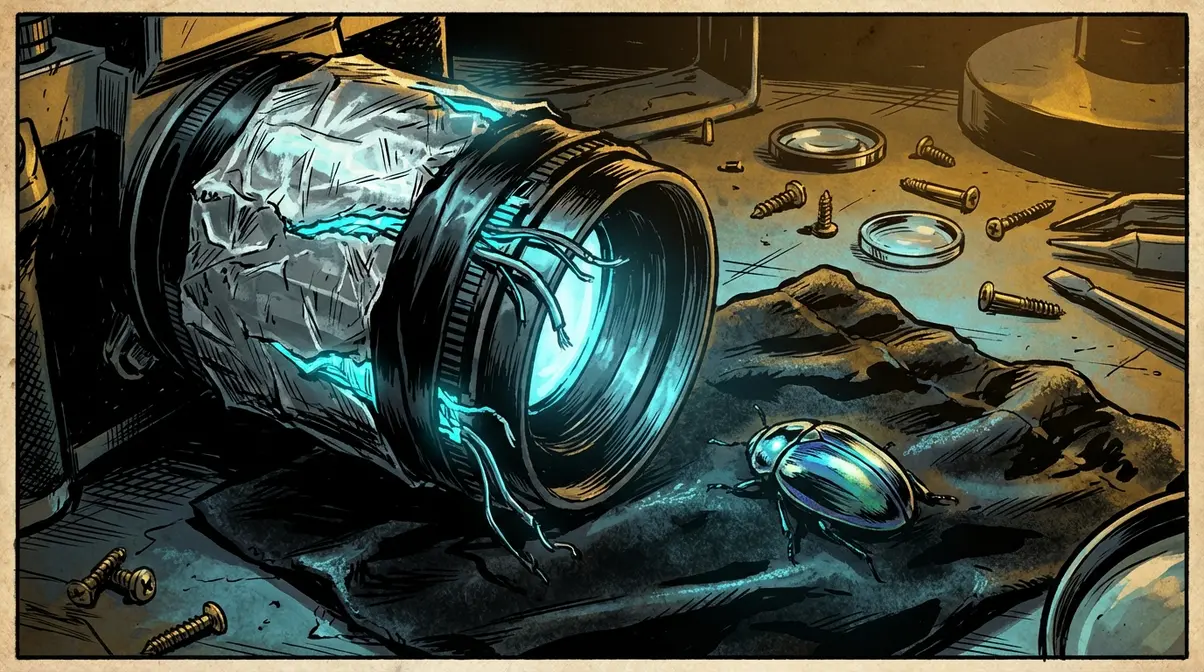
For Brown, the main lens was a probe lens, or scope lens, “almost like a medical endoscope, but a bit thicker,” which lets you get the viewer “right in between the frames within a beehive, or right down at ground level.” He estimates 60 to 70 percent of his footage was shot on Laowa Macro Probe lenses. Some of his other favorites are old microscope lenses from the 1970s, a detail that should make every vintage optics collector sit up straight.
What Cameron Understands
What most people might not know about Cameron is that he is something of a beekeeper, running an organic vegetable farm that includes 300 beehives. This is not a celebrity vanity project. Even for Cameron, the documentary was “revelatory.” “There’s so much that I didn’t know about bee society.”
The “Secrets of” franchise has quietly built itself into one of NatGeo’s most reliable documentary brands: whales in 2021, elephants in 2023, octopus in 2024, bees in 2026. Each installment has pushed the filmmaking further. But what makes Secrets of the Bees distinctive is the scale of the problem. Whales are enormous. Elephants fill the frame. A vulture bee is two millimeters long and lives inside a rotting fish.
At a recent press Q&A, Cameron told the crowd, “We are the despicable creatures,” referring to humanity’s impact on the natural world. The comment got a laugh, but the philosophy behind it is no joke. The series captures bees playing with balls, solving puzzles, using tools. Cameron admitted he used to think of bees as “basically little Roombas that were hardwired with relatively basic programming,” but “it turns out that while they have that, they’re also capable of learning.”
The Craft That Disappears
The best thing about Brown’s rig is that you will never notice it. That is the point. The footage in Secrets of the Bees moves with the fluidity of a Steadicam tracking shot, except the “actors” weigh less than a grain of rice and the “set” is a wax hexagon smaller than your thumbnail. You watch a bee emerge from its cell for the first time, and you do not think about the six axes of motion control that made the shot possible. You think about the bee.
Brown grew up shooting on 16mm film. He did a biology degree at Oxford, and there happened to be a famous film company nearby, Oxford Scientific Films, where he started working during his university holidays. Thirty years later, he is building his own robotics in a home studio and deploying them in the Amazon. The through-line is not technology. It is patience, obsession, and a willingness to solve problems nobody else has bothered to define.
In the maker forums and cinematography boards, there is a recurring debate about whether DIY gear can compete with professional equipment. The question misses the point entirely. Brown’s rig is not competing with anything. It exists because nothing else does what it does. He needed a tool. He built it. Then he took it to the jungle and filmed something no human had ever seen before.
Secrets of the Bees is now streaming on Disney+ and Hulu.
'%3e%3cg id='Final-Copy-2_2_' transform='translate(1275.000000, 200.000000)'%3e%3cpath class='st0' d='M7.4,12.8h6.8l3.1-11.6H7.4C4.2,1.2,1.6,3.8,1.6,7S4.2,12.8,7.4,12.8z'/%3e%3c/g%3e%3c/g%3e%3c/g%3e%3cg id='final---dec.11-2020'%3e%3cg id='_x30_208-our-toggle' transform='translate(-1275.000000, -200.000000)'%3e%3cg id='Final-Copy-2' transform='translate(1275.000000, 200.000000)'%3e%3cpath class='st1' d='M22.6,0H7.4c-3.9,0-7,3.1-7,7s3.1,7,7,7h15.2c3.9,0,7-3.1,7-7S26.4,0,22.6,0z M1.6,7c0-3.2,2.6-5.8,5.8-5.8 h9.9l-3.1,11.6H7.4C4.2,12.8,1.6,10.2,1.6,7z'/%3e%3cpath id='x' class='st2' d='M24.6,4c0.2,0.2,0.2,0.6,0,0.8l0,0L22.5,7l2.2,2.2c0.2,0.2,0.2,0.6,0,0.8c-0.2,0.2-0.6,0.2-0.8,0 l0,0l-2.2-2.2L19.5,10c-0.2,0.2-0.6,0.2-0.8,0c-0.2-0.2-0.2-0.6,0-0.8l0,0L20.8,7l-2.2-2.2c-0.2-0.2-0.2-0.6,0-0.8 c0.2-0.2,0.6-0.2,0.8,0l0,0l2.2,2.2L23.8,4C24,3.8,24.4,3.8,24.6,4z'/%3e%3cpath id='y' class='st3' d='M12.7,4.1c0.2,0.2,0.3,0.6,0.1,0.8l0,0L8.6,9.8C8.5,9.9,8.4,10,8.3,10c-0.2,0.1-0.5,0.1-0.7-0.1l0,0 L5.4,7.7c-0.2-0.2-0.2-0.6,0-0.8c0.2-0.2,0.6-0.2,0.8,0l0,0L8,8.6l3.8-4.5C12,3.9,12.4,3.9,12.7,4.1z'/%3e%3c/g%3e%3c/g%3e%3c/g%3e%3c/g%3e%3c/svg%3e) Your Privacy Choices
Your Privacy Choices