

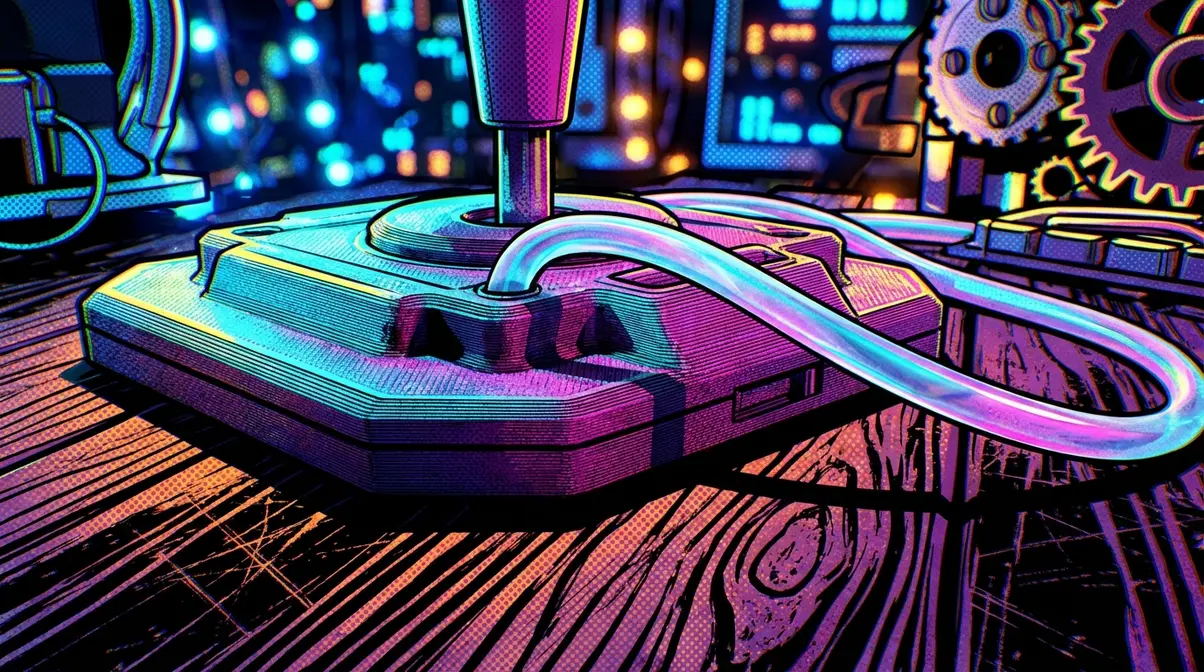

Here’s the assumption I want to push back on: that open-source assistive technology is a nice idea that doesn’t scale. That it’s a hobbyist curiosity, a feel-good weekend project, a thing that works in theory but breaks down the moment it meets the real world. The LipSync Joystick V4, built by the Neil Squire Society and distributed through their Makers Making Change program, is a living counter-argument. It is not a prototype. It is not a proof of concept. Over 1,400 units have been built and deployed to users worldwide, and the latest version is the most refined yet.
A Straw, a Teleprinter, and Forty-Five Years of Sip-and-Puff
In January 1981, Neil Squire, an accounting student and basketball player at the University of Victoria, hit a patch of black ice only a short distance from his home. His car hit a tree and he sustained a C1/brainstem injury. This accident left him paralyzed from the neck down, unable to speak and reliant on a respirator. He was twenty-one years old.
Bill Cameron, his second cousin, was overcome with the limited “new world” surrounding Neil and began dedicating himself to opening doors for people with significant physical disabilities. It struck Bill there was no device for Neil to communicate, so he put his engineering background to use. Bill wheeled a tele-type machine into the Intensive Care Unit at Shaughnessey Hospital and designed and installed a machine to register sips and puffs through a straw. These sips and puffs were translated to dots and dashes. Morse code, rendered on a screen. Words from breath.
In 1984, as this enthusiastic group around Neil was looking for an appropriate name for their activities, he died unexpectedly and the Neil Squire Society was born. What started as one engineer’s refusal to accept a broken system became a national non-profit, headquartered in Burnaby, British Columbia, with offices in Fredericton, Ottawa, and Regina. In 2024, the Neil Squire Society celebrated its 40th anniversary.
I keep thinking about that teleprinter. The LipSync V4 is its direct descendant. The sip-and-puff interface that Bill Cameron jury-rigged in a hospital ICU in 1981 is the same fundamental interaction model powering a device that now works with iPhones, Android tablets, Mac laptops, and the Xbox Adaptive Controller. That’s not nostalgia. That’s a design lineage.
What the V4 Actually Is
Let’s get specific, because the details matter. The most recent version, the LipSync 4.1, is made up of the LipSync Joystick and LipSync Hub. The Joystick is the primary user interface, and contains a low-force Hall-Effect joystick and sip and puff sensors. The Hub has a display that provides a graphical interface for independently adjusting settings, as well as providing the connection to the host device and up to three external assistive switches with 3.5 mm jacks.
That two-part architecture is the big structural change from earlier versions. One of the big goals of redesigning the LipSync from scratch was to take advantage of technological advancements that occurred over the last eight years. In the original hardware, they used about 96% of the memory, leaving little room for adding new features or complex coding. It also meant they had to have different versions of the LipSync, since they couldn’t fit gaming mode and mouse mode on the same device. The V4 consolidates all of that.
The joystick itself is a genuine leap. The force required to deflect the mouthpiece has been reduced from 300 grams-force to 50 grams-force, about 80%. This reduction will make the joystick easier and less likely to cause soreness or fatigue for all users and make the new LipSync an option for those who weren’t able to use the stiffer one. The digital magnetic sensor will significantly cut down any cursor drift. If you’ve never used a sip-and-puff device, cursor drift probably sounds like a minor annoyance. For someone navigating their phone with their mouth, it’s the difference between independence and frustration.
The $325 Problem (and the $3,000 One)
An estimated 1,000,000 people in Canada and the United States have limited or no use of their arms, meaning they’re unable to use touchscreen devices that could provide access to helpful apps and services. While solutions exist for desktop computers, they can cost up to $3,000 and do not work well on mobile devices.
The LipSync device is comprised of off-the-shelf electronics and hardware, a custom PCB, and 3D printed parts. The overall cost of materials for a single build is about $325 (plus shipping). In larger quantities, the cost of materials is closer to $175. Is $325 cheap? Not for everyone. Plenty of people in the disability community live on fixed incomes where that figure is steep. But compared to $3,000 proprietary alternatives that don’t even work on mobile? The math speaks for itself.
The real kicker is the licensing. The LipSync has been certified as open source hardware by the Open Source Hardware Association under the OSHWA UID CA000046. The hardware lives under the CERN 2.0 Weakly Reciprocal license, all software is under the GNU General Public License v3.0, and accompanying material such as instruction manuals, videos, and other copyrightable works are published under Creative Commons Attribution-ShareAlike 4.0. Three layers of licensing, each tailored to its domain. Nobody can lock this down. Nobody can take it proprietary. That’s not an accident; it’s a philosophy.
The Maker Pipeline
This is where the model gets interesting, and where I think most people underestimate what the Neil Squire team has built. You may submit a build request through the MMC Library Page to have a volunteer maker build the device. As the requestor, you are responsible for reimbursing the maker for the cost of materials and any shipping. If you have the skills and equipment to build this device and would like to donate your time to create the device for someone who needs it, visit the MMC Maker Wanted section.
This is not just a GitHub repo with a README. The Neil Squire Society has built an entire distribution infrastructure around volunteer labor. In early 2018, Makers Making Change held a buildathon at Acadia University in Nova Scotia, where approximately twenty university students came together to build mouth-operated assistive devices. Google employees built LipSyncs at Mountain View HQ during Accessibility Week. TELUS sponsored six buildathons across Canada. The corporate-volunteer pipeline is real and it produces real devices for real people.
Early in 2025, the team released a major firmware update for the LipSync, making the device both easier to use for the people who need it, as well as easier to build by volunteer makers. The new firmware update makes it so the scroll speed is adjustable, something that was too slow on some devices with workarounds that were not user-friendly. Audio and visual feedback also improved, including sounds at startup or when errors occur. These are not glamorous features. They are the kind of refinements that only come from actually listening to users.
Why This Matters Beyond Accessibility
Chad Leaman of the Neil Squire Society once put it plainly in an interview with ABILITY Magazine: “When I was in university, I was in computer science and had a summer job at Neil Squire. Along the way it just kind of clicked. They didn’t have me in a cubicle punching code. Instead, I was applying some of my knowledge to help people, which really resonated with me.” There’s something in that quote that gets at the heart of the maker-accessibility intersection. The skills are the same ones that drive the 3D printing community, the open-source hardware movement, the indie hardware scene. The difference is the application.
The LipSync is compatible with a range of host devices that support a USB Mouse, a USB Gamepad, and/or a Bluetooth Mouse. Compatible devices include PC and Mac computers and laptops, Android, iOS, and Windows smartphones and tablets, and the Xbox Adaptive Controller. That last one matters enormously. Adaptive gaming is not a footnote; for many users, it’s the primary reason they want a LipSync. Social connection, competition, play. The things that make life worth the trouble.
The conventional wisdom says open-source hardware can’t compete with commercial products on reliability, on polish, on the unglamorous work of ongoing support. The LipSync V4 doesn’t just compete. It offers something commercial AT vendors rarely do: a device that belongs to its community, that can be fixed by its community, that improves because its community demands it. The GitHub repo is the living proof. The Makers Making Change library is the infrastructure. And the origin story, a second cousin with a teleprinter and a refusal to accept the world as it was, is the reason any of it exists.
Go build one for somebody.

'%3e%3cg id='Final-Copy-2_2_' transform='translate(1275.000000, 200.000000)'%3e%3cpath class='st0' d='M7.4,12.8h6.8l3.1-11.6H7.4C4.2,1.2,1.6,3.8,1.6,7S4.2,12.8,7.4,12.8z'/%3e%3c/g%3e%3c/g%3e%3c/g%3e%3cg id='final---dec.11-2020'%3e%3cg id='_x30_208-our-toggle' transform='translate(-1275.000000, -200.000000)'%3e%3cg id='Final-Copy-2' transform='translate(1275.000000, 200.000000)'%3e%3cpath class='st1' d='M22.6,0H7.4c-3.9,0-7,3.1-7,7s3.1,7,7,7h15.2c3.9,0,7-3.1,7-7S26.4,0,22.6,0z M1.6,7c0-3.2,2.6-5.8,5.8-5.8 h9.9l-3.1,11.6H7.4C4.2,12.8,1.6,10.2,1.6,7z'/%3e%3cpath id='x' class='st2' d='M24.6,4c0.2,0.2,0.2,0.6,0,0.8l0,0L22.5,7l2.2,2.2c0.2,0.2,0.2,0.6,0,0.8c-0.2,0.2-0.6,0.2-0.8,0 l0,0l-2.2-2.2L19.5,10c-0.2,0.2-0.6,0.2-0.8,0c-0.2-0.2-0.2-0.6,0-0.8l0,0L20.8,7l-2.2-2.2c-0.2-0.2-0.2-0.6,0-0.8 c0.2-0.2,0.6-0.2,0.8,0l0,0l2.2,2.2L23.8,4C24,3.8,24.4,3.8,24.6,4z'/%3e%3cpath id='y' class='st3' d='M12.7,4.1c0.2,0.2,0.3,0.6,0.1,0.8l0,0L8.6,9.8C8.5,9.9,8.4,10,8.3,10c-0.2,0.1-0.5,0.1-0.7-0.1l0,0 L5.4,7.7c-0.2-0.2-0.2-0.6,0-0.8c0.2-0.2,0.6-0.2,0.8,0l0,0L8,8.6l3.8-4.5C12,3.9,12.4,3.9,12.7,4.1z'/%3e%3c/g%3e%3c/g%3e%3c/g%3e%3c/g%3e%3c/svg%3e) Your Privacy Choices
Your Privacy Choices