

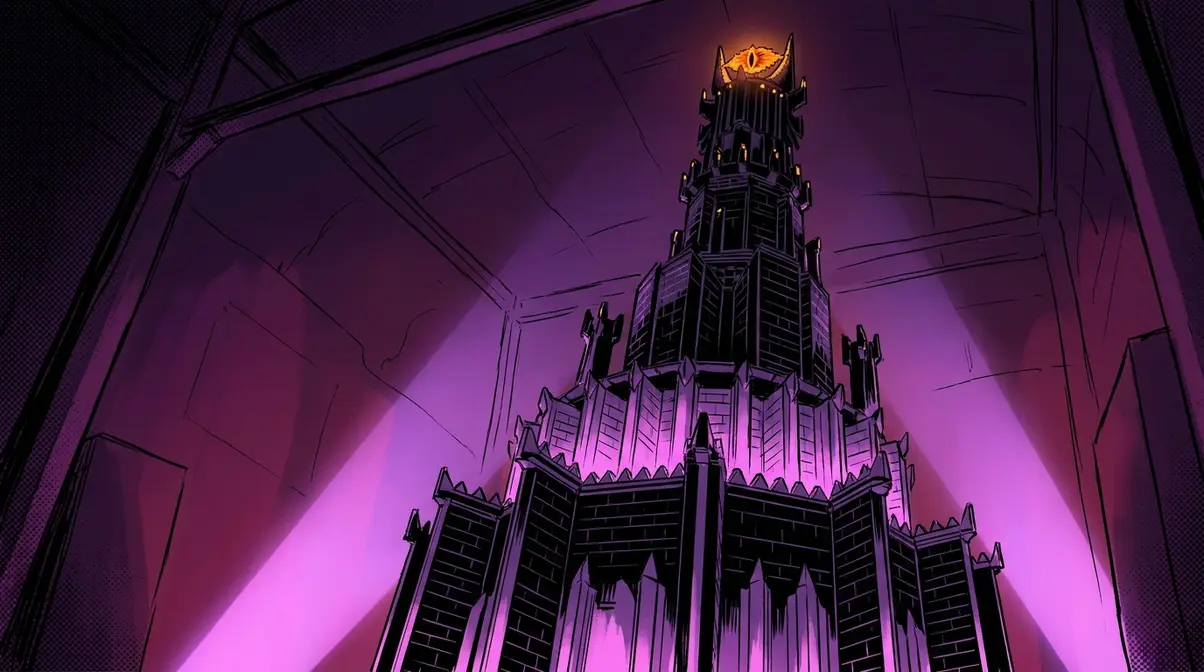

LEGO Barad-dûr (set 10333) is a 5,471-piece, 83cm-tall buildable replica of Sauron’s fortress from The Lord of the Rings, released in June 2024 under the LEGO Icons line. Its four-section modular design allows builders to stack duplicate tower segments for added height, spawning a cottage industry of fan-made extensions and heated community math about proportions, cost-per-centimeter, and structural stability.
Inside the LEGO Barad-dûr Modular Tower Design
10333 The Lord of the Rings: Barad-dûr is built in four sections, and the part of the tower that houses the Mouth of Sauron’s study is designed in such a way that it’s stackable. That single engineering decision turned a $460 display set into an open-ended vertical puzzle. If you have the capital to pick up multiple copies, or the drive to part out the upper section on Pick a Brick or BrickLink, you can add essentially unlimited height to your LEGO Barad-dûr.
The concept was not an afterthought. LEGO designers Antica Bracanov and Ashwin Visser first unveiled the set to LEGO Fan Media in Billund in September 2023, and took the opportunity to show off that stacking in action. At RLFM Days, Bracanov showed off what Barad-dûr looks like with three additional segments, producing a comically tall but undeniably striking tower.
Bracanov, the lead designer, is a Croatian AFOL-turned-professional who joined LEGO in 2016 after being a member of the AFOL community for about 7 years. In a Brick Fanatics roundtable, she framed the modularity partly as logistics: “The model is huge,” she noted. “If you want to move it around, it’s easier if you can take it apart a little bit.” But the stacking potential was always lurking inside that pragmatism. I’d argue it’s the most interesting unintended consequence in a LEGO set since people started turning Modular Buildings into entire city blocks.
The Barad-dûr Proportion Problem, by the Numbers
Here is where the math gets uncomfortable for Tolkien purists. In Peter Jackson’s film trilogy, Barad-dûr dwarfs Orthanc by roughly a factor of ten. Tolkien described what Saruman made at Isengard as “only a little copy, a child’s model or a slave’s flattery” of Sauron’s vast fortress. But in LEGO form? Set 10333 is a towering recreation of the tallest structure in Middle-earth, reaching a titanic 83cm at its summit. The 2013 Tower of Orthanc (set 10237) measures over 28 inches (73cm) high. That is a difference of ten centimeters. About four inches. A mere twenty percent taller.
To my eye, this ratio is laughable if you’re displaying both towers side by side. And the community noticed instantly. The tower’s proportions feel slightly awkward when compared with the fortress seen in the movies, as one MOC designer on Rebrickable put it, diplomatically. The result? A small arms race of fan-designed extensions, each attempting to solve the proportion gap with varying levels of ambition and budget.
The LEGO Barad-dûr Extension MOC Landscape
Three major fan-designed extensions have emerged on Rebrickable, each offering a different answer to the same question: how tall should this thing actually be?
- Pixabricks (MOC-188585): 424 pieces that add 6.5 inches to the midsection of the official LEGO set, bringing Barad-dûr’s proportions more in line with what is seen in the movie trilogy. Designed with near-identical building techniques to the actual set, to ensure the module would feel right at home slotted between the 3rd and 4th floors of the tower. In my view, this is the sweet spot for most builders: it fixes the silhouette without wrecking your shelf.
- emilewski (MOC-189180): A meticulously designed extension that takes Barad-dûr an astounding 13.9 inches higher. One builder who completed it reported that the final height is 1.2 metres. That is nearly four feet of dark tower. Stunning. Also terrifying, structurally speaking.
- emilewski (MOC-190018): At less than half the pieces and at less than half the cost, this 7-inch extension is an affordable compromise for those who want to expand their Barad-dûr height within a reasonable budget.
And it doesn’t stop at height. Brix_just4me (MOC-193370) tackled the open back of the tower, which LEGO left exposed for play access. The result: a fully enclosed display model that took two months to design, build, and rework. I’d argue this is the most underrated of the bunch. It solves a different problem entirely, turning a dollhouse-format playset into a proper 360-degree display piece.
The Stacking Cost Math for LEGO Barad-dûr
Let’s talk money, because the stacking math is also spending math. Set 10333 retails for $459.99 USD. At £400 a pop, buying additional full copies is probably not on the cards for many people, and it’s also not a very efficient way to get just the parts you need for that section, which constitute only a fraction of the overall model.
The community quickly identified the smarter route: source the stackable segment’s parts individually through BrickLink or Pick a Brick. A “galaxy brain move” from LEGO’s side would be to offer readymade baskets with the necessary pieces. There’s precedent for it: the company created hand-selected Pick a Brick carts for add-ons to its Modular Buildings Collection. As of this writing, LEGO has not done this for Barad-dûr. My take: that’s a missed opportunity.
For the MOC route, the economics are far friendlier. Pixabricks’ 424-piece extension costs a fraction of a second set. Even emilewski’s 13.9-inch version, at 825 parts according to its Rebrickable listing, is a bargain compared to dropping another $460 for parts you’ll mostly shelve.
Why LEGO Barad-dûr Was Designed from the Eye Down
The tower’s proportions are not arbitrary. In a Brick Fanatics interview, Bracanov explained that the Eye of Sauron dictated everything: “The eye was the first thing that we designed. We started from top to bottom, because the eye is the most iconic part of the model. We had most of the designers in my team working on their iterations of the eye and then we were just trying to see which one works the best.”
“If you made the eye a couple of millimetres bigger, it would affect everything,” she added. “It would affect the space that it needs between these little support pillars.” The eye’s final dimensions locked the tower’s width, which locked its height, which locked its relationship to Orthanc. That cascade is, I think, the most interesting design story in the entire set: a millimeter-scale decision at the summit creating a proportion debate that would fuel months of MOC engineering below.
The Build Experience and What Sits Inside LEGO Barad-dûr
The set comes with 40 numbered bags, all paper, and three instruction manuals. This is technically a “Build Together” set that you can share with up to two other people. In practice, most builders go solo, and the experience is a marathon. The build can feel pretty dour at times, and while there are epic moments as you realize the sheer scale of Sauron’s fortress, it can drag as you switch between repetitive sections of Barad-dûr’s exterior and rocky lava sections.
But the interiors reward persistence. Tolkien never specified what was inside the Dark Tower, so Bracanov invented freely. On LEGO’s own guided tour page, she explained: “There’s a room for the Mouth of Sauron, which also contains a library. We thought that Sauron has been around for several thousands of years, so it would make sense that he has books containing all his knowledge and magic.” There’s a weapons forge, a prison with a raisable Orc cage, a throne room with a hidden map of Middle-earth, and the universally beloved Orc Cafeteria, complete with a barbecue grill over lava.
The designers utilized clever greebling and SNOT (Studs Not On Top) techniques to break up the textures of what could have been a featureless black monolith. In a Brick Fanatics interview, Bracanov described how the team decided early on to add terrain at the base and use a warm-to-cool color gradient — with elements closer to the lava source rendered in warmer hues — to make the tower look more dynamic. That color gradient across the model is, to me, one of the most sophisticated design moves in any LEGO set of the last five years.
LEGO Barad-dûr vs. Rivendell vs. Orthanc: The Lord of the Rings Sets Compared
Set 10333 exists in a lineage. It enters the wider canon of huge LEGO The Lord of the Rings sets some 15 months after the LEGO Group returned to Middle-earth for 10316 The Lord of the Rings: Rivendell. Rivendell contains 6,167 pieces and retails for $499.99, making it both larger and more expensive. The 2013 Tower of Orthanc (10237) had 2,359 pieces at $199.99 and has since retired to secondary-market prices around $1,400 sealed.
There are 10 minifigures included, with Sauron, Mouth of Sauron, Orcs, Frodo, Sam, Gollum and Gothmog among them. This is the first time LEGO Lord of the Rings fans can own a Sauron minifigure. That alone makes the set a collector landmark. I’d argue the Sauron minifigure is worth the price of admission for serious LOTR collectors, even before you stack a single extra segment.
Frequently Asked Questions About LEGO Barad-dûr Stacking
Can you really stack LEGO Barad-dûr segments to make it taller?
Yes. The model is split into four main sections, with the tower section being fully modular. LEGO fans with more than one copy of the set will be able to stack this section to build a taller tower. You can also source the parts individually through BrickLink or Pick a Brick rather than buying a full second set.
How tall is LEGO Barad-dûr with extensions?
The stock set stands 83cm (32.6 inches). With Pixabricks’ 424-piece MOC extension, it gains 6.5 inches. With emilewski’s 13.9-inch extension, one builder reported the final height is 1.2 metres , or roughly 47 inches.
How much does LEGO set 10333 Barad-dûr cost?
10333 The Lord of the Rings: Barad-dûr retails for £399.99 / $459.99 / €459.99. That works out to roughly $0.08 per piece, which is actually below the typical LEGO price-per-piece average for licensed sets.
Is LEGO Barad-dûr taller than the Tower of Orthanc?
Yes, but not by much. Barad-dûr is 83cm tall; Orthanc measures over 28 inches (73cm) high. That’s only a 10cm difference, which many fans consider disproportionate given that Barad-dûr is supposed to be vastly taller than Orthanc in Tolkien’s world.
How many pieces are in LEGO Barad-dûr?
With 5,471 pieces, the set brings to life the dark tower of Mordor in stunning detail. It ranks among the 20 largest LEGO sets ever produced, though its stablemate Rivendell (10316) edges it out at 6,167 pieces.
When does LEGO Barad-dûr retire?
Based on current LEGO lifecycle tracking, the set’s projected end-of-life is December 31, 2027, though some trackers suggest it could retire earlier. If you’re considering the stacking math, that gives you time to source parts at retail before secondary-market premiums kick in.
'%3e%3cg id='Final-Copy-2_2_' transform='translate(1275.000000, 200.000000)'%3e%3cpath class='st0' d='M7.4,12.8h6.8l3.1-11.6H7.4C4.2,1.2,1.6,3.8,1.6,7S4.2,12.8,7.4,12.8z'/%3e%3c/g%3e%3c/g%3e%3c/g%3e%3cg id='final---dec.11-2020'%3e%3cg id='_x30_208-our-toggle' transform='translate(-1275.000000, -200.000000)'%3e%3cg id='Final-Copy-2' transform='translate(1275.000000, 200.000000)'%3e%3cpath class='st1' d='M22.6,0H7.4c-3.9,0-7,3.1-7,7s3.1,7,7,7h15.2c3.9,0,7-3.1,7-7S26.4,0,22.6,0z M1.6,7c0-3.2,2.6-5.8,5.8-5.8 h9.9l-3.1,11.6H7.4C4.2,12.8,1.6,10.2,1.6,7z'/%3e%3cpath id='x' class='st2' d='M24.6,4c0.2,0.2,0.2,0.6,0,0.8l0,0L22.5,7l2.2,2.2c0.2,0.2,0.2,0.6,0,0.8c-0.2,0.2-0.6,0.2-0.8,0 l0,0l-2.2-2.2L19.5,10c-0.2,0.2-0.6,0.2-0.8,0c-0.2-0.2-0.2-0.6,0-0.8l0,0L20.8,7l-2.2-2.2c-0.2-0.2-0.2-0.6,0-0.8 c0.2-0.2,0.6-0.2,0.8,0l0,0l2.2,2.2L23.8,4C24,3.8,24.4,3.8,24.6,4z'/%3e%3cpath id='y' class='st3' d='M12.7,4.1c0.2,0.2,0.3,0.6,0.1,0.8l0,0L8.6,9.8C8.5,9.9,8.4,10,8.3,10c-0.2,0.1-0.5,0.1-0.7-0.1l0,0 L5.4,7.7c-0.2-0.2-0.2-0.6,0-0.8c0.2-0.2,0.6-0.2,0.8,0l0,0L8,8.6l3.8-4.5C12,3.9,12.4,3.9,12.7,4.1z'/%3e%3c/g%3e%3c/g%3e%3c/g%3e%3c/g%3e%3c/svg%3e) Your Privacy Choices
Your Privacy Choices