

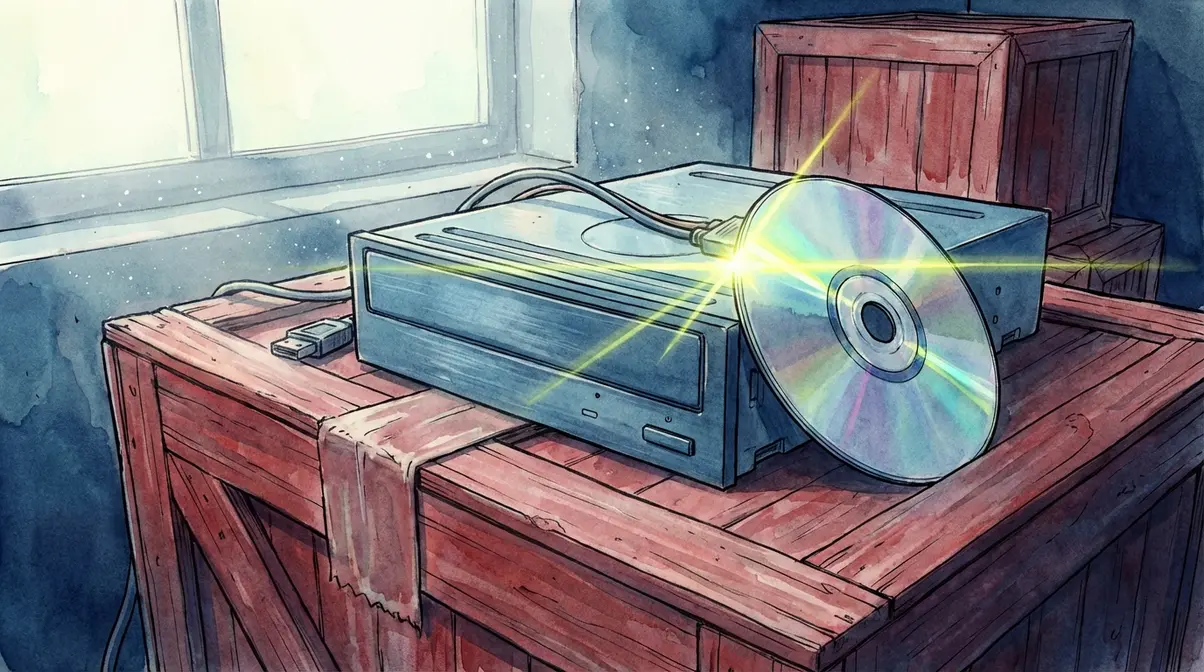

Here is what nobody is saying: Buffalo and Elecom were never Blu-ray companies. They were peripheral companies that happened to sell Blu-ray drives. And the difference matters more than you think.
When Buffalo Japan confirmed in late February that it would discontinue its final three portable USB Blu-ray drives by July 2026, the internet did what the internet does. It mourned. It panicked. It said the words “nail in the coffin” so many times the phrase lost all meaning. Then, barely three weeks later, Elecom posted a terse notice on X announcing it would pull all nine of its external Blu-ray drives from sale by June 30, 2026. Nine models. Every single one. No successors. The Elecom notice even carried an apology, the kind of formal Japanese corporate contrition that reads like a eulogy.
And so the narrative calcified overnight: Blu-ray is dead, physical media is over, the streaming lords have won.
I want to push back on that. Gently, but firmly, the way you’d push a warped record back into its sleeve.
Peripheral Vision
Buffalo was founded in 1975 as an audio equipment manufacturer. It built its reputation on routers, NAS boxes, USB hubs. Optical drives were a sideline, a product category it maintained because the market existed, not because it defined the brand. The three discontinued models tell the story plainly. The BRXLPT6U3E and BRXLPTV63B were competent portable Blu-ray writers, nothing more. The most interesting of the trio, the BRXLPTWOU3, was certified compliant with Japan’s Electronic Bookkeeping Act, a bureaucratic holdover that until recently required companies to submit documents on floppy disks or optical media. That’s not a passion product. That’s a compliance checkbox.
Elecom, founded in Osaka in 1986, follows an even more telling pattern. Its nine discontinued drives were sold under the Logitec brand (not Logitech, which operates as Logicool in Japan), a subsidiary Elecom acquired via stock buyout in December 2004. The lineup was a textbook case of micro-segmentation: permutations of USB-A and USB-C, black and white and silver and grey, M-Disc support here, Mac compatibility there. It was a catalog exercise, not a commitment. Elecom is a company posting ¥95.27 billion in net sales for the first nine months of fiscal 2025, with profits surging over 145%. It is doing extraordinarily well. It simply decided optical drives weren’t part of that future.
These were not artisan workshops closing their doors. These were conglomerates trimming product lines.
The Panic and the Point
Online collector communities erupted. Data archivists warned that Blu-ray discs, with their inorganic recording layers and projected lifespans of fifty years or more, outlast hard drives vulnerable to mechanical failure and SSDs subject to electron migration within a decade. Anime fans in Japan, where physical media still carries real cultural weight, pointed out that modern PCs ship without optical drives, making external USB units the only way to play their collections. The mood was urgent: stock up now, rip everything, the window is closing.
And some of that urgency is warranted. Japan is experiencing a peculiar collision of forces. The end of Windows 10 support pushed a wave of PC upgrades, and new machines almost never include drive bays. In Akihabara, retailers report optical drives selling faster than they can restock. Meanwhile, the companies that make them are walking away.
But the panic assumes that Buffalo and Elecom leaving means the format is abandoned. It doesn’t. It means two companies that were never deeply invested in optical technology have made rational business decisions. That’s all.
Who Actually Stays
Panasonic stays. And Panasonic’s position reveals something the doomsayers keep overlooking. The company’s DMR-ZR1, a flagship Blu-ray recorder it introduced in 2022 and calls “the highest grade in the history of DIGA,” has been so overwhelmed with orders that Panasonic issued a public apology for delays. The company has promised to strengthen its production system and increase output. This is not the behavior of a format in freefall. This is the behavior of a market consolidating around its most committed player.
Forum chatter among hardware enthusiasts suggests Panasonic was already supplying optical drive mechanisms and firmware to rivals before they exited. If true, the company’s vertical integration gives it a structural advantage nobody else in the space can match. It doesn’t just sell Blu-ray products. It makes the components that make Blu-ray products possible.
Buffalo Americas, for its part, quickly clarified that the Japan discontinuation has no bearing on its U.S. operations. David Tran from the American division told Tom’s Hardware that optical drives remain critical for government and enterprise customers who rely on TAA-compliant hardware. The company still lists three drives for the American market, starting at $99. Whether that commitment outlasts the next quarterly review is anyone’s guess. But for now, the lights are on.
What This Actually Sounds Like
I keep thinking about liner notes. The ones tucked inside a gatefold sleeve, written by someone who was in the room when the music was made. They never say the album is perfect. They say it’s real. They describe the tape hiss, the borrowed amp, the session that almost didn’t happen.
Physical media has always been like that. Imperfect, tactile, stubbornly present. A Blu-ray disc spinning at 100 Mbps delivers a picture that Netflix at 16 Mbps cannot touch. That’s not opinion. That’s math. And the people who care about that difference will continue to care about it whether Buffalo sells drives or not.
The mistake is confusing the exit of peripheral manufacturers with the death of a format. Blu-ray isn’t dying because two companies that sold USB hubs and keyboard wrist rests decided to stop bundling disc drives into their catalogs. Blu-ray is contracting, consolidating, becoming the province of companies and consumers who actually want to be there. That’s not death. That’s distillation.
Stock up if you want. Rip your discs if it helps you sleep. But save the eulogy. The format doesn’t need it yet.


'%3e%3cg id='Final-Copy-2_2_' transform='translate(1275.000000, 200.000000)'%3e%3cpath class='st0' d='M7.4,12.8h6.8l3.1-11.6H7.4C4.2,1.2,1.6,3.8,1.6,7S4.2,12.8,7.4,12.8z'/%3e%3c/g%3e%3c/g%3e%3c/g%3e%3cg id='final---dec.11-2020'%3e%3cg id='_x30_208-our-toggle' transform='translate(-1275.000000, -200.000000)'%3e%3cg id='Final-Copy-2' transform='translate(1275.000000, 200.000000)'%3e%3cpath class='st1' d='M22.6,0H7.4c-3.9,0-7,3.1-7,7s3.1,7,7,7h15.2c3.9,0,7-3.1,7-7S26.4,0,22.6,0z M1.6,7c0-3.2,2.6-5.8,5.8-5.8 h9.9l-3.1,11.6H7.4C4.2,12.8,1.6,10.2,1.6,7z'/%3e%3cpath id='x' class='st2' d='M24.6,4c0.2,0.2,0.2,0.6,0,0.8l0,0L22.5,7l2.2,2.2c0.2,0.2,0.2,0.6,0,0.8c-0.2,0.2-0.6,0.2-0.8,0 l0,0l-2.2-2.2L19.5,10c-0.2,0.2-0.6,0.2-0.8,0c-0.2-0.2-0.2-0.6,0-0.8l0,0L20.8,7l-2.2-2.2c-0.2-0.2-0.2-0.6,0-0.8 c0.2-0.2,0.6-0.2,0.8,0l0,0l2.2,2.2L23.8,4C24,3.8,24.4,3.8,24.6,4z'/%3e%3cpath id='y' class='st3' d='M12.7,4.1c0.2,0.2,0.3,0.6,0.1,0.8l0,0L8.6,9.8C8.5,9.9,8.4,10,8.3,10c-0.2,0.1-0.5,0.1-0.7-0.1l0,0 L5.4,7.7c-0.2-0.2-0.2-0.6,0-0.8c0.2-0.2,0.6-0.2,0.8,0l0,0L8,8.6l3.8-4.5C12,3.9,12.4,3.9,12.7,4.1z'/%3e%3c/g%3e%3c/g%3e%3c/g%3e%3c/g%3e%3c/svg%3e) Your Privacy Choices
Your Privacy Choices