


Nine Sols is a hand-drawn 2D action-platformer developed by Taiwanese indie studio Red Candle Games, released on May 29, 2024. It features lore-rich, Sekiro-inspired deflection-focused combat set in a world the developers call “Taopunk,” cyberpunk mixed with Taoism and Far Eastern mythology. Built over roughly six years by a team of about thirteen people, it represents one of the most dramatic creative pivots in recent indie game history.
Red Candle Games: Taipei’s Unlikely Genre Chameleons
Red Candle Games was founded on September 1, 2015, by six individuals from different backgrounds to create Detention, a psychological horror video game set in 1960s White Terror-era Taiwan. The founding team included Doy Chiang, Hans Chen, Coffee Yao, Vincent Yang, Henry Wang, and Light Wang. Their debut was a side-scrolling horror game steeped in local folklore and political history, the kind of thing that simply didn’t exist in the global indie market at the time. Detention was adapted into a film in 2019, and later adapted into a TV series in 2020.
Their second game, Devotion (2019), was a first-person psychological horror experience set in 1980s Taiwan. It earned an 86 on Metacritic before being swept into a geopolitical firestorm. Hidden visual references mocking Chinese Communist Party general secretary Xi Jinping were discovered by players, leading to the game’s removal from Chinese storefronts. In March 2021, Red Candle Games launched an e-shop on their official website which sold both of their games , a move born from necessity that would shape everything that followed.
Most studios that survive a political ban and a two-year sales blackout would play it safe afterward. Red Candle did the opposite. They abandoned horror entirely and bet their future on a genre they’d never attempted.
Nine Sols and the Invention of Taopunk
The concept for Nine Sols predates the Devotion controversy. Co-founder and producer Vincent Yang envisioned the game years before development began, rooting its story in the Chinese myth of Hou Yi, the divine archer. The question that sparked the project was deceptively simple: what if that myth became science fiction?
In December 2021, the studio announced their next project being Nine Sols, a 2D hand-drawn action-platformer inspired by Sekiro: Shadows Die Twice, Hollow Knight, and Katana Zero, with the former for its deflection-focused combat system. But the game’s identity runs deeper than its mechanical influences. Yang has described the six-year journey of defining “Taopunk” as one of the studio’s greatest challenges. You can’t just bolt a pagoda onto a circuit board and call it a new genre. Every layer of Nine Sols, from its world-building to its character design to the way neon light falls across ancient architecture, had to earn the label.
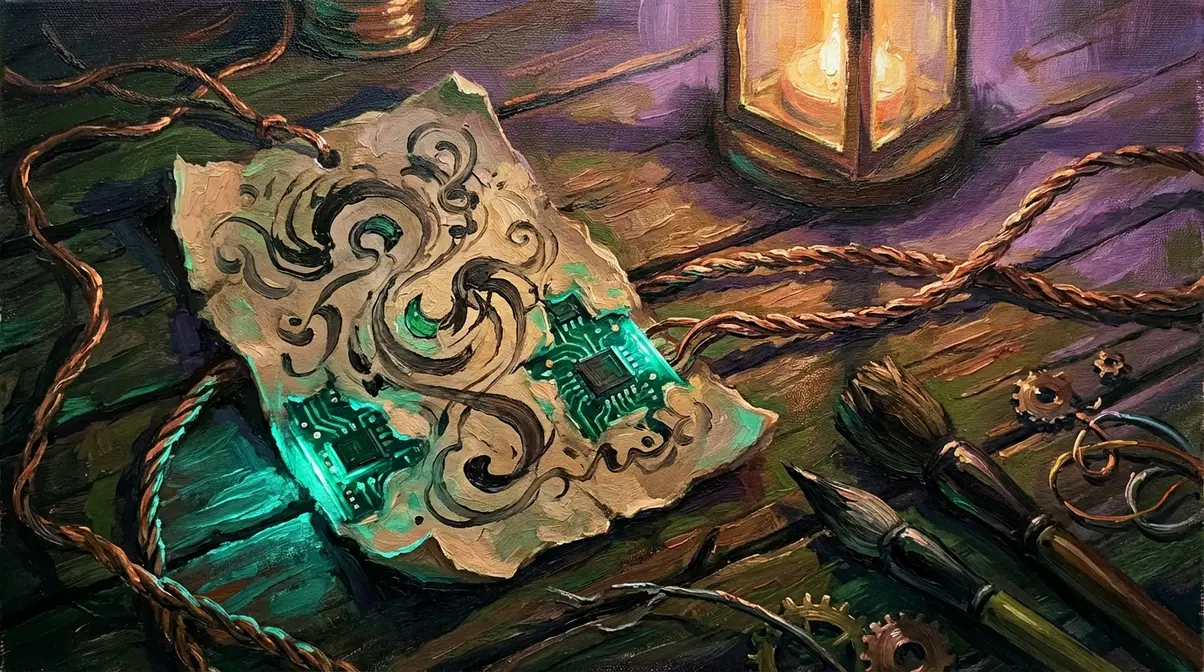
The result is a setting where cybernetic vines twist around lotus blossoms, where Taoist talismans function as combat tools, and where the philosophical weight of Eastern tradition sits comfortably alongside futuristic technology. It feels nothing like the studio’s previous work. It feels nothing like anyone else’s work, either.
Drawing Every Frame by Hand with Thirteen People
Nine Sols is filled with meticulous hand-crafted, anime style landscapes, sprite based hand-drawn animations, blending with Japanese manga inspired cutscenes. That sentence sounds like marketing copy until you consider the scale of the undertaking relative to the team. Red Candle grew from nine people on Detention to around thirteen for Nine Sols, and they cited the smaller size as an advantage, allowing greater versatility and experimentation.
The art team is led by Hans Chen, who served as Art Director on all three Red Candle titles. That’s a remarkable throughline: the same person oversaw Detention’s desaturated, grainy horror textures, Devotion’s claustrophobic apartment interiors, and Nine Sols’ explosively colorful Taopunk landscapes. Lead artist Pege Ho handled most character creation, concept artist Tata developed the Taopunk visual language, and lead animator Minus Chen brought it all to life with fluid, kinetic sprite work. The fact that these names aren’t better known outside of indie circles is a genuine shame.
The digital art book features 416 pages of content (presented as 208 pages in a horizontal double-page PDF layout), offering a curated collection of core visual materials from the development of Nine Sols. Four hundred and sixteen pages of process work. That’s not a supplement. That’s a monument.
The Ghosts of Akira and Ghost in the Shell
Red Candle has been open about the visual DNA running through Nine Sols. The team grew up on 1980s and ’90s Japanese animation, and cyberpunk classics like Akira, Ghost in the Shell, and Shin Megami Tensei became foundational references. Blade Runner informed the dystopian atmosphere. Princess Mononoke shaped the nature-versus-technology tension woven throughout the game’s environments.
What makes Nine Sols special is how it metabolizes those influences rather than merely citing them. The manga-panel cutscene system is a perfect example. Instead of defaulting to pre-rendered cinematics or in-engine dialogue sequences, Red Candle built a storytelling apparatus that feels like flipping through a serialized comic while playing a game. In online fan communities, this technique has been called one of the most underused approaches in interactive media, and Nine Sols makes a persuasive case for why more studios should try it.
Crowdfunded on Their Own Terms
In March 2022, Red Candle Games launched a crowdfunding campaign for Nine Sols on their online store and pledged NT$3 million. That’s roughly US$106,000. They hit the goal in under 24 hours. By the time the campaign closed in April, more than 8,900 backers had contributed NT$13.6 million, over 4.5 times the original target.
The campaign ran entirely through Red Candle’s own website, not Kickstarter, not any third-party platform. This was a deliberate choice, shaped by the Devotion debacle. After losing publishers, being dropped by storefronts, and watching their game vanish from sale for two years, the studio wanted full control. They could have finished Nine Sols without the crowdfunding money. They’ve said as much. But at the time, they felt like they were “walking in the dark” and needed any form of feedback to keep going.
Nine Sols Lands: 800,000 Copies and a Trail of Awards
Overwhelmingly Positive: 95% of the 17,493 user reviews for this game are positive. On OpenCritic, the game earned a “Mighty” rating with an average score of 86, recommended by 98% of critics. PC Gamer gave it 92 out of 100. The Steam page remains a wall of glowing user endorsements nearly two years after launch.
By its first anniversary in May 2025, Nine Sols had sold over 800,000 copies across all platforms , a figure Red Candle announced alongside a timeline of milestones: the BitSummit International Award in Japan, a Gamescom Best Audio nomination, a Steam Awards Outstanding Visual Style nomination, an IGF Excellence in Visual Art finalist nod, the Famitsu Dengeki Indie Game Grand Prize, and the Best Game award at Gamescom LATAM in Brazil.
And yet, Nine Sols received zero nominations at The Game Awards 2024. Not for Best Independent Game. Not for Best Art Direction. Nothing. The snub became a minor cause célèbre among indie game fans online, fueling a persistent “hidden gem” advocacy campaign that arguably did more for the game’s long-term visibility than a nomination would have.
From Sprites to Serialized Manga
In April 2025, Red Candle expanded the Nine Sols universe into a new medium. Red Candle Games announced a prequel manga in partnership with MOJOIN, featuring artwork by Yang Chi-Cheng, available to read online for free in English, Chinese, and Japanese. Titled Nine Sols: The Way of Lear: Prelude, the story goes all the way back to the very beginnings of Nine Sols’ mythic saga, 500 years before the events of the game.
“When we were working on Nine Sols, our team had many ideas for the story of Lear, but due to time constraints and other factors, we weren’t able to include everything,” the studio wrote in its announcement. New chapters released every Wednesday , and the three-part series concluded in May 2025. Fan response was intense. Community forums filled with readers dissecting lore connections between the manga and the game, with some calling it one of the best transmedia expansions they’d seen from an indie studio.
What Comes Next: A Creepypasta in the Dark
The most recent stir around Red Candle involves a creepypasta-style ARG video posted to their YouTube page, with viewers finding names associated with Nine Sols lore in the comments, sparking speculation about a horror game set within that universe. There’s even a playable demo accessible within Nine Sols itself, a first-person maze with light platforming that yields a secret ending if you change your Steam display name to “Yuuki Wu.”
Fan opinion is split. Some want more Taopunk. Some want Red Candle to return to the shadowy, oppressive aesthetic of Detention and Devotion. The most interesting possibility is that they’ll find a way to merge both identities, channeling the hand-drawn beauty of Nine Sols into something darker and stranger. If any studio has earned the benefit of the doubt, it’s this one.
The Argument for Craft
Nine Sols shouldn’t work on paper. A horror studio with no action-platformer experience, recovering from a political scandal, self-publishing through its own website, crowdfunding in Taiwanese dollars, hand-drawing every animation frame with a team small enough to fit in a single conference room. PCGamesN put it well when they noted that most studios would have folded; instead, Red Candle made a game in a genre it had no experience in and somehow created one of the best combat Metroidvanias since Hollow Knight.
The hand-drawn art is the thread that ties it all together. Not as a gimmick or a nostalgic flourish, but as a philosophy. Every environment, every boss animation, every manga-panel cutscene in Nine Sols exists because someone at Red Candle Games drew it by hand and decided it mattered. In a medium increasingly defined by procedural generation and AI-assisted pipelines, that commitment to craft isn’t just admirable. It’s defiant.
Frequently Asked Questions
What is Taopunk?
Taopunk is a term coined by Red Candle Games to describe the setting of Nine Sols, combining cyberpunk with Taoism and Far Eastern mythology. It encompasses the game’s visual style, narrative themes, and world-building, blending futuristic technology with ancient Eastern philosophy.
How many copies has Nine Sols sold?
As of its first anniversary on May 29, 2025, Nine Sols had sold over 800,000 copies across all platforms.
What platforms is Nine Sols available on?
Nine Sols is available on PC, PlayStation 5, PlayStation 4, Xbox One, Xbox Series X|S, and Nintendo Switch. It also launched day one on Xbox Game Pass in November 2024.
Is there a Nine Sols manga?
Yes. Titled Nine Sols: The Way of Lear: Prelude, the manga is set many years before Nine Sols and comes from a partnership with webcomic platform MOJOIN and manga artist Yang Chi-Cheng. It is free to read online in English, Chinese, and Japanese on the MOJOIN website.
Was Nine Sols nominated at The Game Awards?
No. Despite widespread critical acclaim and a 95% positive rating on Steam, Nine Sols received no nominations at The Game Awards 2024. It was, however, a finalist for Excellence in Visual Arts at the 2025 IGF Awards , and won the Famitsu Dengeki Indie Game Grand Prize and Best Game at Gamescom LATAM.
Is Red Candle Games working on a new game?
A creepypasta-style ARG video on Red Candle’s YouTube page has led to speculation about a new horror game potentially set within the Nine Sols universe , but no official announcement has been made as of April 2026.
'%3e%3cg id='Final-Copy-2_2_' transform='translate(1275.000000, 200.000000)'%3e%3cpath class='st0' d='M7.4,12.8h6.8l3.1-11.6H7.4C4.2,1.2,1.6,3.8,1.6,7S4.2,12.8,7.4,12.8z'/%3e%3c/g%3e%3c/g%3e%3c/g%3e%3cg id='final---dec.11-2020'%3e%3cg id='_x30_208-our-toggle' transform='translate(-1275.000000, -200.000000)'%3e%3cg id='Final-Copy-2' transform='translate(1275.000000, 200.000000)'%3e%3cpath class='st1' d='M22.6,0H7.4c-3.9,0-7,3.1-7,7s3.1,7,7,7h15.2c3.9,0,7-3.1,7-7S26.4,0,22.6,0z M1.6,7c0-3.2,2.6-5.8,5.8-5.8 h9.9l-3.1,11.6H7.4C4.2,12.8,1.6,10.2,1.6,7z'/%3e%3cpath id='x' class='st2' d='M24.6,4c0.2,0.2,0.2,0.6,0,0.8l0,0L22.5,7l2.2,2.2c0.2,0.2,0.2,0.6,0,0.8c-0.2,0.2-0.6,0.2-0.8,0 l0,0l-2.2-2.2L19.5,10c-0.2,0.2-0.6,0.2-0.8,0c-0.2-0.2-0.2-0.6,0-0.8l0,0L20.8,7l-2.2-2.2c-0.2-0.2-0.2-0.6,0-0.8 c0.2-0.2,0.6-0.2,0.8,0l0,0l2.2,2.2L23.8,4C24,3.8,24.4,3.8,24.6,4z'/%3e%3cpath id='y' class='st3' d='M12.7,4.1c0.2,0.2,0.3,0.6,0.1,0.8l0,0L8.6,9.8C8.5,9.9,8.4,10,8.3,10c-0.2,0.1-0.5,0.1-0.7-0.1l0,0 L5.4,7.7c-0.2-0.2-0.2-0.6,0-0.8c0.2-0.2,0.6-0.2,0.8,0l0,0L8,8.6l3.8-4.5C12,3.9,12.4,3.9,12.7,4.1z'/%3e%3c/g%3e%3c/g%3e%3c/g%3e%3c/g%3e%3c/svg%3e) Your Privacy Choices
Your Privacy Choices