

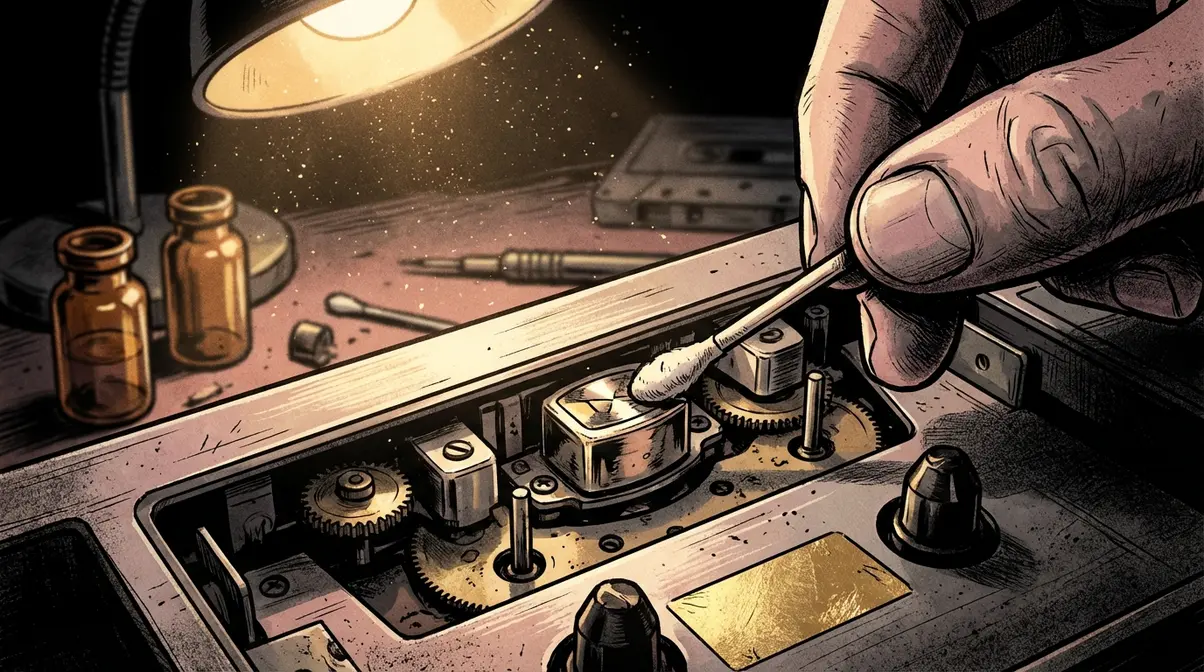

Cassette tape deck maintenance is the practice of cleaning, demagnetizing, and mechanically servicing the tape transport system of a compact cassette player or recorder. It involves removing oxide buildup from heads and guides, neutralizing residual magnetism, and replacing degraded rubber components to preserve sound quality and prevent damage to tapes.
Why a Dirty Head Ruins Everything
The Compact Cassette, invented by Lou Ottens and his team at Philips and introduced in August 1963 , uses a strip of magnetic tape just 0.15 inches wide crawling along at 1⅞ inches per second. That’s a postage stamp of a recording surface compared to reel-to-reel. Every speck of oxide debris on the head is an insult to the signal.
As Paul White wrote in Sound On Sound, even a few hours of use causes brown oxide to accumulate on the heads. The result is treble loss, dropouts, and, if you’re running Dolby B or C noise reduction, a cascading decoding error that makes everything sound worse than it should. Dirty heads mean Dolby can’t do its math. Clean heads are non-negotiable.
Head Cleaning with Isopropyl and Cotton Swabs
Skip the cleaning cassettes. The real method is simple: cotton swabs (wooden-stalk preferred) and isopropyl alcohol at 91% concentration or higher. Dampen the swab, gently wipe each head surface and the metal tape guides, and let everything dry before threading a tape. Paul White’s advice is to clean before every important recording session and at minimum once a week for regular users.
Don’t forget the tape guides. Oxide sticking to guides can cause wow, flutter, and a phasey, unstable sound as the tape snakes unevenly across the head gap.
Pinch Rollers Need Different Treatment
Here’s where the community splits hard. Isopropyl alcohol can dry out and harden rubber pinch rollers over time, and replacement rollers for vintage decks are increasingly difficult to source. Paul White recommended a drop of dish soap in tepid water applied with a cotton swab. Others swear by specialty products like Rubber Renue. Some veterans claim 30-plus years of cleaning rollers with alcohol and never losing one. The safe bet: use water and mild detergent on rubber, reserve alcohol for metal parts only.
Demagnetizing Heads and Guides
Magnetic charge accumulates on heads and metal guides through normal use. Left unchecked, it adds noise to recordings and can erase high-end detail from tapes passing over the magnetized surfaces. Routine demagnetizing (also called degaussing) is the standard preventive measure, recommended roughly every 25 hours of use or once a month.
The TDK HD-01, a battery-powered demagnetizer built into a standard cassette shell, is considered one of the best accessories for cassette decks ever made, with some users reporting continuous use since 1979. These units still trade on the secondhand market for roughly $27 to $75 depending on condition.
A critical safety rule from Paul White: never switch a mains-powered demagnetizer on or off near the heads. The resulting magnetic spike can permanently magnetize them. Always power down the deck before demagnetizing, or you risk blowing your monitor speakers with what amounts to a 50Hz signal at absurd volume.
Not everyone agrees demagnetizing matters. Some engineers argue that modern head materials like Sendust alloy cannot retain magnetism, making the ritual unnecessary. Aiwa apparently agreed, quietly dropping its built-in Automatic Demagnetization System once it switched to Sendust heads. For ferrite and permalloy heads, though, routine degaussing remains wise practice.
Belt Replacement Brings Dead Decks Back
If your deck won’t move tape, or moves it sluggishly with audible speed wobble, the rubber drive belts are almost certainly the culprit. Rubber degrades with age, stretching, cracking, or melting into a sticky residue. This is the single most common failure in vintage cassette decks pulled from closets and thrift stores.
Replacing belts requires opening the deck, removing the old rubber (a flathead screwdriver helps with the gummy remains), cleaning the pulleys thoroughly, and installing model-specific replacements. Thacker belts are well-regarded among enthusiasts for being close to original spec. Store your deck away from heat and direct sunlight to slow future belt degradation.
Azimuth Alignment and Knowing When to Call a Professional
Ideally, all tape heads should be aligned so that their head gaps are exactly perpendicular to the axis of the tape. When this condition is not met there is an “azimuth error,” the result of which is a loss in high-frequency response. Adjusting azimuth yourself requires a calibration tape and test equipment. Most home users should leave this to a qualified technician.
The Nakamichi Dragon, introduced in 1982, was the world’s first production tape recorder with an automatic azimuth correction system , a feature that made it the apex of cassette deck engineering. Its original launch price of US $2,499 in 1982 tells you how seriously Nakamichi took the problem of head alignment. For the rest of us, professional calibration every few years is the practical path. Expect to pay $150 to $300 for a full service with alignment, or a $200 minimum for basic repair work at a reputable shop.
FAQ
How often should I clean my cassette deck heads?
For casual listening, clean after every 30 hours of playback. If you’re recording, clean before every session. Old prerecorded tapes shed more oxide than fresh blanks, so adjust accordingly.
Can I use rubbing alcohol on pinch rollers?
It’s debated. Isopropyl alcohol can harden rubber over time. The safer approach is a cotton swab dampened with a drop of dish soap in warm water. If you use alcohol, use it sparingly and infrequently.
Do I really need to demagnetize my tape deck?
If your deck has ferrite or permalloy heads, yes. Residual magnetism builds up and degrades recordings over time. If your deck uses Sendust or similar alloy heads, the benefit is debatable. When in doubt, demagnetize monthly.
What tools do I need for basic cassette deck maintenance?
Isopropyl alcohol (91%+), cotton swabs, a rubber-safe cleaner or mild dish soap for pinch rollers, and a head demagnetizer. For belt replacement, you’ll also need a small screwdriver set and model-specific replacement belts.
Where can I find replacement belts for my cassette deck?
Thacker belts are a popular choice among enthusiasts. Other suppliers include PRB and webspareparts.com. Always match belts to your specific deck model using the service manual.
Is it worth paying for professional cassette deck repair?
For high-quality vintage decks, absolutely. No comparable new decks are being manufactured today, so keeping a good vintage machine in working order is the only way to get serious cassette playback. Services like Prell Electronics and Cassette Deck Service specialize in this work.


'%3e%3cg id='Final-Copy-2_2_' transform='translate(1275.000000, 200.000000)'%3e%3cpath class='st0' d='M7.4,12.8h6.8l3.1-11.6H7.4C4.2,1.2,1.6,3.8,1.6,7S4.2,12.8,7.4,12.8z'/%3e%3c/g%3e%3c/g%3e%3c/g%3e%3cg id='final---dec.11-2020'%3e%3cg id='_x30_208-our-toggle' transform='translate(-1275.000000, -200.000000)'%3e%3cg id='Final-Copy-2' transform='translate(1275.000000, 200.000000)'%3e%3cpath class='st1' d='M22.6,0H7.4c-3.9,0-7,3.1-7,7s3.1,7,7,7h15.2c3.9,0,7-3.1,7-7S26.4,0,22.6,0z M1.6,7c0-3.2,2.6-5.8,5.8-5.8 h9.9l-3.1,11.6H7.4C4.2,12.8,1.6,10.2,1.6,7z'/%3e%3cpath id='x' class='st2' d='M24.6,4c0.2,0.2,0.2,0.6,0,0.8l0,0L22.5,7l2.2,2.2c0.2,0.2,0.2,0.6,0,0.8c-0.2,0.2-0.6,0.2-0.8,0 l0,0l-2.2-2.2L19.5,10c-0.2,0.2-0.6,0.2-0.8,0c-0.2-0.2-0.2-0.6,0-0.8l0,0L20.8,7l-2.2-2.2c-0.2-0.2-0.2-0.6,0-0.8 c0.2-0.2,0.6-0.2,0.8,0l0,0l2.2,2.2L23.8,4C24,3.8,24.4,3.8,24.6,4z'/%3e%3cpath id='y' class='st3' d='M12.7,4.1c0.2,0.2,0.3,0.6,0.1,0.8l0,0L8.6,9.8C8.5,9.9,8.4,10,8.3,10c-0.2,0.1-0.5,0.1-0.7-0.1l0,0 L5.4,7.7c-0.2-0.2-0.2-0.6,0-0.8c0.2-0.2,0.6-0.2,0.8,0l0,0L8,8.6l3.8-4.5C12,3.9,12.4,3.9,12.7,4.1z'/%3e%3c/g%3e%3c/g%3e%3c/g%3e%3c/g%3e%3c/svg%3e) Your Privacy Choices
Your Privacy Choices