

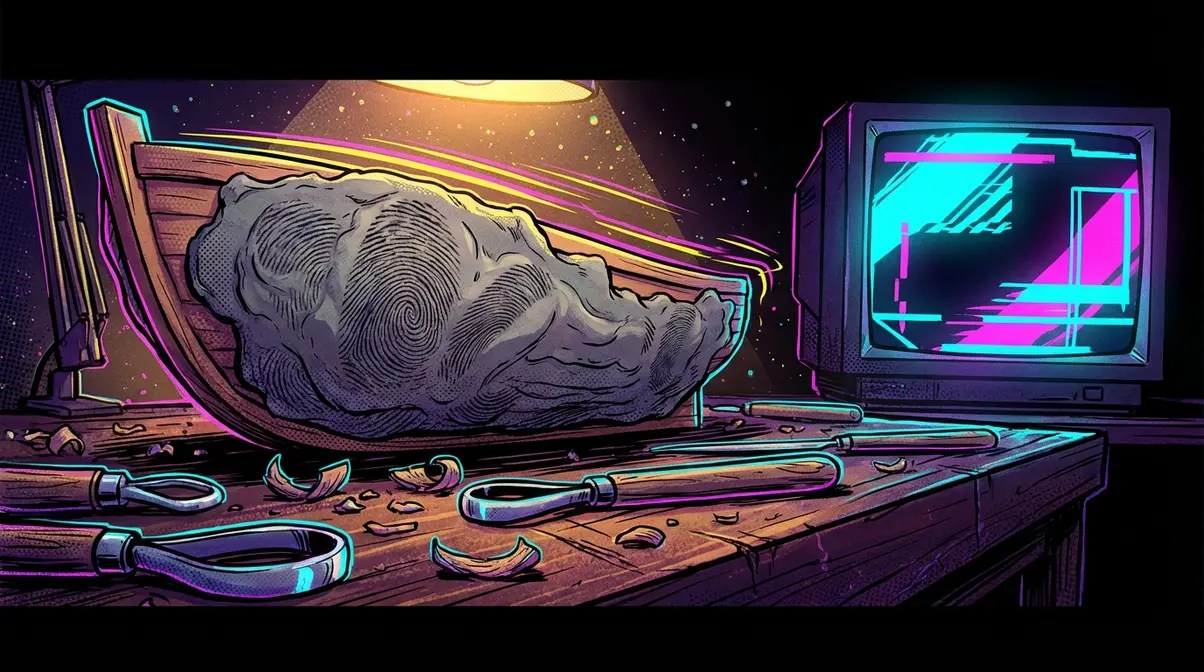

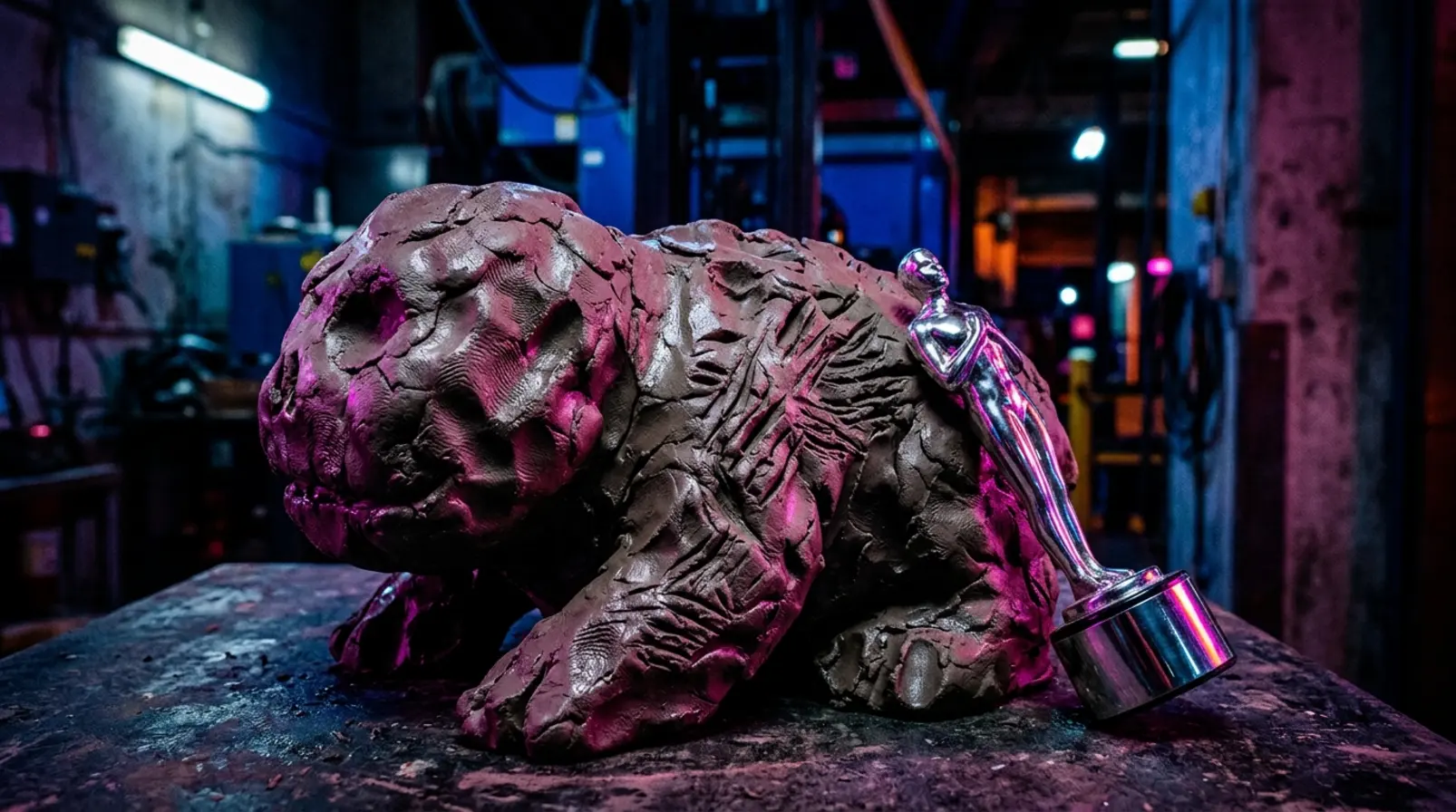
Somewhere in Cologne, in a studio that probably smelled like wet clay and sawdust for the better part of ten years, a tiny spaceship was taking shape. Not on a screen. On a table. Built from welded metal, hand-stitched textiles, and walnut-sized clay faces, the world of Harold Halibut existed as a physical object before it ever existed as a game. That distinction matters more than almost anything else about it.
Three Friends Who Couldn’t Draw
Slow Bros. was founded in 2015 by long-time friends Onat Hekimoglu, Ole Tillmann, Fabian Preuschoff, and Daniel Beckmann , but the idea predates the company by three years. In 2012, the initial three-person development team conceived the idea from a conversation about the potential to create a narrative-led video game using stop-motion animation, citing inspiration from classic adventure games and films including Jason and the Argonauts and The Valley of Gwangi.
The origin story is almost too good. “When we started working on this we were three friends and we had no artist among us, so none of us could draw,” Hekimoglu told MCV/Develop in 2019. “So we decided that the easiest way would be to build stuff.” That sentence contains a kind of reckless creative logic that only works when you’re young enough and broke enough to not know better. They didn’t choose physicality as a gimmick. They chose it because their hands were more skilled than their mice.
Hekimoglu, a filmmaker and graduate of the Cologne Game Lab, wrote his master’s thesis about the game, producing the first prototype. Following those first steps, they were able to found the studio and work full-time through funding from the Film- und Medienstiftung NRW, supplemented by personal equity and living on the financial minimum. The backgrounds of the team tell you everything about why the game looks the way it does: their diverse backgrounds including video game production, filmmaking, carpentry, apparel, and illustration give them a unique skill set.
200 Kilograms of Clay and a Failed Kickstarter
The production numbers read like the inventory of a particularly ambitious art school thesis. Everything you see on screen exists in real life, with the Cologne-based studio hand-crafting every character, every object, every set, before digitally scanning them. That includes over 50 unique characters (and the clothes they’re wearing) and more than 80 sets. Hekimoglu estimated the process required 200 kilograms of clay.
In July 2017, the studio launched a Kickstarter campaign with a goal of €150,000. The campaign did not meet its goal. This is the part of the story that would have killed most projects. A failed crowdfunding campaign is usually the last chapter, not a middle one. But Slow Bros. kept going. “Lots of luck and privilege and distributing every round of financing super thinly,” Ole Tillmann later told PreMortem Games. “It felt ok to offer what little we could to the people continually involved with the project if they agreed to share the eventual profits of the game.”
By 2023, the team still numbered about 4 people doing full-time work and about 5 or 6 people working part-time or freelance. A crew that small building something this large is almost absurd. Tillmann seemed to know it: “None of us would have expected to be making an elaborate, ten-year, puppet-based game opus. But we did!”
The Pipeline Nobody Had Built Before
Here’s where it gets technically interesting. Actual stop-motion animation was abandoned early as too restrictive for an interactive experience. What Slow Bros. invented instead was a hybrid pipeline. The developers hand-made characters, objects, and environments using various materials, then scanned them into the game and animated them in the Unity engine. The game features hand-made clay poseable puppets and detailed model sets, which are then scanned and digitised into Unity, with clever use of mocap suits from Xsens to bring the scenes to life.
Tillmann, speaking to PC Gamer in 2023, made a counterintuitive point about the timeline: “People understandably often assume that’s because we built it by hand. I think the actual art asset-making takes a similar amount of time to 3D models built digitally from scratch, at the same level of fidelity.” The decade wasn’t eaten by the sculpting. It was eaten by everything else. The pipeline itself. The rigging. The scanning. The fact that they were, essentially, inventing a production method as they used it.
A Game That Divides Along Exactly the Right Line
Harold Halibut launched on April 16, 2024, on PC, PS5, and Xbox Series X/S. It received “mixed or average” reviews from critics on Metacritic , landing around 70 on most platforms. On Steam, 82% of its 1,059 user reviews are positive. Those two numbers tell a story all by themselves.
The criticism is fair and predictable. The game is slow. Deliberately, almost defiantly slow. There are no puzzles to speak of, no mechanical challenges. You walk through corridors of the sunken spaceship FEDORA I, talk to its eccentric residents, and absorb the world. Some reviewers found this ponderous. Others found it meditative. “If you don’t have patience, this game isn’t for you,” Hekimoglu said plainly. “We know this is a slow game.” In online discussions, the debate over whether Harold Halibut should have been a film instead of a game has never quite resolved, which feels right. The developers were asked that question directly. “Because it wouldn’t feel the same!” Hekimoglu responded. “The interactivity is what enables us to create a much more empathic connection to the story.”
I think he’s correct. A film would have been beautiful. But a film doesn’t let you linger in a hallway, noticing the grain of a tiny wooden floorboard, the weave of a miniature curtain. The interactivity isn’t about puzzles. It’s about looking.
What the Fingerprints Mean
The game went on to win Best Graphics at the 2024 Deutscher Entwicklerpreis, Best Narrative at the Indie Awards, and was nominated for Artistic Achievement at BAFTA 2025. Slow Bros. has already received €80,000 in prototype funding for a new title called Livestream, described as a narrative first-person adventure using the same model-making-to-digital pipeline.
What stays with me about Harold Halibut isn’t its story, which is gentle and good. It’s the knowledge that every surface I’m looking at was once held in someone’s hands. That someone pressed their thumb into that clay. That someone cut that tiny piece of fabric with scissors. In an industry obsessed with photorealism, Slow Bros. spent a decade proving that the most convincing world is one you can actually touch. The imperfections aren’t bugs. They’re proof of life.
'%3e%3cg id='Final-Copy-2_2_' transform='translate(1275.000000, 200.000000)'%3e%3cpath class='st0' d='M7.4,12.8h6.8l3.1-11.6H7.4C4.2,1.2,1.6,3.8,1.6,7S4.2,12.8,7.4,12.8z'/%3e%3c/g%3e%3c/g%3e%3c/g%3e%3cg id='final---dec.11-2020'%3e%3cg id='_x30_208-our-toggle' transform='translate(-1275.000000, -200.000000)'%3e%3cg id='Final-Copy-2' transform='translate(1275.000000, 200.000000)'%3e%3cpath class='st1' d='M22.6,0H7.4c-3.9,0-7,3.1-7,7s3.1,7,7,7h15.2c3.9,0,7-3.1,7-7S26.4,0,22.6,0z M1.6,7c0-3.2,2.6-5.8,5.8-5.8 h9.9l-3.1,11.6H7.4C4.2,12.8,1.6,10.2,1.6,7z'/%3e%3cpath id='x' class='st2' d='M24.6,4c0.2,0.2,0.2,0.6,0,0.8l0,0L22.5,7l2.2,2.2c0.2,0.2,0.2,0.6,0,0.8c-0.2,0.2-0.6,0.2-0.8,0 l0,0l-2.2-2.2L19.5,10c-0.2,0.2-0.6,0.2-0.8,0c-0.2-0.2-0.2-0.6,0-0.8l0,0L20.8,7l-2.2-2.2c-0.2-0.2-0.2-0.6,0-0.8 c0.2-0.2,0.6-0.2,0.8,0l0,0l2.2,2.2L23.8,4C24,3.8,24.4,3.8,24.6,4z'/%3e%3cpath id='y' class='st3' d='M12.7,4.1c0.2,0.2,0.3,0.6,0.1,0.8l0,0L8.6,9.8C8.5,9.9,8.4,10,8.3,10c-0.2,0.1-0.5,0.1-0.7-0.1l0,0 L5.4,7.7c-0.2-0.2-0.2-0.6,0-0.8c0.2-0.2,0.6-0.2,0.8,0l0,0L8,8.6l3.8-4.5C12,3.9,12.4,3.9,12.7,4.1z'/%3e%3c/g%3e%3c/g%3e%3c/g%3e%3c/g%3e%3c/svg%3e) Your Privacy Choices
Your Privacy Choices