


Put the needle down. Side A, track one. This is the story of a show that could have been anything and chose, on purpose, to be less. Less smooth. Less sharp. Less modern. And in doing so, in my view, became the most vital piece of superhero animation in years.
The Rules of the Room
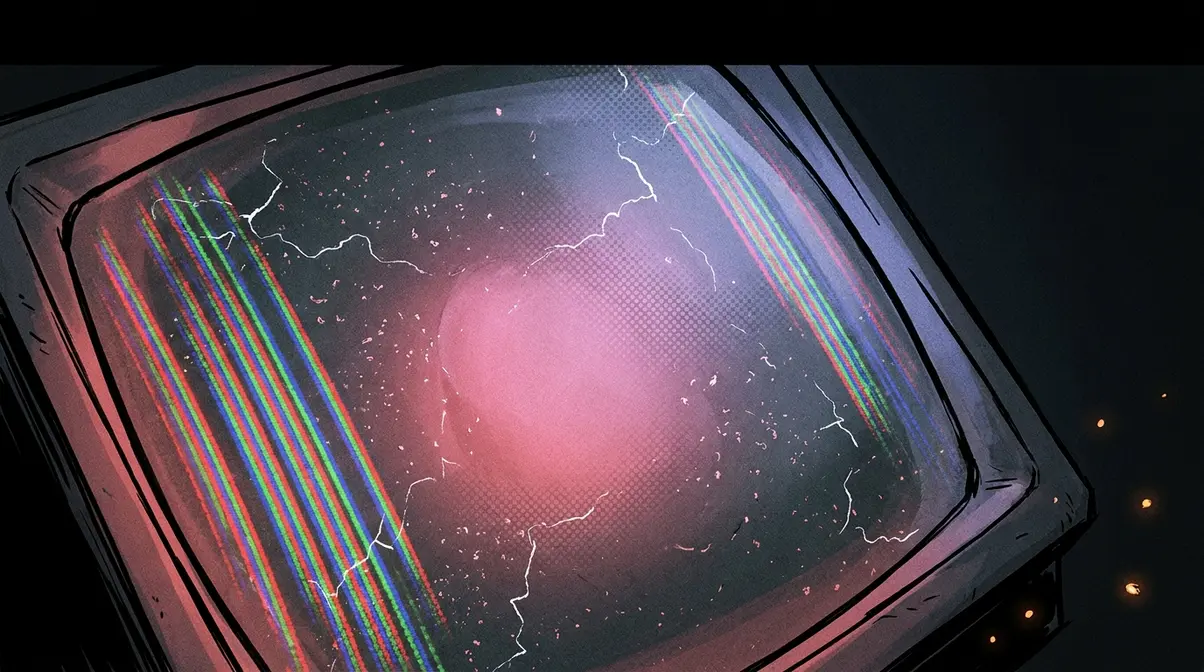
Brad Winderbaum, Marvel’s head of streaming, television, and animation, described early conversations with supervising director Jake Castorena and head of visual development Ryan Meinerding about “creating a code of ethics,” because “technology’s on a hyperbolic curve, and we could do whatever we want. And we cannot listen to that siren’s call.” The result: flat-plane storytelling, locked-off backgrounds, soft character curves, big bold ’90s colors. A VHS-inspired effect was applied to the animation to make it appear more like 1990s television. That last detail is the one that matters most here. Not a retro filter slapped on in post for vibes, but something deeper.
Castorena’s team didn’t just ask “what did old TV look like?” They asked why. Why did the color drip? Why did banding bars appear? Once they understood the science behind those analog artifacts, they could reproduce them with genuine fidelity rather than surface mimicry. Naseer Pasha, one of their in-house animators, helped the post team create a custom filter for the show. In fan circles, this entire philosophy has been nicknamed the “visual noise mandate,” a term that doesn’t appear in any official interview but captures the idea perfectly: the deliberate reintroduction of analog imperfection into a 4K digital pipeline.
The Director Who Understood Why It Worked
Emi Yonemura directed four episodes of X-Men ’97’s first season, including the Emmy-nominated “Remember It,” the Genosha episode that broke the internet and a few million hearts. Yonemura also directed the third, seventh, and ninth episodes. Their career path reads like liner notes to a collector’s edition: Yonemura grew up drawn to Japanese animation and manga, found American comics through X-Men: The Animated Series, and attended the Joe Kubert School because they wanted to follow the dream of doing comics.
What makes Yonemura essential to this conversation isn’t just craft. It’s philosophy. In an August 2024 interview with Awards Daily, Yonemura laid out the tension at the heart of the show’s animation: “We’re intentionally trying to be a 90s show; we can’t go as hardcore as a lot of modern animation with the sakuga style of really fast paced and amazing visuals on screen. So we can’t do that because we want to stay in the realm of the 90s but we don’t want it to look cheap and we still want it to be entertaining.”
There it is. That’s the whole debate in two sentences. And Yonemura didn’t just articulate it; they had to solve it, frame by frame, across the most emotionally devastating episodes of the season.
Less Is the Point
Yonemura credited storyboard artist Jalin Harden with keeping the action “fast-paced enough where it is fun, with really great movement and action, and it’s still telling a beautiful story within that action.” They insisted: “we can’t just have it be a cluster of effects on screen. It has to mean something, there has to be a reason someone is having this fight.” Every shot had to count.
I’d argue this is the part most people miss when they debate whether X-Men ’97 looks “good enough.” The restraint isn’t a limitation. It’s a storytelling instrument. When the Genosha attack hits in Episode 5, the visual language has been so carefully calibrated to feel safe, warm, ’90s-Saturday-morning familiar, that the destruction registers not just as plot but as violation. You feel the frame itself breaking its promise to you. Castorena acknowledged this balance directly: “if we shoot this too modern and we do too many bells and whistles, it’s instantly not the show anymore. But if we don’t improve, if we don’t bring in some new things… we’ll be bored.” He praised episodic directors Chase Conley and Yonemura for “raising the bar every episode… bringing a little bit of modernization into it, but not too much.”
The Fan Divide
Online communities are genuinely split on this. Animation enthusiasts tend to celebrate the discipline, treating X-Men ’97 as proof that 2D restraint can still dominate cultural conversation. Others, particularly fans hungry for the kind of fluid, kinetic sakuga that defines shows like Mob Psycho 100 or Jujutsu Kaisen, wish the show would take the leash off. Side-by-side screenshot comparisons pop up regularly, with nostalgia purists lamenting that the new show looks “too clean” while others insist Studio Mir’s work hits the sweet spot.
My take: both camps are right, and that’s the point. Winderbaum said they followed their “code of ethics” to align with ’90s animation restrictions but “occasionally broke this for dramatic effect.” He described the thrill of those rule-breaking moments in an interview with IndieWire: “You’re following Cyclops down the z-axis, and it just gives you this emotional charge because it’s dynamically pivoting, both in the story and in the style.” The visual noise isn’t there to be wallpaper. It’s there so the silence hits harder when it stops.
The Personal Frequency
There’s a reason Yonemura’s episodes feel different from the rest of the season, and it isn’t just technical. In an interview with Award Focus, Yonemura spoke about growing up as “a lonely kid,” finding in the X-Men “a family of outsiders that you could, in a weird way, relate to and fall in love with.” The characters became “an extended family.” That’s not professional polish talking. That’s someone who watched the original show on a CRT, probably taped episodes on a VHS they labeled in marker, and carried those characters through years of real life before ever getting to direct them.
Yonemura described the production culture in the same interview: “Everyone, from the production assistants to the top execs, cared so much about this product, this show, and these characters… We would actually say, ‘No, no, no, Rogue wouldn’t do that. Rogue would be more like this,’ and we’d agree.” In my view, that kind of collective ownership is what separates a revival from a reboot. It’s the difference between sampling a record and actually learning to play the song.
What Comes Next
X-Men ’97 has been renewed for Season 3, with Season 2 set to release in summer 2026. Work on the second season began by July 2022, with Conley and Yonemura returning as directors. Winderbaum has said the studio aims to release future seasons annually “for a number of years,” and confirmed that the third season is in production with discussions about potential fourth and fifth seasons already underway.
The question hanging over all of it: will the visual noise mandate hold? With new seasons in the pipeline and a behind-the-scenes art book due from Abrams, there will be pressure to escalate, to modernize, to let the technology flex. Perhaps the single most important creative decision for Season 2 isn’t a plot point or a character return. It’s whether someone in the room still has the nerve to say: no, pull that back. Make it grainier. Let it breathe.
Because what Emi Yonemura understood, and what the best episodes of X-Men ’97 prove, is that visual noise isn’t clutter. It’s context. It’s the warm hiss on the tape before the music starts. It tells your brain: this is the thing you loved, and it’s okay to love it again.
That’s not nostalgia. That’s craft.
'%3e%3cg id='Final-Copy-2_2_' transform='translate(1275.000000, 200.000000)'%3e%3cpath class='st0' d='M7.4,12.8h6.8l3.1-11.6H7.4C4.2,1.2,1.6,3.8,1.6,7S4.2,12.8,7.4,12.8z'/%3e%3c/g%3e%3c/g%3e%3c/g%3e%3cg id='final---dec.11-2020'%3e%3cg id='_x30_208-our-toggle' transform='translate(-1275.000000, -200.000000)'%3e%3cg id='Final-Copy-2' transform='translate(1275.000000, 200.000000)'%3e%3cpath class='st1' d='M22.6,0H7.4c-3.9,0-7,3.1-7,7s3.1,7,7,7h15.2c3.9,0,7-3.1,7-7S26.4,0,22.6,0z M1.6,7c0-3.2,2.6-5.8,5.8-5.8 h9.9l-3.1,11.6H7.4C4.2,12.8,1.6,10.2,1.6,7z'/%3e%3cpath id='x' class='st2' d='M24.6,4c0.2,0.2,0.2,0.6,0,0.8l0,0L22.5,7l2.2,2.2c0.2,0.2,0.2,0.6,0,0.8c-0.2,0.2-0.6,0.2-0.8,0 l0,0l-2.2-2.2L19.5,10c-0.2,0.2-0.6,0.2-0.8,0c-0.2-0.2-0.2-0.6,0-0.8l0,0L20.8,7l-2.2-2.2c-0.2-0.2-0.2-0.6,0-0.8 c0.2-0.2,0.6-0.2,0.8,0l0,0l2.2,2.2L23.8,4C24,3.8,24.4,3.8,24.6,4z'/%3e%3cpath id='y' class='st3' d='M12.7,4.1c0.2,0.2,0.3,0.6,0.1,0.8l0,0L8.6,9.8C8.5,9.9,8.4,10,8.3,10c-0.2,0.1-0.5,0.1-0.7-0.1l0,0 L5.4,7.7c-0.2-0.2-0.2-0.6,0-0.8c0.2-0.2,0.6-0.2,0.8,0l0,0L8,8.6l3.8-4.5C12,3.9,12.4,3.9,12.7,4.1z'/%3e%3c/g%3e%3c/g%3e%3c/g%3e%3c/g%3e%3c/svg%3e) Your Privacy Choices
Your Privacy Choices