

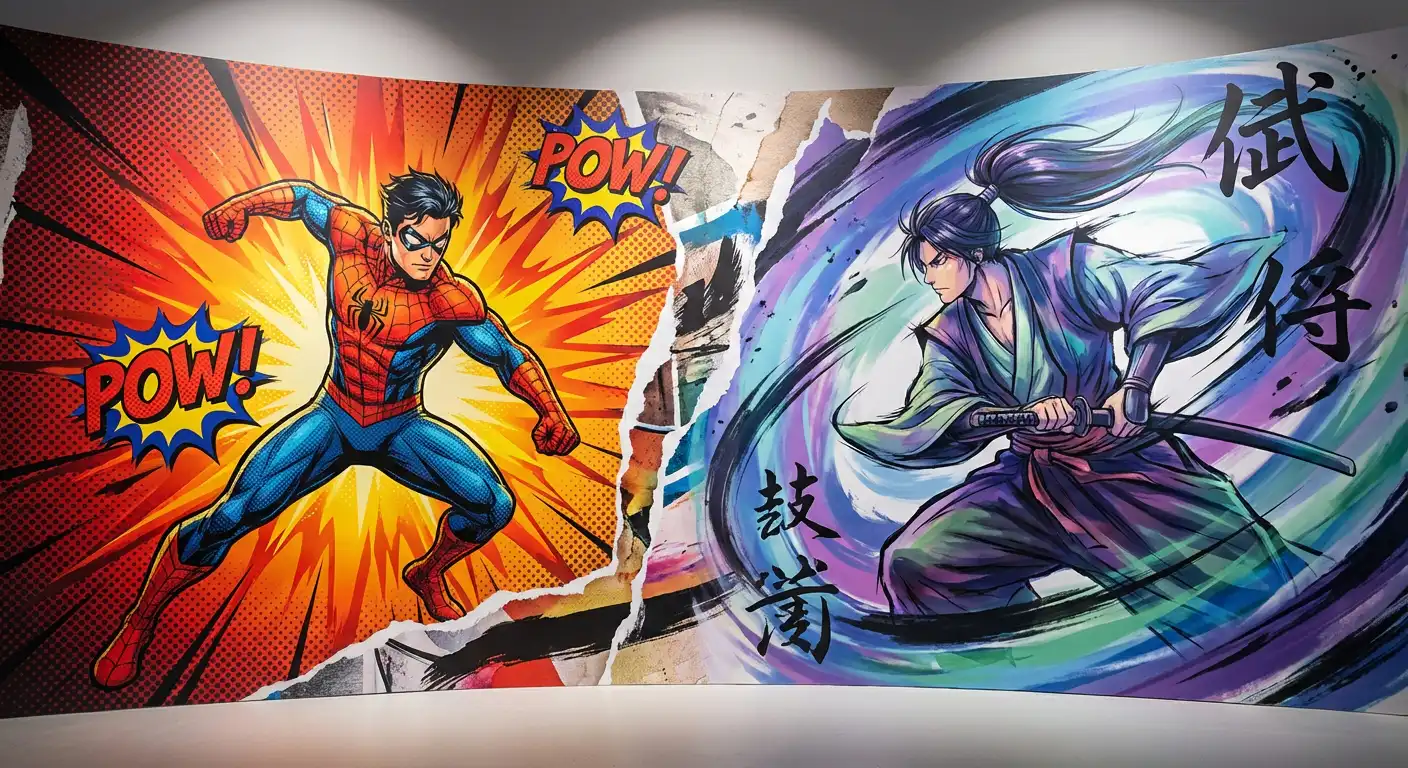

While Disney perfected emotional realism and DreamWorks mastered irreverent humor, Sony Pictures Animation took a radically different path: they decided not to have a signature style at all. What seemed like a risky business decision has transformed into the studio’s greatest competitive advantage, positioning Sony to become the most influential animation studio of the next five years.
This unconventional approach has allowed Sony to create everything from the rubber-hose chaos of Hotel Transylvania to the groundbreaking comic book aesthetic of the Spider-Verse films. Each movie exists as its own visual universe, unbound by corporate mandates about what “Sony animation” should look like.
The Spider-Verse Revolution: Where Comics Meet Cinema
The Spider-Verse trilogy represents Sony’s most significant contribution to animation history. The films don’t just reference comic books; they authentically recreate the experience of reading one. The animation team developed custom shaders to apply Ben-Day dot textures (those tiny colored dots from vintage comic printing) directly onto 3D models. They embraced 19th-century printing artifacts like chromatic aberration and off-set printing errors, elements that trigger nostalgia for anyone who’s ever held a comic book.
Two bold technical decisions defined the look: no motion blur, and animating primarily “on twos” (meaning 12 frames per second instead of the standard 24). This created a staccato, hand-crafted feel that made every frame look like a comic panel come to life. The result? A $690.8 million box office success that won Critics’ Choice, Producers Guild, and Annie Awards for Best Animated Feature.
Breaking the Pipeline on Purpose
What truly sets Sony apart is their encouragement of creative chaos. Artists were told to experiment without worrying about “breaking the pipeline,” a phrase that strikes fear in most animation studios where efficiency is paramount. The hand of the artist remains visible in every shot, complete with intentional imperfections. Design and style took precedence over accuracy or realism.
The Anime-Animation-Comics Trifecta
Sony’s latest innovation, K-Pop: Demon Hunters, showcases their mastery of blending multiple art forms. The film combines K-pop stage performance aesthetics, anime-inspired expressions, and K-drama storytelling into a completely 3D production that somehow feels hand-drawn. The movie won Best Animated Feature at both the Golden Globes and Critics Choice Awards, proving that audiences crave visual diversity.
Each universe in Across the Spider-Verse looks like it was drawn by a different artist, from impressionist watercolors to bustling urban landscapes. This commitment to visual variety extends across Sony’s entire catalog. They’re even producing Fixed, their first traditionally hand-drawn film, demonstrating that their “no house style” philosophy embraces every animation technique imaginable.
The Ripple Effect Across the Industry
Sony’s success has forced competitors to reconsider their approaches. DreamWorks pivoted toward stylized animation with The Bad Guys and Puss in Boots: The Last Wish. Netflix followed suit with Nimona. The entire industry is chasing what one observer called Sony’s “unpredictable visual magic.”
While other studios lean heavily into sequels and established IP, Sony is developing seven original projects. They’re betting that creative freedom and visual innovation will resonate more than brand recognition, a risky strategy that’s paying off spectacularly.
The Future Is Hybrid
Sony Pictures Animation has proven that the future of animation isn’t about perfecting a single style. It’s about having the courage to let each story find its own visual language. By treating filmmakers as artists rather than assembly-line workers, Sony creates films that feel personal, experimental, and genuinely new.
As Spider-Man: Beyond the Spider-Verse approaches its 2027 release, studio presidents admit the work-in-progress art is “really blowing my mind.” If Sony continues prioritizing artistic vision over corporate consistency, they won’t just influence animation’s future. They’ll define it.
'%3e%3cg id='Final-Copy-2_2_' transform='translate(1275.000000, 200.000000)'%3e%3cpath class='st0' d='M7.4,12.8h6.8l3.1-11.6H7.4C4.2,1.2,1.6,3.8,1.6,7S4.2,12.8,7.4,12.8z'/%3e%3c/g%3e%3c/g%3e%3c/g%3e%3cg id='final---dec.11-2020'%3e%3cg id='_x30_208-our-toggle' transform='translate(-1275.000000, -200.000000)'%3e%3cg id='Final-Copy-2' transform='translate(1275.000000, 200.000000)'%3e%3cpath class='st1' d='M22.6,0H7.4c-3.9,0-7,3.1-7,7s3.1,7,7,7h15.2c3.9,0,7-3.1,7-7S26.4,0,22.6,0z M1.6,7c0-3.2,2.6-5.8,5.8-5.8 h9.9l-3.1,11.6H7.4C4.2,12.8,1.6,10.2,1.6,7z'/%3e%3cpath id='x' class='st2' d='M24.6,4c0.2,0.2,0.2,0.6,0,0.8l0,0L22.5,7l2.2,2.2c0.2,0.2,0.2,0.6,0,0.8c-0.2,0.2-0.6,0.2-0.8,0 l0,0l-2.2-2.2L19.5,10c-0.2,0.2-0.6,0.2-0.8,0c-0.2-0.2-0.2-0.6,0-0.8l0,0L20.8,7l-2.2-2.2c-0.2-0.2-0.2-0.6,0-0.8 c0.2-0.2,0.6-0.2,0.8,0l0,0l2.2,2.2L23.8,4C24,3.8,24.4,3.8,24.6,4z'/%3e%3cpath id='y' class='st3' d='M12.7,4.1c0.2,0.2,0.3,0.6,0.1,0.8l0,0L8.6,9.8C8.5,9.9,8.4,10,8.3,10c-0.2,0.1-0.5,0.1-0.7-0.1l0,0 L5.4,7.7c-0.2-0.2-0.2-0.6,0-0.8c0.2-0.2,0.6-0.2,0.8,0l0,0L8,8.6l3.8-4.5C12,3.9,12.4,3.9,12.7,4.1z'/%3e%3c/g%3e%3c/g%3e%3c/g%3e%3c/g%3e%3c/svg%3e) Your Privacy Choices
Your Privacy Choices