


Fixed is not evidence that Sony Pictures Animation abandoned weird animation. If anything, Sony’s role makes the story stranger. The studio backed a rare adult 2D feature from Genndy Tartakovsky, one of American animation’s defining voices. The film was made. The film was finished. Then it entered the more dangerous part of the modern entertainment machine: distribution, merger economics, and corporate cost-cutting.
Directed by Tartakovsky and produced by Sony Pictures Animation, Fixed is an R-rated animated comedy about Bull, a dog who learns he is going to be neutered in the morning and tries to squeeze one last wild night out of his remaining hours. Netflix describes the film as a raunchy animated adventure centered on a soon-to-be-neutered dog, with Adam DeVine, Idris Elba, Kathryn Hahn, Fred Armisen, Beck Bennett, and Bobby Moynihan among the voice cast.
That premise sounds like a dare. The production history is the real trapdoor. Fixed was once set to be released by Warner Bros. Pictures through New Line Cinema before being dropped during Warner Bros. Discovery’s cost-cutting era. Variety reported in August 2024 that Warner Bros./New Line was no longer releasing Sony Pictures Animation’s Fixed. Netflix eventually picked it up and released it on August 13, 2025.
So the movie survived. But survival is not the same as innocence. The story of Fixed is not about Sony failing Tartakovsky. It is about how even a completed, studio-backed animated feature can become vulnerable once corporate math gets between the artists and the audience.
How Fixed Became a Finished Film Without a Home
The idea behind Fixed had been floating around Tartakovsky’s career for years. He has described the movie as emerging from the ridiculous chemistry of his longtime friend group, the kind of private humor that sounds impossible to explain until animation gives it a body. Sony Pictures Animation’s official description frames the film as the story of Bull discovering he is going to be neutered and heading into one final adventure with his friends before morning arrives.
On paper, Tartakovsky should have been one of the safer bets in American animation. He created Dexter’s Laboratory, Samurai Jack, and Primal. He directed the first three Hotel Transylvania films for Sony Pictures Animation, helping turn the franchise into a major theatrical property. Box Office Mojo lists the first Hotel Transylvania at more than $358 million worldwide.
But Fixed was never a normal safe bet. It was hand-drawn. It was vulgar. It was adult. It was not another four-quadrant franchise extension with a toy aisle waiting behind it. That is what makes Sony’s involvement notable rather than blameworthy. Sony backed a strange Tartakovsky movie at a time when most American feature animation still treats 2D as either nostalgia, specialty work, or risk. The danger came later, when the finished film had to survive the logic of release.
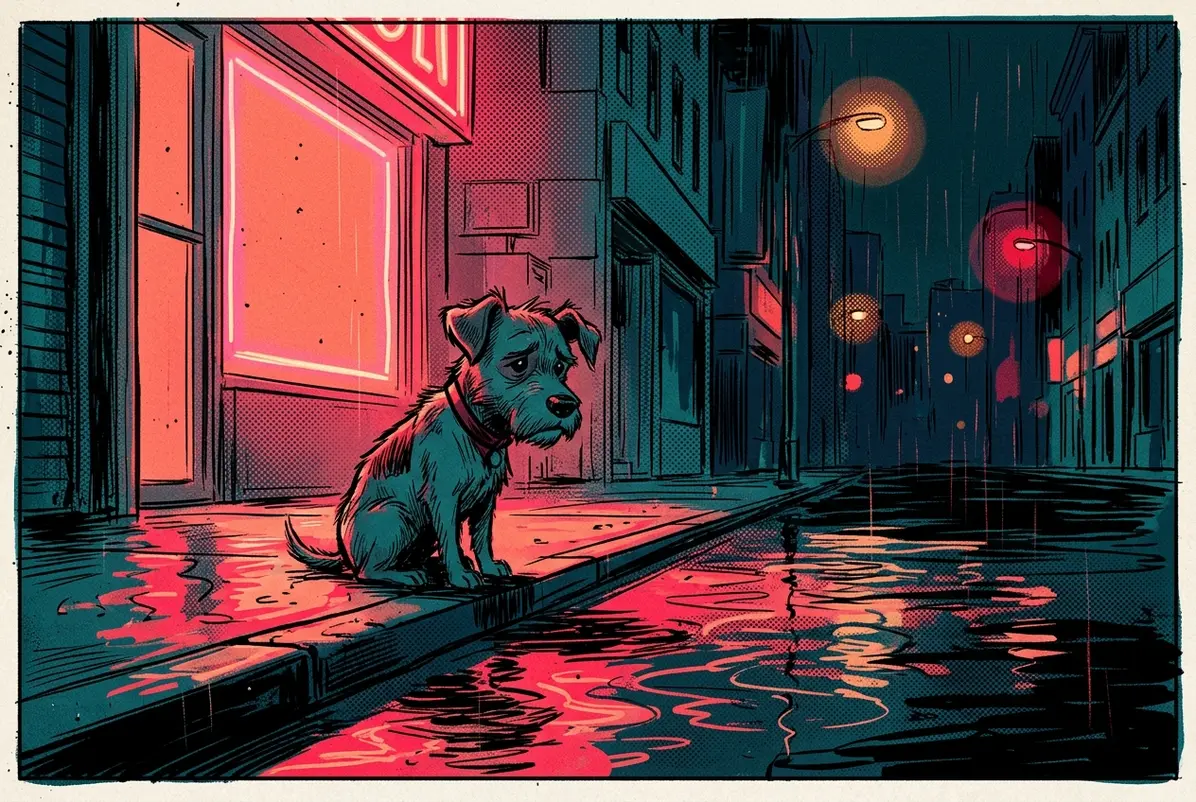
That is where the story turns. Warner Bros. Pictures, through New Line Cinema, had been attached to release Fixed. Then the film was dropped. The important detail is not that a distributor changed plans. Studios change plans constantly. The important detail is that a completed animated film by a major creator could still become temporarily stranded, not because audiences rejected it, but because audiences never got the chance.
The Problem Was Not Sony. The Problem Was the Release Machine.
The cleanest way to understand Fixed is this: Sony made the weird thing. Netflix rescued the weird thing. The dangerous space was the middle.
That middle matters because Fixed arrived in the shadow of a larger Warner Bros. Discovery pattern. In 2022, Warner Bros. Discovery shocked the industry by shelving Batgirl, a nearly completed DC film with a reported budget around $90 million. Variety reported that the studio would not release the film theatrically or on HBO Max. Scoob!: Holiday Haunt met a similar fate. Later, Coyote vs. Acme became another flashpoint after Warner Bros. Discovery moved to shelve the completed hybrid Looney Tunes film.
The numbers behind that era were enormous. The Hollywood Reporter reported that Warner Bros. Discovery took $825 million in content impairments and development write-offs after the Discovery merger. Later reporting noted that the company expected billions more in restructuring charges tied partly to content impairment. Deadline reported that Warner Bros. Discovery projected total pre-tax restructuring charges of $4.1 billion to $5.3 billion, including $2.8 billion to $3.5 billion in content impairment and development write-offs.
This is where the language gets cold enough to make the damage sound procedural. “Content impairment.” “Development write-off.” “Cost-saving measure.” These phrases sound like office furniture being moved from one floor to another. But behind them are films: actors on sets, animators at desks, editors cutting scenes, composers writing cues, production crews solving problems, directors watching years of work become a line item in a corporate restructuring plan.
The stronger criticism is not that every canceled movie is secretly a masterpiece. The stronger criticism is that the modern studio system can reach a point where withholding a completed work may look financially preferable to releasing it. That is the nightmare. Not bad reviews. Not box office failure. Something colder: in some cases, a finished film can appear more useful to the balance sheet as an absence than as a release.
Fixed Survived, but the System Still Looks Sick
Fixed escaped. Netflix acquired the film and put it in front of viewers. Coyote vs. Acme also escaped after public backlash and industry pressure. The Associated Press reported that Ketchup Entertainment acquired worldwide distribution rights to Coyote vs. Acme after Warner Bros. had previously shelved it. The film is now scheduled for release on August 28, 2026.
Those rescues matter. They are not nothing. They prove that a finished film can sometimes be pulled back from the ledge if enough people make the disappearance embarrassing. But embarrassment is not a distribution strategy. Public pressure should not be the emergency exit for completed art.
Batgirl remains unreleased. Scoob!: Holiday Haunt remains unreleased. The message that sends to artists is brutal: finishing the work does not guarantee the work gets to exist in public. Completion used to feel like a finish line. Now it can be just another checkpoint before the accountants enter the room.
That is why Fixed matters beyond its jokes. The film is not simply a raunchy dog comedy that got lucky. It is a living example of the new fragility. A movie can have a major studio behind it, a famous director, a completed cut, a voice cast, a festival presence, and still find itself waiting for someone to decide whether release is more useful than delay, resale, or disappearance.
What Tartakovsky Said About the Fallout
Tartakovsky has not spoken about the ordeal like a man shrugging off a routine business complication. In a Deadline interview, he described the emotional toll of not knowing whether Fixed would come out, with the headline quoting him saying he was going to “a dark place.” That line matters because it strips away the corporate euphemism. A shelved film is not just a missing title on a release calendar. It is years of work converted into doubt.
For Tartakovsky, that doubt is especially striking. This is not a newcomer discovering that Hollywood is cruel. This is a veteran whose fingerprints are all over modern American animation. His work helped define Cartoon Network’s golden era, pushed action animation into mythic territory with Samurai Jack, and proved with Primal that wordless, violent, emotionally direct animation could still hit like cave painting and cinema at the same time.
That is what makes the Fixed saga so grim. If Genndy Tartakovsky can finish an animated feature and still watch it drift into corporate uncertainty, the issue is not one filmmaker’s lack of stature. The issue is the machinery around the work. The creator can be proven. The film can be finished. The audience can be waiting. The release machine can still stall.
The Animation Is the Real Rebellion
The easiest way to reduce Fixed is to describe it as a horny dog movie. That is accurate, but useless. The better question is why this particular horny dog movie feels like an endangered species.
Fixed is a 2D adult animated feature in an American studio landscape that rarely makes room for that combination at scale. The film’s vulgarity is obvious. The craft is the deeper provocation. Tartakovsky has said the project began with the spirit of a raunchy Lady and the Tramp before evolving into something more exaggerated and cartoony. Netflix’s preview emphasized the film’s bright, caricatured look, while also noting its R-rated premise and adult tone.
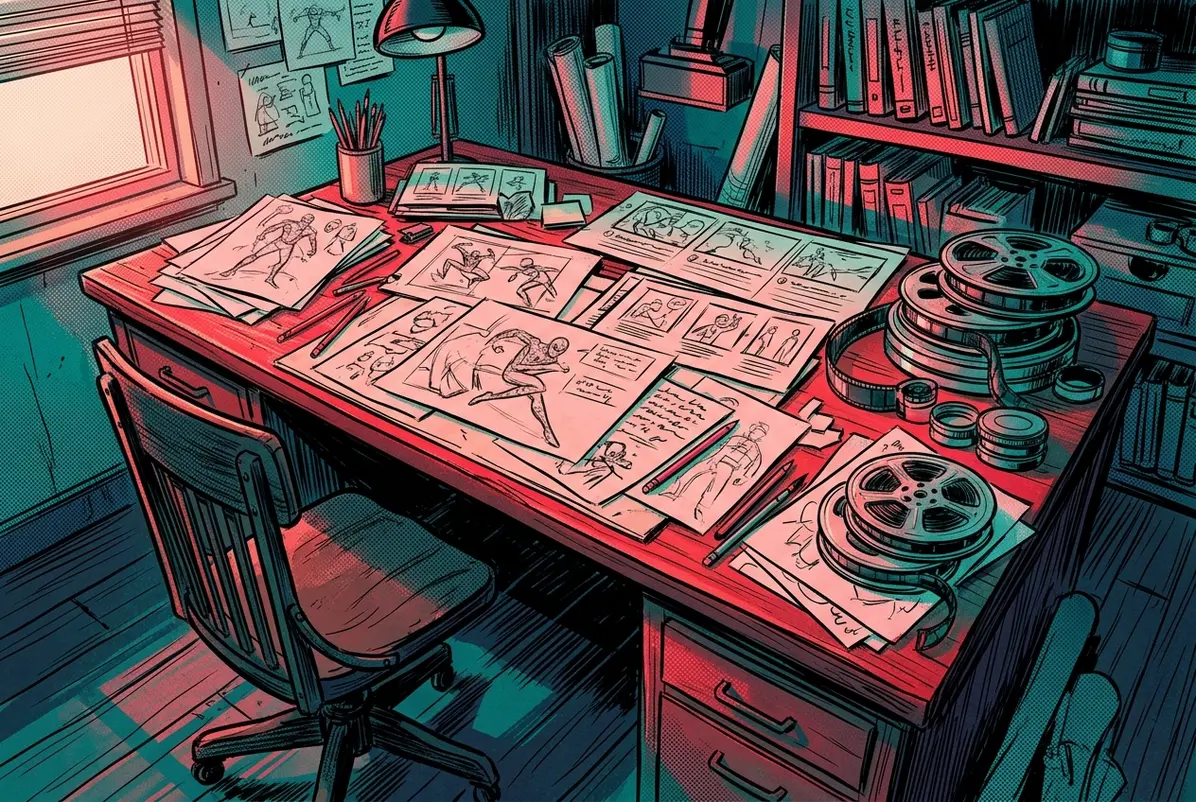
That matters because 2D animation is not just an aesthetic choice here. It is the whole pulse of the thing. The squash, the stretch, the bug-eyed panic, the manic timing, the ridiculous bodies pushed past dignity — all of it belongs to a cartoon language that American features mostly abandoned as a mainstream industrial habit. Fixed uses that language for something rude, sentimental, stupid, alive, and deeply unfashionable. That is the charm. That is also the risk.
In a SlashFilm interview, Tartakovsky said the animators pushed each other once they began seeing the quality of the work, reaching a theatrical level despite the film’s relatively modest budget. That detail is the soul of the story. The animators were not merely executing a gag about dog anatomy. They were getting a rare chance to flex a muscle the industry keeps letting atrophy.
The vulgarity is the decoy. The real subject is permission. Permission to draw like maniacs. Permission to make adult 2D animation without disguising it as prestige misery or family nostalgia. Permission to let cartoons be funny, gross, elastic, emotional, and technically obsessive at the same time.
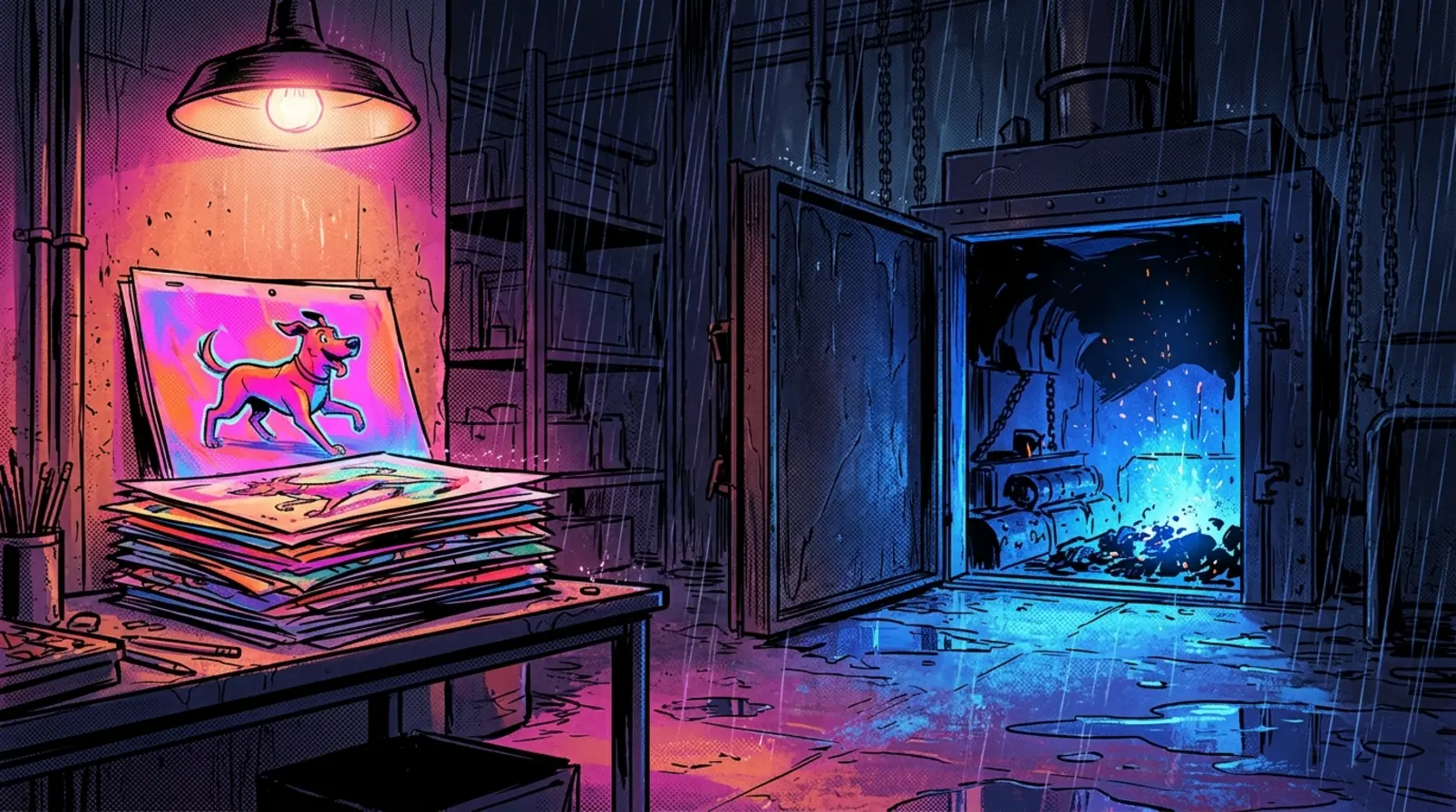
That is why the near-shelving feels like more than a business hiccup. When a film like Fixed nearly disappears, what nearly disappears with it is not only one title. It is a workflow. A tradition. A small industrial proof that this kind of thing can still be made inside the American studio system. The glow is not decoration. The glow is part of the archive.
The Real Problem Is the Incentive Structure
It would be easy, and wrong, to turn this into a simple morality play about one studio being good and another being evil. The reality is more useful and more depressing. Sony backed the movie. Warner Bros. dropped the release. Netflix gave it a home. Ketchup rescued Coyote vs. Acme. These are decisions made by companies under pressure, not fairy-tale characters wearing black hats and white hats.
But refusing cartoon villainy does not mean pretending the system is fine. The incentive structure is the problem. A culture industry that can make non-release financially attractive has built a trapdoor under its own artists. The film does not have to be hated. It does not have to be broken. It does not have to fail. It only has to become inconvenient in the wrong spreadsheet.
That is the scarier lesson of Fixed. The old Hollywood nightmare was that a movie would bomb. At least a bomb is public. At least a failure leaves evidence. The newer nightmare is quieter: a finished film can be removed from the public imagination before the public ever gets to form one.
For animation, that danger cuts especially deep. Animated films are not improvised into existence. They are planned, drawn, revised, timed, voiced, boarded, rendered, painted, mixed, and polished through a long chain of labor. To bury that kind of work after completion is not merely to cancel a product. It is to tell an entire workforce that the finish line can move after the race is over.
The Dog Got Out. That Does Not Mean the Fence Is Fixed.
Fixed is now visible. That should be celebrated. The film exists where viewers can argue with it, laugh at it, hate it, defend it, quote it, dismiss it, or discover that its craft is more interesting than its premise. That is what release gives a movie: not guaranteed love, but the dignity of contact.
The tragedy of shelved films is that they are denied even that. They do not get to fail honestly. They do not get to find the wrong audience, then the right one years later. They do not get to become cult objects, cautionary tales, rediscovered oddities, or beloved disasters. They become rumors with budgets. Ghosts with production stills.
That is why Fixed deserves attention even from people who have no interest in an R-rated cartoon about a dog facing neutering. The film is a weird little survivor from a much bigger industrial sickness. It proves that artists can still make something strange inside the machine. It also proves that the machine can still almost lose it.
Sony made the weird thing. Netflix opened the door. The danger was the space in between, where completed work can become trapped between art and accounting, waiting for someone powerful to decide whether its existence is worth more than its disappearance.
Fixed got out. Good. But the happy ending is not proof that the system works. It only proves the dog slipped the leash.
Frequently Asked Questions About Fixed and Shelved Animated Films
What is Fixed?
Fixed is a 2025 R-rated adult animated comedy directed by Genndy Tartakovsky and produced by Sony Pictures Animation. The film follows Bull, a dog who learns he is going to be neutered in the morning and heads into one last wild night with his friends.
Where can you watch Fixed?
Fixed is streaming on Netflix. Netflix released the film on August 13, 2025.
Did Sony Pictures Animation shelve Fixed?
No. Sony Pictures Animation produced Fixed. Warner Bros. Pictures, through New Line Cinema, had been attached to release it before dropping the film. Netflix later picked it up and released it.
What other completed films did Warner Bros. Discovery shelve?
Warner Bros. Discovery shelved or canceled several high-profile completed or nearly completed projects, including Batgirl, Scoob!: Holiday Haunt, and Coyote vs. Acme. Coyote vs. Acme was later acquired by Ketchup Entertainment for release, while Batgirl and Scoob!: Holiday Haunt remain unreleased.
Is Fixed traditionally animated?
Yes. Fixed uses 2D animation, and much of the film’s critical interest comes from seeing that style applied to an adult studio comedy rather than a family-oriented feature.
Why does Fixed matter beyond its comedy?
Fixed matters because its release history shows how fragile completed animation can become when distribution decisions, merger economics, and corporate cost-cutting collide. The film survived, but its path reveals how easily finished creative work can get trapped between art and accounting.
'%3e%3cg id='Final-Copy-2_2_' transform='translate(1275.000000, 200.000000)'%3e%3cpath class='st0' d='M7.4,12.8h6.8l3.1-11.6H7.4C4.2,1.2,1.6,3.8,1.6,7S4.2,12.8,7.4,12.8z'/%3e%3c/g%3e%3c/g%3e%3c/g%3e%3cg id='final---dec.11-2020'%3e%3cg id='_x30_208-our-toggle' transform='translate(-1275.000000, -200.000000)'%3e%3cg id='Final-Copy-2' transform='translate(1275.000000, 200.000000)'%3e%3cpath class='st1' d='M22.6,0H7.4c-3.9,0-7,3.1-7,7s3.1,7,7,7h15.2c3.9,0,7-3.1,7-7S26.4,0,22.6,0z M1.6,7c0-3.2,2.6-5.8,5.8-5.8 h9.9l-3.1,11.6H7.4C4.2,12.8,1.6,10.2,1.6,7z'/%3e%3cpath id='x' class='st2' d='M24.6,4c0.2,0.2,0.2,0.6,0,0.8l0,0L22.5,7l2.2,2.2c0.2,0.2,0.2,0.6,0,0.8c-0.2,0.2-0.6,0.2-0.8,0 l0,0l-2.2-2.2L19.5,10c-0.2,0.2-0.6,0.2-0.8,0c-0.2-0.2-0.2-0.6,0-0.8l0,0L20.8,7l-2.2-2.2c-0.2-0.2-0.2-0.6,0-0.8 c0.2-0.2,0.6-0.2,0.8,0l0,0l2.2,2.2L23.8,4C24,3.8,24.4,3.8,24.6,4z'/%3e%3cpath id='y' class='st3' d='M12.7,4.1c0.2,0.2,0.3,0.6,0.1,0.8l0,0L8.6,9.8C8.5,9.9,8.4,10,8.3,10c-0.2,0.1-0.5,0.1-0.7-0.1l0,0 L5.4,7.7c-0.2-0.2-0.2-0.6,0-0.8c0.2-0.2,0.6-0.2,0.8,0l0,0L8,8.6l3.8-4.5C12,3.9,12.4,3.9,12.7,4.1z'/%3e%3c/g%3e%3c/g%3e%3c/g%3e%3c/g%3e%3c/svg%3e) Your Privacy Choices
Your Privacy Choices