


Here’s something that will ruin your night if you let it: the world’s first fully computer-animated television series almost vanished. Not because of a fire or a flood or corporate malice, but because the only machines on Earth capable of reading its master tapes were rusting in warehouses, and the number of people alive who knew how to fix them could fit in a minivan.
The show was ReBoot. If you watched it on YTV or ABC in the mid-nineties, you remember the low-poly charm, the inside-the-computer conceit, the way it looked like nothing else on television because nothing else like it existed. Mainframe Entertainment in Vancouver rendered every frame, recorded every episode to Sony D-1 tape, and shipped it off to broadcasters who compressed and standards-converted it into the fuzzy signal that hit your TV. Co-creator Gavin Blair has been blunt about what that process did to the image: by the time it got broadcast, it looked like 1994 TV.
The D-1 masters, though, were pristine. Uncompressed 4:2:2 component digital video at 720×576 PAL resolution, captured at 167 megabits per second. This was the format Hollywood used for high-end graphics and animation work, and the decks that played it back cost $160,000 when Sony introduced them in 1986. A few years later a slimmer model brought the price down to a mere $120,000. These were not consumer products. They were infrastructure.
The Tapes Turn Up
For roughly a decade, the ReBoot master tapes were assumed lost or destroyed. Then, in late 2023, two Vancouver fans changed the math. Raquel Lin and Jacob Weldon, co-creators of the documentary project ReBoot ReWind, toured the Mainframe Entertainment facility and found the original PAL D-1 masters for every episode of the show’s run. All four seasons. All 47 episodes. Plus animation tests, toy commercials, footage from an Electronic Arts video game, and IMAX content. Two hundred and sixty tapes in total.
Lin and Weldon had met at Vancouver’s Anime Evolution convention in 2009. Lin was cosplaying as Dot Matrix, a character she credits with inspiring her career in business administration. Weldon was the kind of fan who looked at ReBoot’s single line on Wikipedia and saw sixteen years of untold pioneering history. A decade of friendship later, they set out to make the definitive documentary. Finding the tapes turned the project into something much bigger.
The Deck Problem
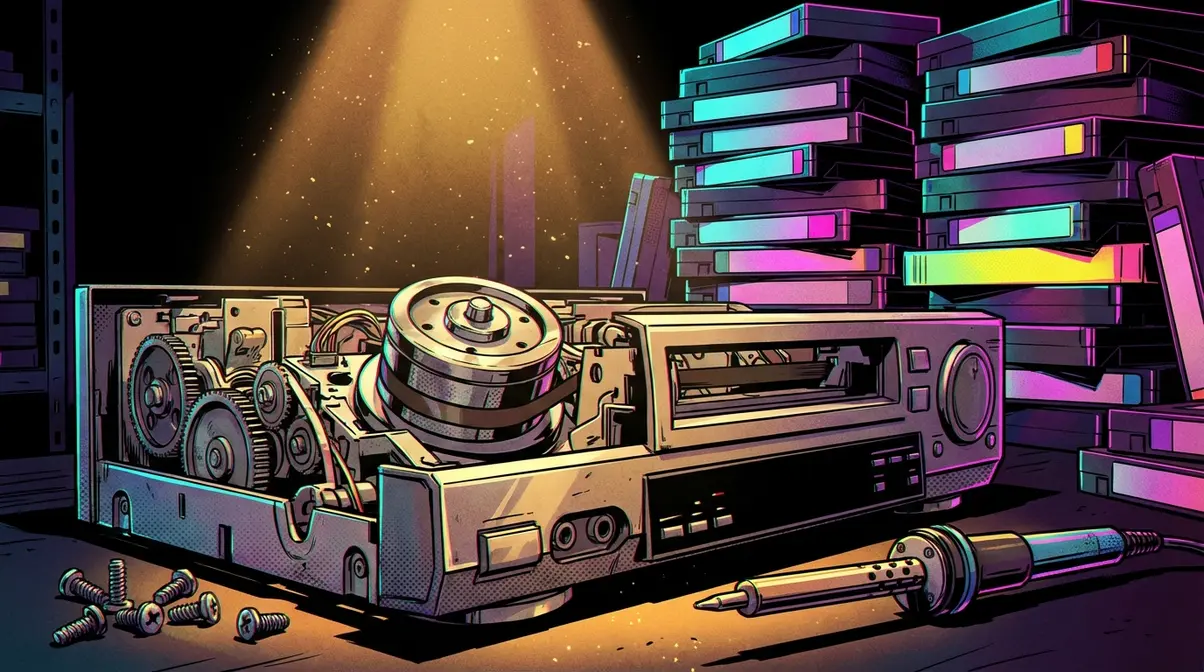
Finding the tapes was the easy part. Playing them was the crisis. The D-1 format is extinct. The decks weigh 250 pounds each, draw 650 watts, and contain multiple Intel 80186 processors communicating over an internal Ethernet network. The helical scan head drum spins at 9,000 RPM for PAL video. The heads themselves are rated for 500 hours of use. Nobody manufactures replacement parts.
What the team specifically needed was a Bosch BTS DCR-500. Former Mainframe technicians advised that a Sony model might play the tapes, but the Bosch had superior dynamic tracking for these particular PAL recordings. Lin put out a public call on social media and described the machines the way you’d describe a vintage sports car: they were “essentially the Ferraris of tape decks back in the ’90s.” The phrase stuck.
Hundreds of tips poured in from around the world. The breakthrough, improbably, arrived as an email written in German. After translation, it pointed the team to three Bosch BTS D-1 decks available in Germany. They bought all three for roughly $15,000. In today’s dollars, a single new unit would have cost upward of a third of a million. Even broken, this was a bargain.
Three Broken Machines and a Miracle
The decks arrived in Vancouver in rough shape. One of the manuals was missing. Nobody on the team initially knew how to operate them. Enter Mark Westhaver, proprietor of Disappearing Inc., a vintage computer restoration specialist and fellow ReBoot superfan who responded to the call and volunteered his time. With an estimated 100 people ever qualified to service D-1 decks at the format’s peak, Westhaver may be one of the last remaining experts under forty.
The most functional deck had already logged over 650 hours on its heads, well past the 500-hour rating. The solution came from a retired German technician who had a pair of brand-new, never-used BTS heads. That $8,000 acquisition was the hinge on which the entire project swung. It took all three somewhat-dodgy machines and that miraculous spare head to achieve a stable scanning rate.
Bryan Baker, the team’s software engineer, wrote custom tools to manage the decks, track errors, and streamline capture. The uncompressed video produces about 40 gigabytes of raw data per tape. With traditional spinning hard drives, capture crawled at 7 frames per second. Kioxia, which sponsored the effort, provided enterprise CM7R SSDs that pushed the rate to 25-35 frames per second, close to real-time PAL playback. Without that speed, processing 260 tapes would have taken an unconscionable amount of time.
What You Need to Know Right Now
If you care about physical media preservation, here’s the field guide version of what this story teaches:
- Tape formats die faster than you think. D-1 was the backbone of broadcast for years. Within two decades, the machines became nearly unserviceable. If you have archival media in any proprietary format, the clock is already running.
- The deck matters more than the tape. The ReBoot tapes survived thirty years in decent condition, suffering mostly from sticky shed syndrome. The real bottleneck was always playback hardware. Preservation means preserving the entire chain, not just the media.
- Community is infrastructure. This project succeeded because fans, retired technicians, and corporate sponsors formed an ad hoc network that no single institution could have replicated. The German email. The volunteer restorer. The SSD sponsor. Remove any one link and the tapes stay unread.
- Don’t wait for the rights holders. As of March 2026, Linus Tech Tips announced that all original D-1 master tapes have been recovered. But the rights holders haven’t decided on a release format. The team wants an SD Blu-ray. Fans want anything. The tapes, at least, are safe.
Too Clean, or Finally Right?
There’s a genuine debate in fan communities about whether a pristine remaster even serves ReBoot well. Some argue the low-poly models benefit from a little fuzz, that the softness of nineties broadcast was part of the charm. Others point out that the remastered first episode, released on YouTube for the show’s 30th anniversary, looks fantastic: no fuzziness, just the geometry and textures as Mainframe’s artists originally rendered them. The team has been explicit that they are not using AI upscaling to fake detail.
I’ll side with the restorationists on this one. What we saw on TV in 1994 was a degraded copy of a degraded copy. The D-1 masters are what the creators actually made. Seeing the real thing isn’t revisionism. It’s correction.
The ReBoot ReWind eight-part documentary is streaming now on Telus Storyhive. The full remastered series remains in limbo, waiting on rights negotiations. Mainframe’s watching, as Lin put it. So are the rest of us.
'%3e%3cg id='Final-Copy-2_2_' transform='translate(1275.000000, 200.000000)'%3e%3cpath class='st0' d='M7.4,12.8h6.8l3.1-11.6H7.4C4.2,1.2,1.6,3.8,1.6,7S4.2,12.8,7.4,12.8z'/%3e%3c/g%3e%3c/g%3e%3c/g%3e%3cg id='final---dec.11-2020'%3e%3cg id='_x30_208-our-toggle' transform='translate(-1275.000000, -200.000000)'%3e%3cg id='Final-Copy-2' transform='translate(1275.000000, 200.000000)'%3e%3cpath class='st1' d='M22.6,0H7.4c-3.9,0-7,3.1-7,7s3.1,7,7,7h15.2c3.9,0,7-3.1,7-7S26.4,0,22.6,0z M1.6,7c0-3.2,2.6-5.8,5.8-5.8 h9.9l-3.1,11.6H7.4C4.2,12.8,1.6,10.2,1.6,7z'/%3e%3cpath id='x' class='st2' d='M24.6,4c0.2,0.2,0.2,0.6,0,0.8l0,0L22.5,7l2.2,2.2c0.2,0.2,0.2,0.6,0,0.8c-0.2,0.2-0.6,0.2-0.8,0 l0,0l-2.2-2.2L19.5,10c-0.2,0.2-0.6,0.2-0.8,0c-0.2-0.2-0.2-0.6,0-0.8l0,0L20.8,7l-2.2-2.2c-0.2-0.2-0.2-0.6,0-0.8 c0.2-0.2,0.6-0.2,0.8,0l0,0l2.2,2.2L23.8,4C24,3.8,24.4,3.8,24.6,4z'/%3e%3cpath id='y' class='st3' d='M12.7,4.1c0.2,0.2,0.3,0.6,0.1,0.8l0,0L8.6,9.8C8.5,9.9,8.4,10,8.3,10c-0.2,0.1-0.5,0.1-0.7-0.1l0,0 L5.4,7.7c-0.2-0.2-0.2-0.6,0-0.8c0.2-0.2,0.6-0.2,0.8,0l0,0L8,8.6l3.8-4.5C12,3.9,12.4,3.9,12.7,4.1z'/%3e%3c/g%3e%3c/g%3e%3c/g%3e%3c/g%3e%3c/svg%3e) Your Privacy Choices
Your Privacy Choices