

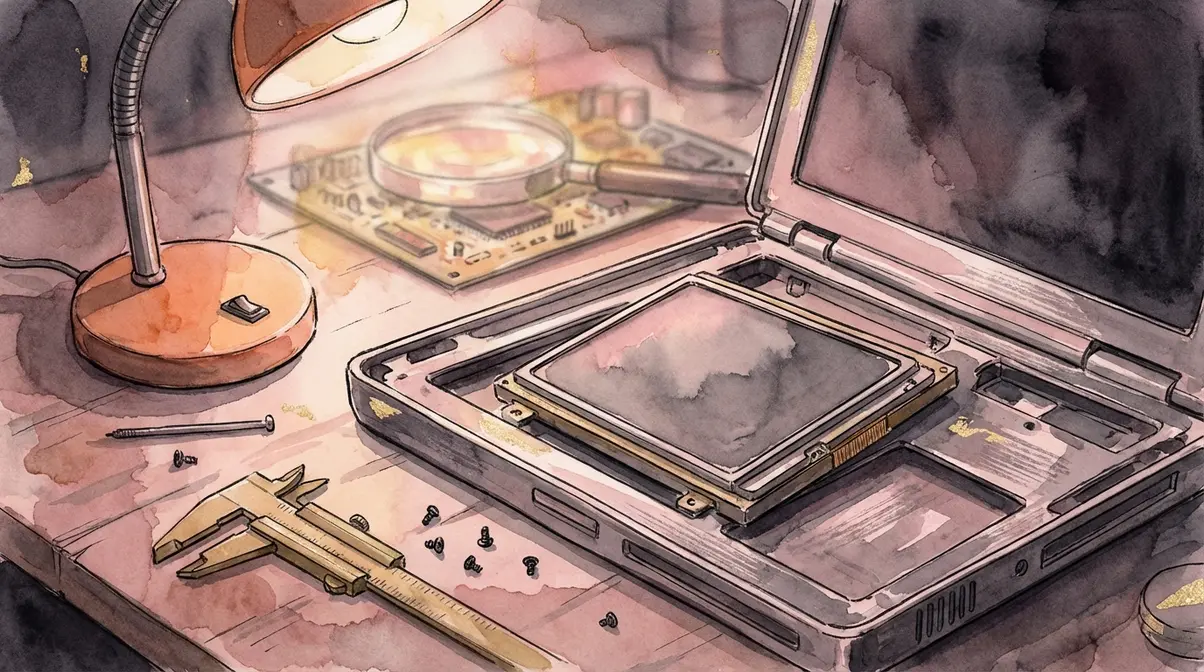

There is a product that doesn’t exist. It has no SKU, no spec sheet, no blog post from Framework’s engineering team explaining the compromises they made with BOE. You can’t order it. You can’t install it with the single screwdriver that comes in the box. And yet, if you spend any time in the places where Framework owners gather to argue about their machines, you will feel its absence like a missing track on a record you love.
The product is a 4:3 display module for the Framework Laptop 13. A retrofit panel. The old shape. The shape of CRTs and PowerBooks and the monitors we learned to type on. It does not exist, and I think about it constantly.
What Framework Actually Built
The display is the defining module of the Framework Laptop. The system is built around the form factor of it. Framework decided from the outset to prioritize both portability and an aspect ratio ideal for productivity. That ratio is 3:2, not 4:3. A 13.5″ 3:2 panel covers around 11% more visible area than a 13.3″ 16:9 one does, and the taller height makes it awesome for coding, document editing, and a range of other use cases. It’s a good ratio. A smart ratio. A ratio chosen by engineers who looked at spreadsheets and made the right call for the most people.
And in 2024, Framework pushed the display story further. Along with the launch of their latest generation Framework Laptop 13, they announced a new higher-resolution 13.5″ display option available on both AMD and Intel-powered DIY Edition configurations. They custom developed this display with panel partner BOE to improve over the already-great default version. Resolution increased from 2256×1504 to 2880×1920, an amazing 256 PPI. Brightness went up from 400 nit to 500 nit. Refresh rate jumped from 60Hz to 120Hz with support for variable refresh rate, and gray-to-gray response time dropped to 12ms.
The best part? Framework made sure this panel can be swapped into all existing Framework Laptop 13 models, going back to the original 11th Gen version from 2021. A laptop you bought five years ago can accept a display that didn’t exist when you unboxed it. The display sits behind a magnetically attached bezel and is held into the lid with four fasteners. The screwdriver included in the box is the only tool you need.
David Heinemeier Hansson, the creator of Ruby on Rails, did exactly that swap. “It’s a $269 upgrade, so it’s not cheap, but it’s a hellavu lot cheaper than buying a whole new computer. Not to mention way less wasteful. The installation is involved enough that you feel like you’ve made a real personal contribution to your hardware, but without feeling complicated or onerous.” He went further: “I’d go so far as to say that this is the best looking laptop screen I’ve ever used for programming. The combination of 256 PPI, matte covering, 3:2 aspect ratio, and 120hz is amazing for working with text.”
This is real. This is verified. This is what Framework ships. And it is 3:2.
The Ghost Ratio
So where does 4:3 come in? It comes in the way all the best unreleased things come in: through longing.
On the Framework Community forums, a thread titled “Will Framework ever make a 4:3 laptop?” opens with the declaration: “Whether you’re coding, playing Quake III Arena, or watching full screen TV, 4:3 has always been the best aspect ratio. Nothing has ever been designed for a 3:2 ratio.” It reads like a manifesto. It reads like someone who remembers what a ThinkPad 600X looked like and has never fully recovered.
The thread is a holy war, and holy wars don’t resolve. Others push back: “I realize that the 3:2 ratio is getting a good response but when considering the bigger picture, I think it’ll do more harm than good. A very large collection of movies and shows are made for the 16:9 ratio. People have already been through a huge change when the ‘normal’ aspect ratio went from 3:4 to 16:9.” Meanwhile, some new owners arrive bewildered: “Hey all, just got the machine, having a hard time dealing with the weird screen size… Contemplating returning it…”
There’s something tender about all of this. The 4:3 partisans aren’t wrong, exactly. They’re remembering a shape that held most of the software ever written, most of the games ever rendered in software mode, most of the photographs ever displayed on a monitor before widescreen conquered everything. 4:3 is the shape of the original Macintosh. Of Windows 3.1. Of every DOS prompt that ever blinked at you. It is the shape of computing before computing became entertainment.
What the Modders Already Know
Framework’s modular architecture has become a magnet for people who want their computers to feel like something other than sealed appliances. A project called the Campus, built by a maker named flurpyflurples, transforms a Framework 13 into something that looks like it escaped from a 1990s computer lab. The chassis was designed and made entirely from scratch to accommodate a fully custom low-profile mechanical keyboard built with KL Chalk switches. Community response was overwhelmingly enthusiastic, with users immediately suggesting additional modifications like optical drives, trackpoints, and even coffee makers. The project taps into a deep nostalgia for laptops that felt like serious tools rather than disposable consumer electronics.
Elsewhere, a builder named Ben Makes Everything used a Framework laptop’s motherboard and battery to create a slab-style cyberdeck. The Framework motherboard presents an excellent choice for custom portable computer projects due to its relatively compact size and built-in modular I/O port options. Framework even released additional documentation to support this use-case. Another project, the Framedeck, was inspired by the TRS-80 Model 100 , directly invoking the golden age of portable computing when every screen was taller than it was wide.
These builders are doing something Framework’s product team hasn’t done yet. They’re pulling the hardware backward in time, wrapping modern silicon in the proportions and textures of machines we grew up with. The 4:3 display module is the logical next step. It’s the one mod that can’t be 3D-printed or CNC-milled in a garage.
Why It Matters (and Why It Probably Won’t Happen)
Here’s the honest engineering reality. When Framework built its 2.8K display, they found a panel that BOE was designing for another customer with rounded corners. Rather than paying for a fully custom panel, they leveraged this existing panel’s mask set and customized the back end process to fit the Framework Laptop 13. Panel manufacturing is brutally expensive at small scale. A 4:3 panel in a 13-inch class would be an exotic order. The demand, passionate as it is, lives in forum threads, not in purchase orders that justify a mask set.
And yet. Framework is the company that sells individual display kits to end users. Everything is replaceable. The screen, the keyboard, the motherboard, even the tiny rubber feet on the bottom. Framework sells every single part, and there’s a massive community creating mods and improvements. If any company could find a way to make a 4:3 retrofit panel economically viable, it would be this one.
In my opinion, the 4:3 display module for the Framework 13 is the single most interesting product that doesn’t exist in personal computing right now. Not because 4:3 is objectively better than 3:2. It isn’t, by most measurable standards. But because the ability to choose your aspect ratio the way you choose your ports, your RAM, your processor generation, would complete the promise that Framework made when it published its first display deep-dive back in 2021. The display is the defining module. Let us define it.
A Note on What You’re Reading
I want to be transparent. No product called the “Framework 13 Retro-Fit 4:3 Display Module” has been announced, leaked, or rumored by any credible source as of this writing. Framework’s current display offerings are exclusively 3:2. Everything in this piece about what exists is sourced and verified. Everything about the 4:3 module is desire, not reportage. I think the distinction matters. I also think the desire matters. The best gear starts as a want before it becomes a spec sheet.
If Framework is listening: the forum threads are right there. The cyberdeck builders are right there. The people who remember what a 1024×768 desktop looked like at the right distance from their face are right there. Four fasteners and a screwdriver. You already taught us how.

'%3e%3cg id='Final-Copy-2_2_' transform='translate(1275.000000, 200.000000)'%3e%3cpath class='st0' d='M7.4,12.8h6.8l3.1-11.6H7.4C4.2,1.2,1.6,3.8,1.6,7S4.2,12.8,7.4,12.8z'/%3e%3c/g%3e%3c/g%3e%3c/g%3e%3cg id='final---dec.11-2020'%3e%3cg id='_x30_208-our-toggle' transform='translate(-1275.000000, -200.000000)'%3e%3cg id='Final-Copy-2' transform='translate(1275.000000, 200.000000)'%3e%3cpath class='st1' d='M22.6,0H7.4c-3.9,0-7,3.1-7,7s3.1,7,7,7h15.2c3.9,0,7-3.1,7-7S26.4,0,22.6,0z M1.6,7c0-3.2,2.6-5.8,5.8-5.8 h9.9l-3.1,11.6H7.4C4.2,12.8,1.6,10.2,1.6,7z'/%3e%3cpath id='x' class='st2' d='M24.6,4c0.2,0.2,0.2,0.6,0,0.8l0,0L22.5,7l2.2,2.2c0.2,0.2,0.2,0.6,0,0.8c-0.2,0.2-0.6,0.2-0.8,0 l0,0l-2.2-2.2L19.5,10c-0.2,0.2-0.6,0.2-0.8,0c-0.2-0.2-0.2-0.6,0-0.8l0,0L20.8,7l-2.2-2.2c-0.2-0.2-0.2-0.6,0-0.8 c0.2-0.2,0.6-0.2,0.8,0l0,0l2.2,2.2L23.8,4C24,3.8,24.4,3.8,24.6,4z'/%3e%3cpath id='y' class='st3' d='M12.7,4.1c0.2,0.2,0.3,0.6,0.1,0.8l0,0L8.6,9.8C8.5,9.9,8.4,10,8.3,10c-0.2,0.1-0.5,0.1-0.7-0.1l0,0 L5.4,7.7c-0.2-0.2-0.2-0.6,0-0.8c0.2-0.2,0.6-0.2,0.8,0l0,0L8,8.6l3.8-4.5C12,3.9,12.4,3.9,12.7,4.1z'/%3e%3c/g%3e%3c/g%3e%3c/g%3e%3c/g%3e%3c/svg%3e) Your Privacy Choices
Your Privacy Choices