

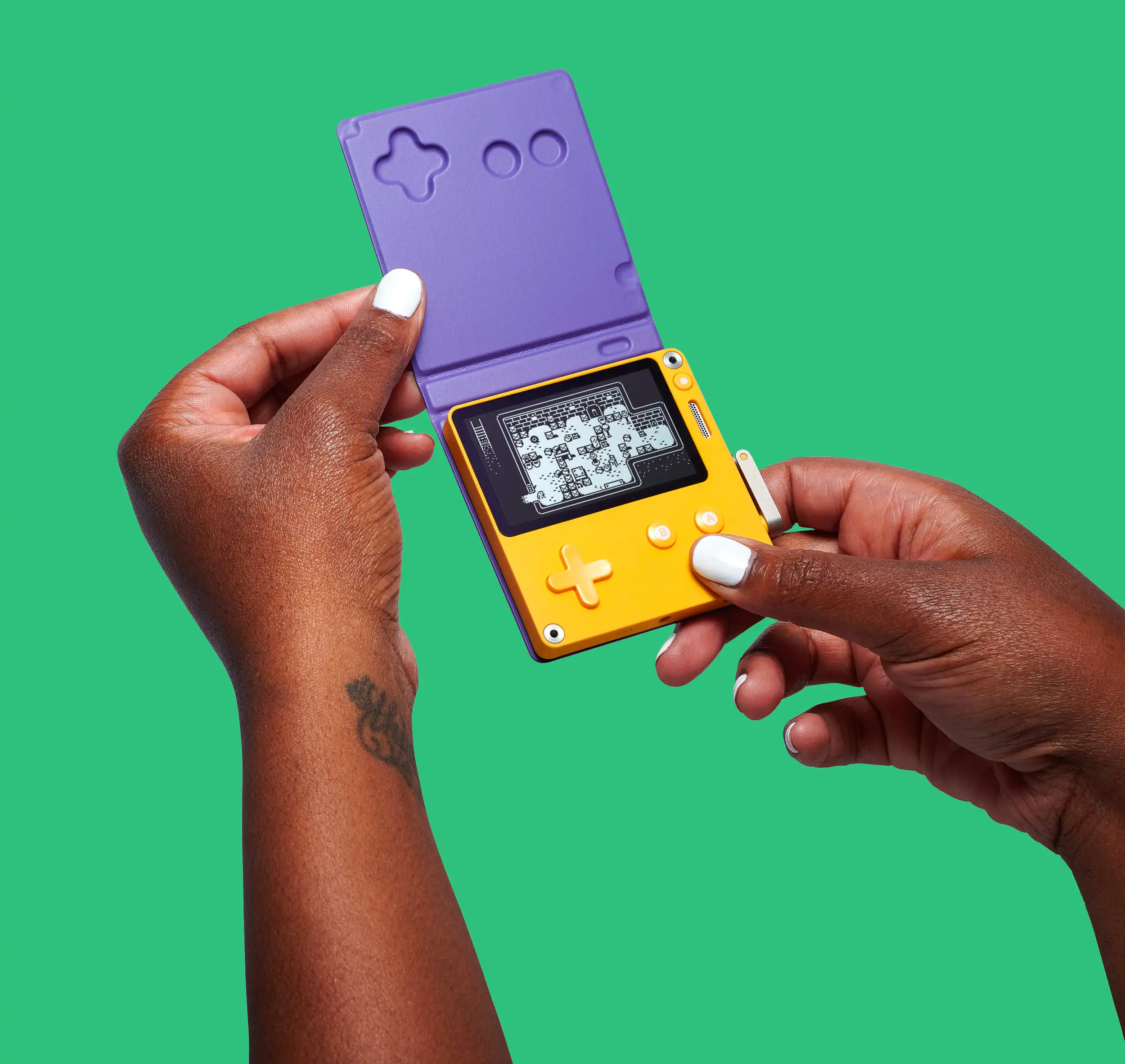

The Playdate crank is a foldable, stainless steel rotary analog input built into the side of Panic Inc.’s handheld game console. Designed by Teenage Engineering, it reads rotation as either a per-frame delta or an absolute angle from 0 to 359 degrees. Lucas Pope’s Mars After Midnight (2024) mapped it one-to-one to a hinged door shutter, turning physical rotation into the game’s defining interaction.
A Mechanical Engineer Who Never Left the Workshop
Lucas Pope grew up in Virginia, the son of a handyman whose garage was stocked with parts and tools. That upbringing fed an early obsession with mechanical engineering and robotics. He enrolled at Virginia Tech to study the discipline formally, but found that the programming side of his coursework held more pull than the engineering itself. The tension between physical systems and digital logic never fully resolved. It just migrated into his games.
Pope’s career wound through Quake modding with Ratloop in the late 1990s, a stint at Realtime Associates working on Re-Mission (a 2006 shooter designed to encourage young cancer patients to take their chemotherapy medication), and a role at Naughty Dog during the development of Uncharted: Drake’s Fortune and its sequel. Former Naughty Dog president Christophe Balestra once said Pope was among “the people who saved the day” on their internal tools. By the time Pope went independent under his company 3909 LLC, he had spent years thinking about the invisible machinery beneath polished surfaces.
Papers, Please sold over five million copies. Return of the Obra Dinn won the Seumas McNally Grand Prize. Both games are obsessed with procedure, with the weight of small physical actions repeated under pressure. Pope, now living in Japan with his wife Keiko Ishizaka, had built an entire body of work around the idea that meaning lives in the gesture, not the spectacle.
The Playdate Crank as a New Kind of Constraint
The Playdate was announced in May 2019 and began shipping in April 2022. It is a compact, bright yellow handheld with a 2.7-inch black-and-white Sharp Memory LCD display running at 400 × 240 pixels, roughly four times the resolution of the original Game Boy. It weighs 86 grams. Its CPU is a Cortex M7 clocked at 168 MHz. It has 16 MB of RAM, 4 GB of storage, and a three-axis accelerometer.
Then there is the crank. A magnetic steel arm folds out from a pocket on the device’s right side. The handle is plastic with a stainless steel core. A dock sensor detects when it is stowed, which can itself trigger game logic. Panic co-founder Cabel Sasser has said the team “worked hard to make sure buttons feel perfectly clicky and that the crank action is silky smooth.”
The crank’s origin traces back to around 2011, when Sasser reached out to Jesper Kouthoofd at Teenage Engineering, the Stockholm-based firm known for its stylish synthesizers. Early prototypes included several exotic inputs: a slider, a pinball-style spring, even a small circular display on the back. The crank survived. Everything else was cut. Sasser’s reaction to the crank concept, as quoted by Polygon, is now legendary in Playdate lore: “The crank. My God.”
Pope Meets the Playdate Crank
Pope has said he first saw the Playdate when everyone else did, during the 2019 reveal. He described it as a “jackpot” moment. “Anything that’s 1-bit is right up my alley and then I saw the crank,” he told TechRadar. “Everything made me think: ‘This is awesome. I want to make a game for it.’” Panic sent him a pre-release unit after he handled one at a gaming event in Japan.
What followed was a multi-year development process driven explicitly by the hardware. Pope told Game Developer that he “approached Mars from a mechanical/hardware perspective first, to build something that fit the Playdate’s unique features.” This is not how most games are made. Most games begin with a narrative pitch or a genre template. Pope began with the crank in his hand.
How Mars After Midnight Uses the Playdate Crank
Mars After Midnight launched on March 12, 2024, as a Playdate exclusive priced at six dollars. The player runs late-night community support groups in an off-colony Martian settlement. Aliens arrive at the door. You peer at them through a hinged window. The crank opens and closes that window.
Pope’s own devlog on itch.io explains the design decision plainly: “The Playdate’s got this great mechanical crank on the side that’s begging to be used. I played around with a few ways of crankin and found that a light touch felt best. So the crank is treated as a short-throw lever instead of a rotary control and maps directly to the position of the hinged window.” He added: “It’s nice when in-game mechanicals can match actual physical mechanicals 1:1 so thanks, crank.”
The crank is also used in the game’s cleanup mini-games and throughout other stages of play. The character art for the Martians is procedurally generated, and voices are synthesized using a system Pope built himself. The entire package runs in 55 megabytes.
Pope also described the peephole mechanic as a solution to the small screen. “Since apparently I can only make first-person games, and it’s hard to feel ~there~ on a small portable, I thought making the screen represent a peephole on a door could be interesting.” The constraint of the display became the concept of the game.
The Playdate Crank Debate That Won’t Die
Within gaming communities, the crank remains genuinely polarizing. When Panic first announced the Playdate, plenty of observers dismissed the crank as a gimmick that would hurt the handheld’s lasting appeal. Two years into the console’s life, that accusation has softened but not vanished. The crank is not a limitation, and not an improvement on what came before. It is entirely its own thing, which makes it difficult to categorize and easy to underestimate.
A persistent complaint among Playdate owners is that too many games barely use the crank at all. Pope’s game became the counterexample people cite when arguing that the input method has real creative potential. One widely shared community sentiment holds that Mars After Midnight is “everything I want from a Playdate game,” specifically because it uses the crank in a way that feels neither tacked on nor gimmicky.
Edge magazine called the game “as harmonious a marriage of hardware and software as you’ll find in a crossplatform age.” Others wanted more. TheGamer’s review, which scored the game 3.5 out of 5, acknowledged the crank design but noted a yearning for deeper systemic connections between the support groups.
A Game Pope Made for His Children
Pope has been candid about the motivation behind Mars After Midnight‘s lighter tone. “It’s frustrating to have children who are crazy about games but can’t play my games,” he told TechRadar. “They’re too violent, too mature, and just not interesting. I wanted to make something for them.” His 2021 announcement devlog framed the concept simply: “Think Papers Please, -lite, with no border checkpoint, no desk, no paperwork, on Mars.”
This pivot divided fans. Those who loved the biting political edge of Papers, Please felt the new game lacked teeth. But Pope himself has said the Playdate “lowers the temperature” on expectation, and the platform’s intimacy gave him permission to work smaller, warmer, and stranger. Matt Sephton, developer of Playdate titles YOYOZO and Sparrow Solitaire, observed that Pope “is in a unique position in that his previous games enable him to take a chance on a game like this.”
What the Playdate Crank Means for Physical Input Design
Panic sold through its initial 20,000-unit preorder in roughly 20 minutes in July 2021. By February 2024, over 70,000 Playdates had shipped. Developers have earned more than one million dollars through the Catalog storefront since its March 2023 launch. These are small numbers by console standards, but the Playdate was never meant to compete on scale. It competes on feel.
The crank is the physical thesis of that argument. It has enough resistance to serve as a precise input device but no haptic feedback, which means the sensation is entirely analog and entirely yours. Cabel Sasser’s GDC 2024 talk revealed how fragile the supply chain behind this simplicity actually is: the crank handle, buttons, and screen assembly are all manufactured by different sub-contractors with their own raw materials. “There are so many ways things can go wrong,” Sasser said.
Pope’s genius with Mars After Midnight was recognizing that the crank’s resistance is not an obstacle to overcome but a texture to design around. The one-to-one mapping between physical rotation and on-screen shutter movement creates a closed loop between hand and eye that no touchscreen or thumbstick replicates. It is a small, satisfying machine. Pope, the mechanical engineer’s son, understood that immediately.
Frequently Asked Questions
What is the Playdate crank made of?
The crank arm is stainless steel with a magnetic attachment. The handle is plastic with a stainless steel core. It folds into a pocket on the side of the device when not in use.
Who designed the Playdate crank?
The crank was conceived during the collaboration between Panic Inc. and Swedish consumer electronics company Teenage Engineering, led by designer Jesper Kouthoofd. Early prototypes included other experimental inputs like a slider and a pinball-style spring, but only the crank made it to production.
How does Lucas Pope use the crank in Mars After Midnight?
Pope maps the crank to a hinged door shutter with one-to-one movement. Turning the crank opens and closes the window through which the player evaluates arriving Martians. The crank is also used in cleanup mini-games and other stages of play. Pope treats it as a short-throw lever rather than a full rotary control.
Is Mars After Midnight available on other platforms?
No. Pope has said the game is a Playdate exclusive because it uses the console’s unique hardware properties so thoroughly that it would not translate to another device.
How much does Mars After Midnight cost?
Mars After Midnight launched on March 12, 2024, at a price of six dollars for an approximately three-hour experience. It runs in 55 megabytes of storage.
How many Playdate consoles have been sold?
Panic confirmed in February 2024 that over 70,000 Playdates had been sold. The console’s price has increased twice since launch, rising from $149 at announcement to $229 as of March 2025.

'%3e%3cg id='Final-Copy-2_2_' transform='translate(1275.000000, 200.000000)'%3e%3cpath class='st0' d='M7.4,12.8h6.8l3.1-11.6H7.4C4.2,1.2,1.6,3.8,1.6,7S4.2,12.8,7.4,12.8z'/%3e%3c/g%3e%3c/g%3e%3c/g%3e%3cg id='final---dec.11-2020'%3e%3cg id='_x30_208-our-toggle' transform='translate(-1275.000000, -200.000000)'%3e%3cg id='Final-Copy-2' transform='translate(1275.000000, 200.000000)'%3e%3cpath class='st1' d='M22.6,0H7.4c-3.9,0-7,3.1-7,7s3.1,7,7,7h15.2c3.9,0,7-3.1,7-7S26.4,0,22.6,0z M1.6,7c0-3.2,2.6-5.8,5.8-5.8 h9.9l-3.1,11.6H7.4C4.2,12.8,1.6,10.2,1.6,7z'/%3e%3cpath id='x' class='st2' d='M24.6,4c0.2,0.2,0.2,0.6,0,0.8l0,0L22.5,7l2.2,2.2c0.2,0.2,0.2,0.6,0,0.8c-0.2,0.2-0.6,0.2-0.8,0 l0,0l-2.2-2.2L19.5,10c-0.2,0.2-0.6,0.2-0.8,0c-0.2-0.2-0.2-0.6,0-0.8l0,0L20.8,7l-2.2-2.2c-0.2-0.2-0.2-0.6,0-0.8 c0.2-0.2,0.6-0.2,0.8,0l0,0l2.2,2.2L23.8,4C24,3.8,24.4,3.8,24.6,4z'/%3e%3cpath id='y' class='st3' d='M12.7,4.1c0.2,0.2,0.3,0.6,0.1,0.8l0,0L8.6,9.8C8.5,9.9,8.4,10,8.3,10c-0.2,0.1-0.5,0.1-0.7-0.1l0,0 L5.4,7.7c-0.2-0.2-0.2-0.6,0-0.8c0.2-0.2,0.6-0.2,0.8,0l0,0L8,8.6l3.8-4.5C12,3.9,12.4,3.9,12.7,4.1z'/%3e%3c/g%3e%3c/g%3e%3c/g%3e%3c/g%3e%3c/svg%3e) Your Privacy Choices
Your Privacy Choices