

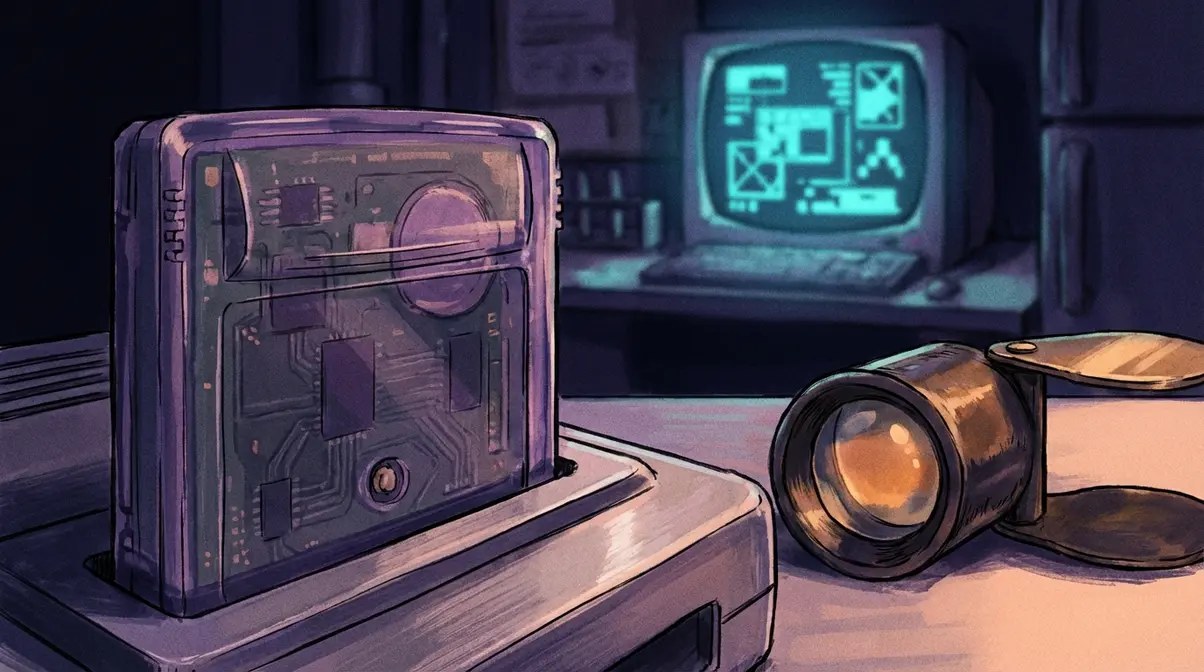

Picture a convention floor on a Saturday morning. Folding tables stacked with loose Game Boy cartridges, labels sun-faded or suspiciously pristine. A seller wants $120 for Pokémon FireRed. You turn the cart over in your hands. The label font looks right. The shell color looks right. The stamped number on the sticker looks right. But something nags at you, some whisper from a forum post you half-remember about the weight of the plastic or the finish on the pins. You put it back down. You walk away. You’ll never know.
That moment of doubt is now a $3.8-billion-dollar problem. The global retro console market is projected to reach $8.5 billion by 2033, and the counterfeits are scaling with it. Italian financial police seized roughly 12,000 fake retro consoles in 2024, loaded with over 47 million pirated games, valued at an estimated €47.5 million. That was one bust, in one country. The cartridge side of the equation is harder to measure, because a convincing fake disappears into someone’s collection and stays there, sometimes for years, sometimes forever.
The Fakes Are Getting Smarter
Retro gaming communities have built entire institutions around this anxiety. Dedicated verification forums sprang up years ago after mainstream collecting spaces were flooded with authentication requests. Volunteer verifiers developed visual shorthand: look for black epoxy blob chips, stacked PCBs, internal stickers, oddly cut circuit boards. These tells worked. Then counterfeiters started reading the same guides.
As one retro gaming journalist put it, reproduction makers are “getting wise to the key elements we’ve been looking out for to tell the duds from the real deal.” Telltale markers that collectors relied on for years, like the “M8” etching near the top of DS cartridge prongs, have been replicated by savvier bootleggers. The arms race is real, and the human eye is losing ground.
The financial sting is obvious. But there’s a quieter pain that collectors talk about in deeply personal terms: save file corruption. Counterfeit cartridges often swap in cheaper SRAM where the original used EEPROM or Flash memory. The game boots. It plays. Then one day, your save is gone. For Pokémon fans who spent hundreds of hours building a roster, that loss lands like a gut punch.
Enter Retrace
On March 23, 2026, Epilogue released Retrace, a free companion app for its Operator line of cartridge readers. The pitch is disarmingly simple: plug your GB Operator or SN Operator into your phone over USB-C, insert a cartridge, and the app identifies it in seconds, pulling up title, region, publisher, developer, and save file size. The entire game database ships bundled with the app, so identification works offline, no signal required. Cover art and market pricing data pull in when you’re back on Wi-Fi.
But the headline feature is counterfeit detection. Retrace analyzes cartridge data against known counterfeit markers and delivers an instant authenticity verdict. Epilogue tested the system against 388 suspected counterfeit cartridges and reports a 98.7% detection rate under controlled laboratory conditions. The app is free. The GB Operator hardware runs $49.99. The SN Operator, shipping in April, is $71.99.
It is worth pausing on those numbers. A 98.7% detection rate sounds commanding until you imagine the 1.3% that slips through on a $200 cartridge. Epilogue, to their credit, does not oversell. Their own documentation calls Retrace “an informational add-on tool and not a substitute for physical inspection,” recommending that users pair the app’s analysis with a visual check of the circuit board inside the shell. For high-value purchases, they advise inspecting boards against known reliable reference images.
Trust, Earned and Unearned
Not everyone is convinced. Alex at Sypnotix, reviewing an earlier iteration of Epilogue’s counterfeit detection on the GB Operator, wrote bluntly that he couldn’t “trust Epilogue as a curator for counterfeits,” noting that some known fakes from Asia were being flagged as authentic. That review dates to early 2024, before the Retrace overhaul, but the skepticism it represents hasn’t evaporated. Veteran collectors remain adamant: nothing replaces cracking open the shell and looking at the PCB with your own eyes.
They’re not wrong. But they’re also not the whole audience. The person at that convention table on Saturday morning probably doesn’t carry a tri-wing screwdriver and a loupe. They grew up with Pokémon, they’re somewhere between 25 and 45, they have adult money, and they want to buy a cartridge that actually works. For that person, a $60 device and a free app that catches 98.7% of fakes before money changes hands is not a gimmick. It’s a first line of defense that didn’t exist six months ago.
What This Is and What It Isn’t
I want to be precise about something. Epilogue describes Retrace’s detection as analysis of “known counterfeit markers,” which sounds like pattern-matching against a curated database rather than a neural network learning in real time. Whether this constitutes “AI” in any rigorous sense is an open question the company hasn’t publicly answered. The marketing leans into the language. The technology may be more modest. That doesn’t make it less useful, but it matters what we call things, especially when trust is the entire product.
Epilogue is a small operation. They started in 2021 as two people in a studio apartment in Bucharest. They now run their own local assembly line, shipping thousands of units per week to tens of thousands of customers worldwide, with a core team that remains remarkably lean. Retrace is their first mobile app, released in beta, and they’ve signaled that a third Operator device is in development. The ambition is clear: build the definitive hardware-software ecosystem for physical cartridge preservation and authentication.
The counterfeit problem isn’t going to be solved by one app, one company, or one detection rate. Bootleggers adapt. They read the same release notes we do. But Retrace represents something genuinely new in the retro collecting landscape: a portable, accessible tool that lowers the barrier between suspicion and evidence. You still might want to crack open that shell. But now, standing at the folding table with $120 on the line, you don’t have to walk away wondering. You can know something. And in a market built on trust, knowing something is worth a lot.
'%3e%3cg id='Final-Copy-2_2_' transform='translate(1275.000000, 200.000000)'%3e%3cpath class='st0' d='M7.4,12.8h6.8l3.1-11.6H7.4C4.2,1.2,1.6,3.8,1.6,7S4.2,12.8,7.4,12.8z'/%3e%3c/g%3e%3c/g%3e%3c/g%3e%3cg id='final---dec.11-2020'%3e%3cg id='_x30_208-our-toggle' transform='translate(-1275.000000, -200.000000)'%3e%3cg id='Final-Copy-2' transform='translate(1275.000000, 200.000000)'%3e%3cpath class='st1' d='M22.6,0H7.4c-3.9,0-7,3.1-7,7s3.1,7,7,7h15.2c3.9,0,7-3.1,7-7S26.4,0,22.6,0z M1.6,7c0-3.2,2.6-5.8,5.8-5.8 h9.9l-3.1,11.6H7.4C4.2,12.8,1.6,10.2,1.6,7z'/%3e%3cpath id='x' class='st2' d='M24.6,4c0.2,0.2,0.2,0.6,0,0.8l0,0L22.5,7l2.2,2.2c0.2,0.2,0.2,0.6,0,0.8c-0.2,0.2-0.6,0.2-0.8,0 l0,0l-2.2-2.2L19.5,10c-0.2,0.2-0.6,0.2-0.8,0c-0.2-0.2-0.2-0.6,0-0.8l0,0L20.8,7l-2.2-2.2c-0.2-0.2-0.2-0.6,0-0.8 c0.2-0.2,0.6-0.2,0.8,0l0,0l2.2,2.2L23.8,4C24,3.8,24.4,3.8,24.6,4z'/%3e%3cpath id='y' class='st3' d='M12.7,4.1c0.2,0.2,0.3,0.6,0.1,0.8l0,0L8.6,9.8C8.5,9.9,8.4,10,8.3,10c-0.2,0.1-0.5,0.1-0.7-0.1l0,0 L5.4,7.7c-0.2-0.2-0.2-0.6,0-0.8c0.2-0.2,0.6-0.2,0.8,0l0,0L8,8.6l3.8-4.5C12,3.9,12.4,3.9,12.7,4.1z'/%3e%3c/g%3e%3c/g%3e%3c/g%3e%3c/g%3e%3c/svg%3e) Your Privacy Choices
Your Privacy Choices