

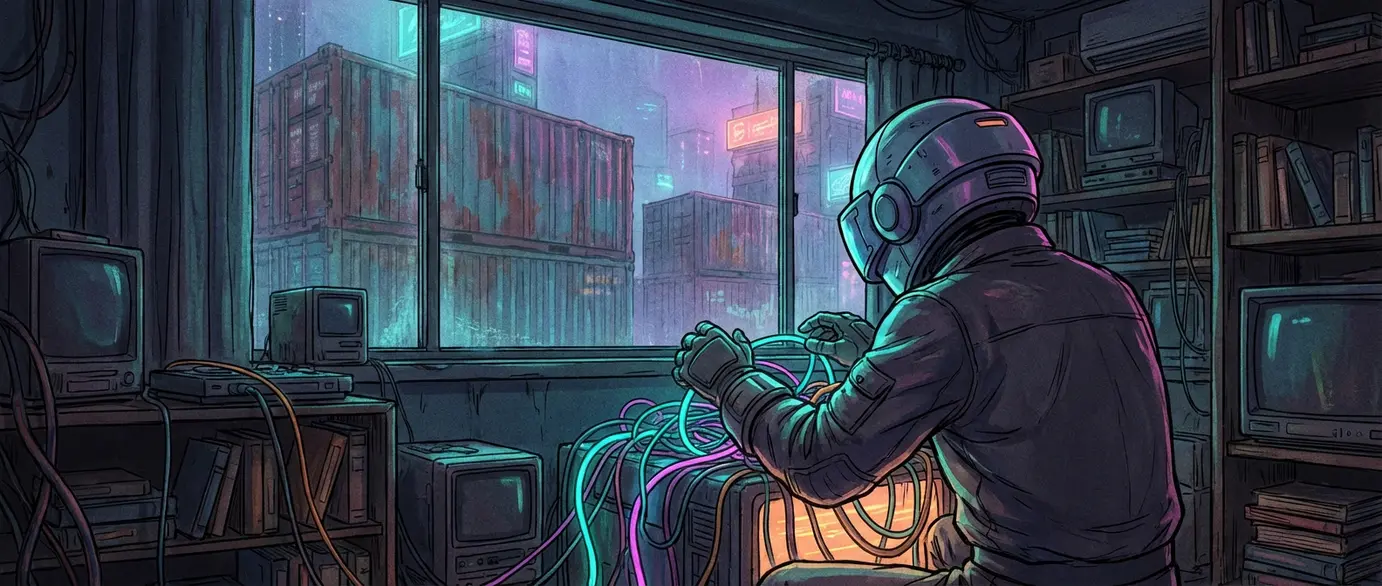

What is the OASIS from Ready Player One? The OASIS is a fully immersive virtual reality simulation created by author Ernest Cline for his 2011 novel Ready Player One, later adapted into a film directed by Steven Spielberg released in March 2018. In the story, set in 2045, humanity escapes a dystopian reality by spending most of their time in this interconnected virtual universe where anything is possible.
Twenty years ago, the idea of living inside a virtual world felt like pure science fiction. Today, with VR headsets in millions of homes, brain-computer interfaces helping paralyzed patients, and companies investing billions into the metaverse, Cline’s vision doesn’t seem quite so far-fetched. But how close are we really?
The Readyverse: Fiction Becomes Reality
In January 2024, Ernest Cline co-founded Readyverse Studios with blockchain tech company Futureverse, announcing an actual platform inspired by his fictional creation. “The future has arrived even more quickly than I imagined,” Cline stated. “It’s almost like a feedback loop of a lot of people are taking inspiration from the book and from the movie.”
The metaverse market currently sits at approximately $105-130 billion and is projected to reach over $900 billion by 2030. Goldman Sachs estimates the metaverse could eventually be worth $8 trillion. That’s serious money betting on virtual worlds.
Ready Player One Technology: What Actually Exists Today
The building blocks are falling into place, though not quite as seamlessly as in Cline’s novel. Modern VR headsets like the Oculus Quest 3, HTC Vive, and Apple Vision Pro offer wireless freedom and increasingly realistic visuals. Manufacturers are pushing toward 4K per-eye resolutions that approach the limits of human visual acuity.
Full-body haptic suits exist too. The Teslasuit uses electrical muscle stimulation and transcutaneous electrical nerve stimulation to simulate touch sensations across your entire body. It even includes biometric sensors that track your heart rate and stress levels.
Brain-computer interfaces, perhaps the most sci-fi element, are real. Neuralink, valued at $9 billion after a $650 million funding round, announced plans in January 2026 to begin high-volume production of its brain implants. These devices are already helping people with severe paralysis control computers with their thoughts.
Why We’re Still Decades Away from a True OASIS
Here’s the reality check: these technologies exist as separate, expensive, limited pieces. The Teslasuit costs thousands of dollars. Neuralink focuses on medical applications for paralyzed patients, not gaming. Only 1 in 10 US adults even understand what the metaverse is.
The technical challenges are staggering. Creating a unified virtual world requires processing your head movements, transmitting that data to the cloud, rendering a multiplayer scene, compressing it, and displaying it on your headset in under 20 milliseconds. We’re not there yet.
Interoperability remains the biggest barrier. Instead of one OASIS, we have fragmented platforms: Roblox, Fortnite, Minecraft, VRChat. Each operates as its own walled garden. Companies have little incentive to let you carry your digital items between competing services.
Most analysts predict we won’t achieve Ready Player One levels of immersion until around 2045, the year Cline set his story. We’re roughly halfway there chronologically, but technologically? Maybe a quarter of the way.
The Unexpected Path: Medical Before Gaming
The evolution differs from Cline’s vision in fascinating ways. Brain-computer interfaces are helping paralyzed people communicate before they’re entertaining gamers. About half of universities worldwide offer VR-based courses, and 69% of healthcare decision-makers plan to invest in VR for patient treatment and staff training.
Enterprise adoption is outpacing consumer use. Companies treat VR as just another digital tool, useful for training and collaboration but no longer experimental. The revolution is happening in boardrooms and hospitals before living rooms.
Ready Player One in 2026: A Progress Report
We have the pieces: advanced VR headsets, haptic feedback systems, brain-computer interfaces, and massive investment. What we lack is integration, affordability, and a unified platform. The technology exists, but the seamless, accessible, interconnected OASIS remains science fiction.
By 2030, experts predict 2.63 billion active metaverse users and estimate 25% of people will spend at least one hour daily in virtual worlds. That’s significant adoption, but it’s still fragmented across multiple platforms rather than one cohesive universe.
The dream is alive and funded. Whether it arrives by 2045 or takes even longer depends on solving problems that are as much about business models and human behavior as they are about technology.
Frequently Asked Questions
Is the Readyverse the same as the OASIS from Ready Player One?
No, the Readyverse is a real platform co-founded by Ernest Cline in 2024 that’s inspired by the fictional OASIS but far more limited in scope and capability. It’s an early attempt to create interconnected virtual experiences, not a fully realized simulation.
Can you buy a haptic suit like in Ready Player One?
Yes, full-body haptic suits like the Teslasuit exist and are available for purchase, though they cost thousands of dollars and are primarily used by enterprises for training rather than consumer gaming. The technology works but remains expensive and limited compared to the novel’s depiction.
When will brain-computer interfaces be available for gaming?
Current brain-computer interfaces like Neuralink focus on medical applications for paralyzed patients and are not consumer-ready for gaming. Most experts predict consumer BCIs for entertainment are at least 15 to 20 years away from widespread availability.
How much is the metaverse market worth?
The metaverse market is currently valued at approximately $105-130 billion and is projected to reach over $900 billion by 2030. Some analysts, including Goldman Sachs, estimate it could eventually be worth up to $8 trillion.
What’s the biggest challenge preventing a Ready Player One style world?
Interoperability is the primary barrier, as different platforms operate as separate walled gardens without allowing users to transfer digital items or identities between them. Technical challenges around latency, processing power, and creating seamless experiences across billions of users also remain significant obstacles.
How many people currently use VR and metaverse platforms?
Current metaverse platforms have more than 600 million monthly active users, with projections suggesting this will grow to 2.63 billion by 2030. However, only 1 in 10 US adults are familiar with the concept of the metaverse, indicating significant awareness gaps remain.
Want to stay updated on the latest developments in VR, the metaverse, and immersive technology? Follow Hyperlific for deep dives into the tech shaping our future, one nostalgic reference at a time.


'%3e%3cg id='Final-Copy-2_2_' transform='translate(1275.000000, 200.000000)'%3e%3cpath class='st0' d='M7.4,12.8h6.8l3.1-11.6H7.4C4.2,1.2,1.6,3.8,1.6,7S4.2,12.8,7.4,12.8z'/%3e%3c/g%3e%3c/g%3e%3c/g%3e%3cg id='final---dec.11-2020'%3e%3cg id='_x30_208-our-toggle' transform='translate(-1275.000000, -200.000000)'%3e%3cg id='Final-Copy-2' transform='translate(1275.000000, 200.000000)'%3e%3cpath class='st1' d='M22.6,0H7.4c-3.9,0-7,3.1-7,7s3.1,7,7,7h15.2c3.9,0,7-3.1,7-7S26.4,0,22.6,0z M1.6,7c0-3.2,2.6-5.8,5.8-5.8 h9.9l-3.1,11.6H7.4C4.2,12.8,1.6,10.2,1.6,7z'/%3e%3cpath id='x' class='st2' d='M24.6,4c0.2,0.2,0.2,0.6,0,0.8l0,0L22.5,7l2.2,2.2c0.2,0.2,0.2,0.6,0,0.8c-0.2,0.2-0.6,0.2-0.8,0 l0,0l-2.2-2.2L19.5,10c-0.2,0.2-0.6,0.2-0.8,0c-0.2-0.2-0.2-0.6,0-0.8l0,0L20.8,7l-2.2-2.2c-0.2-0.2-0.2-0.6,0-0.8 c0.2-0.2,0.6-0.2,0.8,0l0,0l2.2,2.2L23.8,4C24,3.8,24.4,3.8,24.6,4z'/%3e%3cpath id='y' class='st3' d='M12.7,4.1c0.2,0.2,0.3,0.6,0.1,0.8l0,0L8.6,9.8C8.5,9.9,8.4,10,8.3,10c-0.2,0.1-0.5,0.1-0.7-0.1l0,0 L5.4,7.7c-0.2-0.2-0.2-0.6,0-0.8c0.2-0.2,0.6-0.2,0.8,0l0,0L8,8.6l3.8-4.5C12,3.9,12.4,3.9,12.7,4.1z'/%3e%3c/g%3e%3c/g%3e%3c/g%3e%3c/g%3e%3c/svg%3e) Your Privacy Choices
Your Privacy Choices